An offering statement pursuant to Regulation A relating to these securities has been filed with the United States Securities and Exchange Commission (the “Commission”). Information contained in this Preliminary Offering Circular is subject to completion or amendment. These securities may not be sold nor may offers to buy be accepted before the offering statement filed with the Commission is qualified. This Preliminary Offering Circular shall not constitute an offer to sell or the solicitation of an offer to buy nor may there be any sales of these securities in any state in which such offer, solicitation or sale would be unlawful before registration or qualification under the laws of any such state. We may elect to satisfy our obligation to deliver a Final Offering Circular by sending you a notice within two business days after the completion of our sale to you that contains the URL where the Offering Circular was filed may be obtained.
PRELIMINARY OFFERING CIRCULAR DATED OCTOBER 30, 2017

Purchase One Share of Common Stock for Every Two Shares Owned
at $7.25 Per Share(1)
We are offering for sale up to 1,362,906 shares of our common stock on a “best efforts” basis by distributing, at no charge to our stockholders, non-transferable subscription rights to purchase all 1,362,906 of such shares as described further below, in addition to a related over-subscription privilege. The purchase price is $7.25 per share. Subscription rights will be distributed to persons who owned shares of our common stock as of 5:00 p.m., Mountain Time, on [·], 2017, the record date for the rights offering. There is no minimum purchase requirement and we are not required to sell any minimum number of shares in this offering. We will not escrow your subscription funds. See “TERMS OF THE OFFERING.”
Although our common stock is quoted on the OTC-Pink (symbol “SLRK”), there has been a limited trading market in our common stock and it is not anticipated that an active market will develop as a result of this offering. See “RISK FACTORS” and “MARKET INFORMATION AND DIVIDEND POLICY AND RELATED MATTERS.” As of October 25, 2017, the last reported sales price of our common stock was $8.20.
Investing in our common stock involves risks. See “RISK FACTORS” beginning on page 14.
The United States Securities and Exchange Commission (the “Commission”) does not pass upon the merits of or give its approval to any securities offered or the terms of the offering, nor does it pass upon the accuracy or completeness of any offering circular or other solicitation materials. These securities are offered pursuant to an exemption from registration with the Commission; however, the Commission has not made an independent determination that the securities offered are exempt from registration.
Neither the Commission nor any states securities commission has approved or disapproved of these securities or passed upon the adequacy or accuracy of this offering circular. Any representation to the contrary is a criminal offense.
The shares of common stock offered hereby are not deposits and are not insured by the FDIC or any other governmental agency. The shares of common stock may not be used as collateral to secure a loan from Solera National Bank and loans from Solera National Bank may not be used to purchase this stock.
|
|
|
Per Share |
|
Total(2) |
| ||
|
|
|
|
|
|
| ||
|
Offering Price |
|
$ |
7.25 |
|
$ |
9,881,068 |
|
|
Underwriting Discounts and Commissions(1) |
|
$ |
— |
|
$ |
— |
|
|
Proceeds to Us from this Offering to the Public (Before Expenses) |
|
$ |
7.25 |
|
$ |
9,881,068 |
|
(1 )This offering is not underwritten. We are offering the shares of common stock directly to the public through our officers and directors without the services of an underwriter or selling agent. Our officers and directors will not receive any discounts or commissions for selling any shares, but may be reimbursed for reasonable expenses they incur, if any.
(2 )Represents the maximum proceeds from the sale of all 1,362,906 shares at $7.25 per share before deduction of estimated offering expenses of $50,000.
The date of this offering circular is [·], 2017
|
4 | |
|
|
|
|
4 | |
|
|
|
|
5 | |
|
|
|
|
9 | |
|
|
|
|
10 | |
|
|
|
|
12 | |
|
|
|
|
14 | |
|
|
|
|
30 | |
|
|
|
|
32 | |
|
|
|
|
33 | |
|
|
|
|
33 | |
|
|
|
|
35 | |
|
|
|
|
36 | |
|
|
|
|
MANAGEMENT’S DISCUSSION AND ANALYSIS OF FINANCIAL CONDITION AND RESULTS OF OPERATIONS |
44 |
|
|
|
|
67 | |
|
|
|
|
69 | |
|
|
|
|
70 | |
|
|
|
|
SECURITY OWNERSHIP OF CERTAIN BENEFICIAL OWNERS AND MANAGEMENT |
70 |
|
|
|
|
71 | |
|
|
|
|
73 | |
|
|
|
|
73 | |
|
|
|
|
74 |
You should rely only on the information contained in this offering circular. Solera National Bancorp, Inc. (the “Company”) have not authorized any person to provide you with different or inconsistent information. If anyone provides you with different or inconsistent information, you should not rely on it. We are not making an offer to sell these securities in any jurisdiction where the offer or sale is not permitted. You should assume that the information appearing in this offering circular is accurate only as of the date hereof. The Company’s business, financial condition, results of operations and prospects may have changed since that date.
The offering statement that contains this offering circular (including the exhibits to the offering statement) contains additional information about us and the securities offered under this offering circular. That offering statement can be read at the Commission’s website or at the Commission’s offices mentioned under the heading “Where You Can Find More Information.”
Unless otherwise indicated or unless the context requires otherwise, all references in this offering circular to “we,” “us,” “our” or similar references mean the Company and its wholly owned subsidiaries.
Certain of the statements contained in this offering circular may constitute “forward-looking statements” within the meaning of the meaning of the Private Securities Litigation Reform Act of 1995 and Section 27A of the Securities Act of 1933, as amended (the “Securities Act”). Forward-looking statements discuss future expectations, describe future plans and strategies, contain projections of results of operations or of financial condition or state other forward-looking information. Forward-looking statements are generally identifiable by the use of forward-looking terminology such as “anticipate,” “believe,” “continue,” “could,” “would,” “endeavor,” “estimate,” “expect,” “forecast,” “goal,” “intend,” “may,” “objective,” “potential,” “plan,” “predict,” “project,” “seek,” “should,” “will” or the negative of such terms and other similar words and expressions of future intent. These forward-looking statements are subject to certain known and unknown risks and uncertainties that could cause actual results to differ materially from our historical experience and our present expectations or projections. Such risks and uncertainties and other factors include, but are not limited to, adverse developments or conditions related to or arising from:
· significant volatility and deterioration in the credit and financial markets; and adverse changes in general economic conditions;
· deterioration in our asset or credit quality, including changes in the level and trend of loan delinquencies and write-offs and changes in our allowance for loan losses and provision for loan losses that may be impacted by deterioration in the residential and commercial real estate markets;
· inflation and changes in the interest rate environment (including changes in the shape of the yield curve) that reduce our margins or the fair value of financial instruments;
· fluctuations in the demand for loans, the number of unsold homes, land and other properties and fluctuations in real estate values in our market areas;
· the availability of capital;
· changes in laws or government regulations affecting financial institutions, including changes in regulatory costs and capital requirements, as well as changes in monetary and fiscal policies;
· the use of estimates in determining the fair value of certain of our assets, which estimates may prove to be incorrect and result in significant declines in valuation;
· our ability to attract and retain deposits and loans in view of increased competitive pressures and other factors;
· further increases in premiums for deposit insurance;
· our ability to control general operating costs and expenses;
· the soundness of other financial institutions;
· the potential for regulatory action against us or our wholly owned bank subsidiary, Solera National Bank (the “Bank”), which could require us to increase our allowance for loan losses, write down assets, change our regulatory capital position or affect our ability to borrow funds or maintain or increase deposits, which could adversely affect our liquidity and earnings;
· environmental conditions, including natural disasters, or the impacts of war or terrorist attacks, any of which may disrupt our business, our operations or our borrowers;
· the failure or security breach of computer systems on which we depend;
· the effects of the Dodd-Frank Wall Street Reform and Consumer Protection Act or other changes in laws, regulations, and accounting rules, or their interpretations;
· general economic or business conditions in Colorado, including but not limited to adverse changes in economic conditions resulting from a prolonged economic downturn;
· our ability to enter new markets successfully and capitalize on growth opportunities;
· changes in consumer spending, borrowing and savings habits;
· changes in accounting policies and practices, as may be adopted by the bank regulatory agencies, taxing authorities and the Financial Accounting Standards Board;
· other risks that are described in this offering circular under “RISK FACTORS;” and
· our ability to manage the risks involved in the foregoing.
The statements under “RISK FACTORS” and other sections of this offering circular address additional facts that could cause our actual results to differ from those set forth in the forward-looking statements. We caution investors not to place significant reliance on the forward-looking statements contained in this offering circular.
Because of these and other uncertainties, our actual future results, performance or achievements, or industry results, may be materially different from the results contemplated by these forward-looking statements. In addition, our past results of operations do not necessarily indicate our future results. Please take into account that forward-looking statements speak only as of the date of, and are based on our beliefs and assumptions as of the date of this offering circular. We do not undertake any obligation to publicly correct or update any forward-looking statement whether as a result of new information, future events or otherwise. We qualify all of our forward-looking statements by these cautionary statements.
QUESTIONS AND ANSWERS RELATING TO THE OFFERING
What is the rights portion of the offering?
We are distributing at no charge, to holders of our shares of common stock, non-transferable subscription rights to purchase shares of our common stock at a price of $7.25 per share, as described below. You will receive subscription rights to purchase one share for every two shares of common stock you owned as of 5:00 p.m., Mountain Time, on [·], 2017, the record date. The subscription rights entitle the holder to exercise these subscription rights as well as an over-subscription privilege, both of which are described below.
What are the subscription rights?
The subscription rights give our stockholders the right to purchase a specified number of shares of our common stock at a subscription price of $7.25 per share. We have granted to you, as a stockholder of record as of 5:00 p.m., Mountain Time, on [·], 2017, subscription rights to purchase one share of our common stock for every two shares of our common stock you owned on that date. We will not issue fractional shares through the exercise of the subscription rights, and any fractional share interests resulting from the exercise of the subscription rights will be
eliminated by rounding down to the nearest whole share. For example, if you owned 99 shares of our common stock on the record date, you would receive subscription rights to purchase 49 shares of common stock for $7.25 per share, and if you choose to exercise your subscription rights in full, you would receive a total of 49 shares. You may exercise all or a portion of your subscription rights or you may choose not to exercise any subscription rights at all. However, if you exercise less than your full subscription rights, you will not be entitled to purchase any additional shares by using your over-subscription privilege.
If you are a “registered” stockholder, i.e., hold your stock directly in certificate form, the number of shares you may purchase pursuant to your subscription rights is indicated on the enclosed stockholder subscription agreement. If you should lose your stockholder subscription agreement, we have a record of all subscription rights and can send you a duplicate if time permits. If you hold your shares in the name of a custodian bank, broker, dealer or other nominee, the rights will be issued to the nominee record holder. If you are not contacted by your custodian bank, broker, dealer or other nominee, you should contact your nominee as soon as possible.
What is the over-subscription privilege?
Stockholders who hold subscription rights are also being given an over-subscription privilege in the offering to purchase up to an additional one share for every two shares owned as of [·], 2017. If you wish to purchase more shares than are covered by your subscription rights, you may subscribe for shares pursuant to this over-subscription privilege, at the same purchase price of $7.25 per share. You should indicate on your subscription agreement how many additional shares you would like to purchase pursuant to your over-subscription privilege. In totality between your subscriptions rights and your over-subscription rights, you may subscribe for up to the total number of shares that you currently own.
Unlike the subscription rights, however, the over-subscription privilege does not entitle you to purchase any specific number of shares. We reserve the right to allocate shares and to accept such subscriptions in our sole discretion, and to reject any such subscription, in whole or in part. We will notify you as soon as practicable after the close of the rights portion of the offering whether and to what extent your subscription has been accepted.
In order to properly exercise your over-subscription privilege, you must deliver the subscription payment related to your over-subscription privilege at the time you deliver payment to exercise your subscription rights. We will not know the actual number of unsubscribed shares prior to the expiration of the rights offering, so if you wish to maximize the number of shares you purchase pursuant to your over-subscription privilege, you will need to deliver full payment for the maximum number of shares you wish to purchase under your over-subscription privilege.
Am I required to exercise all of the subscription rights I receive in the rights offering?
No. You may exercise any portion of your subscription rights, or you may choose not to exercise any subscription rights. However, if you do not exercise your subscription rights in full, your ownership interest will be diluted as a result of the stock offering. See “RISK FACTORS.”
How soon must I act to exercise my subscription rights?
In order to exercise any or all of your subscription rights or your over-subscription privilege, you must make sure that we receive your completed and signed subscription agreement and payment prior to 5:00 p.m., Mountain Time, on March 31, 2018. This deadline applies both to your subscription rights and to your over-subscription privilege. If you hold your shares in the name of a custodian bank, broker, dealer or other nominee, your nominee may establish a deadline prior to 5:00 p.m., Mountain Time, on March 31, 2018, by which you must provide it with your instructions to exercise your subscription rights and payment for your shares. Our board of directors may, in its discretion, extend the rights offering without notice to subscribers, and may cancel or amend the rights offering at any time. In the event that the rights offering is cancelled, all subscription payments received will be returned promptly, without interest or penalty.
Although we will make reasonable attempts to provide this offering circular to holders of subscription rights, the rights offering and all subscription rights will expire at 5:00 p.m., Mountain Time, on March 31, 2018 (unless extended), whether or not we have been able to locate each person entitled to subscription rights.
May I transfer my subscription rights?
No. The subscription rights are non-transferable.
Is there a minimum purchase requirement to participate in the rights offering?
No. There is no individual minimum purchase requirement.
Are there any limits on the number of shares I may purchase?
Yes. The maximum total number of shares you may subscribe for, between the subscription and the over-subscription rights is the equivalent of the number of shares you owned as of 5:00 pm, Mountain Time, on [·], 2017. Additionally, we reserve the right to allocate the over-subscription shares and to accept over-subscriptions in our sole discretion, and to reject any over-subscription, in whole or in part.
How do I exercise my subscription rights if I am a registered stockholder?
If you hold your shares directly in certificate form and wish to participate in the rights offering, you must deliver a properly completed and signed subscription agreement, together with payment in full, to us before 5:00 p.m., Mountain Time, on March 31, 2018. In certain cases, you may be required to provide additional documentation or signature guarantees.
Please follow the delivery instructions in the subscription agreement. You are solely responsible for completing delivery to us of your subscription documents and payment. We urge you to allow sufficient time for delivery of your subscription materials to us so that they are received by us and all funds have cleared by 5:00 p.m., Mountain Time, on March 31, 2018.
If you send a payment that is insufficient to purchase the number of shares you requested, or if the number of shares you requested is not specified in the forms, we will apply your payment to exercise your subscription rights to the fullest extent possible based on the amount of the payment received, subject to the availability of shares under the over-subscription privilege and the elimination of fractional shares.
What form of payment is required to purchase the shares?
As described in the instructions accompanying the subscription agreement, payments submitted to us must be made in full United States currency by check, ACH or wire transfer:
· Make check payable to “Solera National Bancorp, Inc. Stock Offering Account.”
· Wire transfer funds to:
Solera National Bank
ABA# 107007281
319 S. Sheridan Blvd
Lakewood, CO 80226
For Credit To: Solera National Bancorp Account No. 2012368, Attention: [INSERT YOUR NAME HERE] Stock Purchase
· ACH funds to:
Bank Name: Solera National Bank
Routing No.: 107007281
Account Name: [INSERT YOUR NAME HERE] Stock Purchase
Account No.: 2012368
Please remember that in order for us to accept payments by the expiration date, the funds for such payments must have cleared by that date. If you plan to use a personal check, please bear this in mind and send in your subscription so that we receive it at least five business days prior to the expiration date to allow the funds to clear.
What should I do if I want to participate in the rights offering, but my shares are held in the name of a custodian bank, broker, dealer or other nominee?
If you hold your shares of common stock through a custodian bank, broker, dealer or other nominee, then your nominee is the record holder of the shares you own. If you are not contacted by your nominee, you should contact your nominee as soon as possible. Your nominee must exercise the subscription rights on your behalf for the shares of common stock you wish to purchase. You will not receive a subscription agreement. Please follow the instructions of your nominee. Your nominee may establish a deadline that may be before the March 31, 2018 expiration date that we have established for the rights offering.
After I send in my subscription agreement and my payment, may I cancel my subscription or my exercise of subscription rights?
No. Once you submit the subscription agreement and your payment, you will not be allowed to revoke your subscription or request a refund of monies paid. All subscriptions are irrevocable, even if you learn information about us that you consider to be unfavorable. Therefore, you should not submit a subscription agreement unless you are certain that you wish to purchase shares of our common stock.
What fees or charges apply if I purchase shares of the common stock in the rights offering?
We are not charging any fee or sales commission to issue subscription rights or shares to you, other than the subscription price. If you exercise your subscription rights or purchase shares through a custodian bank, broker, dealer or other nominee, you are responsible for paying any fees your nominee may charge you.
How does a “best efforts” offering work?
When shares are offered to the public on a “best efforts” basis, we are only required to use our best efforts to sell our common stock. No party has a firm commitment or obligation to purchase any of our common stock.
May I make an investment through my IRA or other tax-deferred retirement account?
Generally, yes. We currently accept investments through IRAs maintained with certain custodians.
What will you do with the proceeds from your offering?
We expect to use substantially all of the net proceeds from this offering (after paying or reimbursing offering expenses) for general corporate purposes, including broadening our business lines, funding organic growth, establishing new offices and recruiting additional teams. Until used for any of the foregoing purposes, we may invest the net proceeds in short-term securities or hold the net proceeds in deposit accounts in the Bank.
How long will this offering last?
We currently expect that this offering will remain open for investors until we raise the maximum amount being offered, unless terminated by us at an earlier time.
Has our board of directors made a recommendation to our stockholders regarding the rights offering or the purchase of shares in this offering?
No. Our board of directors is making no recommendation regarding your exercise of subscription rights. Persons who exercise subscription rights risk investment loss on new money invested. We cannot predict the price at which our shares of common stock will trade; therefore, we cannot assure you that the market price for our common stock will be above the subscription price or that anyone purchasing shares at the subscription price will be able to sell those shares in the future at the same price or a higher price. We urge you to make your decision based on your own assessment of our business, the rights offering and any public offering of unsubscribed shares. Please see “RISK FACTORS” for a discussion of some of the risks involved in investing in our common stock.
When will I receive my new shares?
If you are currently a registered stockholder, i.e., you hold your stock directly in certificate form, we will send via electronic mail information about how to login to your account to view your statement of ownership for your new book-entry shares. This information will be provided as soon as practicable after the close of the applicable portion of the offering. If you specifically request a stock certificate instead of book entry shares, we will accommodate your request. If you exercised subscription rights, your shares will be issued as soon as practicable after March 31, 2018, the rights expiration date, which date may be extended in our sole discretion. In addition, we reserve the right to have multiple closings of the offering should we determine this to be advisable in our sole discretion, in which case you will receive your shares shortly after the close of that portion of the offering during which you subscribed.
If your shares as of [·], 2017 were held by a custodian bank, broker, dealer or other nominee, you will not receive stock certificates or statements of ownership from us for your new shares. Instead, your nominee will be credited with the shares of common stock you purchase, according to the same timeframe as described above with respect to stock certificates.
Who can help answer my other questions?
If you have other questions regarding the Company, the Bank or the stock offering, please contact Melissa K. Larkin, EVP and Chief Financial Officer, at (303) 937-6423.
WHERE YOU CAN FIND MORE INFORMATION
The Company does not have a class of securities registered under Section 12 of the Securities Exchange Act of 1934, as amended (the “Exchange Act”), and it is not subject to the reporting requirements of Section 13(a) or 15(d) of the Exchange Act. Accordingly, the Company does not file periodic documents and reports with the Commission. The historical financial statements of the Company are included elsewhere in this offering circular and the Offering Statement of which this offering circular is a part was filed electronically with the Commission. You may access the Commission’s web site at http://www.sec.gov. A copy of this offering circular as well as related subscription materials are also available on our website. Go to https://www.solerabank.com, click on “Investor Relations,” then “Shareholder Materials”, then “Documents”.
The Bank files call reports with the FDIC, all of which are available electronically at the FDIC’s web site at http://www.fdic.gov.
The Company’s Proxy Statement for its 2017 Annual Meeting of Shareholders and 2016 Annual Report to Shareholders are available electronically at https://www.solerabank.com. Click on “Investor Relations,” then “Shareholder Materials”, then “Documents”. You may also request copies of these documents, as well as additional copies of this offering circular, at no cost by contacting us at the following address:
Solera National Bancorp, Inc.
319 South Sheridan Boulevard
Lakewood, CO 80226
Attention: Melissa K. Larkin
(303) 209-8600
This offering summary highlights material information regarding our business and this offering that is not otherwise addressed in the “Questions and Answers About this Offering” section of this offering circular. Because it is a summary, it may not contain all of the information that is important to you. To understand this offering fully, you should read the entire offering circular carefully, including the “Risk Factors” section before making a decision to invest in our common shares.
Who We Are
Solera National Bancorp, Inc. is a bank holding company headquartered in Lakewood, Colorado. Solera National Bank has been our wholly owned subsidiary since our formation. Our principal offices are located at 319 South Sheridan Boulevard, Lakewood, Colorado 80226. Our telephone number is (303) 209-8600, and our website address is www.solerabank.com. As of September 30, 2017, we had total assets of approximately $167.6 million; total deposits of approximately $134.8 million; loans, net of unearned fees of $116.3 million; and stockholders’ equity of $24.1 million.
The Company was incorporated in 2006 to organize and serve as the holding company for the Bank which opened for business on September 10, 2007. The Bank is a traditional, community, commercial bank with a specialized focus serving the diverse Denver Metro market. The Bank currently operates one service location in Lakewood, Colorado.
We offer a broad range of commercial and consumer banking services to small and medium-sized businesses, licensed professionals and individuals who are particularly responsive to the personalized service that the Bank provides to its customers. We believe that local ownership and control allows the Bank to serve customers efficiently and effectively. The Bank competes on the basis of providing a personalized banking experience combined with a broad range of services, customized and tailored to fit the individual needs of its clients. The Company remains focused on executing its strategy since its inception of delivering prudent and controlled growth to efficiently leverage the Company’s capital and expense base with the goal of achieving sustained profitability.
As a community-oriented bank, we offer a wide array of personal, consumer and commercial services generally offered by a locally-managed, independently-operated bank. We provide a broad range of deposit instruments and general banking services, including checking, savings accounts (including money market demand accounts), certificates of deposit for both business and personal accounts; internet banking services, such as cash management and Bill Pay; telebanking (banking by phone); courier services and mobile banking.
Since we operate in Colorado, our operating results are significantly influenced by economic conditions in Colorado, particularly the health of the real estate market. Additionally, we are subject to competition from other financial institutions and are impacted by fiscal and regulatory policies of the federal government as well as regulatory oversight by the Office of the Comptroller of the Currency, (the “OCC”).
The Company’s ultimate objective is to create stockholder value through its recognition as the premier community bank in Colorado. We are committed to running a lean and efficient organization that can execute on business decisions quickly.
The Company’s common stock is traded over-the-counter under the ticker symbol SLRK.
As of September 30, 2017, the Bank had 20 full-time equivalent employees.
Our Focus and Strategic Plan
The Bank is a community-oriented bank focused on serving the needs of the local community, including small businesses and business owners.
During 2016 and the first nine months of 2017, the Company has enjoyed significant increases in deposits and loans without having to raise our average cost of funds. Deposits increased by approximately $5.5 million during 2016 to $126.3 million at year end. As of September 30, 2017, deposit have increased another $8.5 million since December 31, 2016 to $134.8 million at September 30, 2017. Thus far in 2017, gross loans have grown $11.3 million from $105.2 at December 31, 2016 to $116.5 at September 30, 2017.
While we have not expanded our geographic footprint since inception, we will continue to explore attractive opportunities, and to grow our loans and deposits through organic growth in our existing branch. Through technology improvements such as mobile banking, improved online banking services and remote deposit capture, we have been able to further expand our footprint without the added cost of additional physical locations. We believe it is prudent at this time to increase our capital in order to provide an additional capital cushion to support future growth, although we are currently well capitalized at both the bank and holding company levels.
Our business strategy over the next several years will be to continue to solidify market share with moderate growth in order to achieve improved efficiency through economies of scale.
Our Mission
Since inception, our mission has been to be a respected and stable provider of financial services to the diverse community in the Denver metropolitan area. Our primary objective as a community bank is to serve the financial needs of small businesses and individuals.
This Offering
|
Securities Offered |
|
Up to 1,362,906 shares of common stock on a best efforts basis and non-transferable subscription rights to stockholders of record as of 5:00 p.m., Mountain Time, on [·], 2017. All 1,362,906 shares being offered are subject to stockholder subscription rights to purchase shares for $7.25 per share. Holders of subscription rights will also be entitled to subscribe for shares pursuant to an over-subscription privilege, at the same purchase price but with acceptance of such over-subscriptions being in our sole discretion. |
|
|
|
|
|
Offering Price Per Share |
|
$7.25 per share. |
|
|
|
|
|
Subscription Rights |
|
The subscription rights will entitle you to purchase one share of our common stock for every two shares you owned as of the record date, at a subscription price of $7.25 per share; however, fractional shares resulting from the exercise of the subscription rights will be eliminated by rounding down to the nearest whole share. You must own at least two shares as of the record date to be eligible to participate in the rights offering. |
|
|
|
|
|
Over-subscription Privilege |
|
We do not expect all of the subscription rights to be exercised. If you fully exercise your subscription rights, the over-subscription privilege entitles you to subscribe for additional shares of our common stock unclaimed by other holders of rights in this offering at the same subscription price of $7.25 per share. Subscriptions received pursuant to the over-subscription privilege will be accepted by us, in whole or in part, in our sole discretion. |
|
|
|
|
|
Record Date for Subscription Rights |
|
5:00 p.m., Mountain Time on [·], 2017. |
|
|
|
|
|
Minimum Investment |
|
None |
|
|
|
|
|
Common Stock Outstanding |
|
As of [·], 2017 we had 2,725,813 shares of common stock outstanding, excluding 25,776 shares of treasury stock. Assuming the sale of all shares offered in the offering, we would have approximately 4,088,719 shares outstanding upon completion of the offering. |
|
|
|
|
|
OTC-Pink Symbol |
|
SLRK |
|
|
|
|
|
Plan of Distribution |
|
We are offering the shares on a “best efforts” basis through our directors and officers, who will not receive any discounts or commissions for selling such shares. The shares are being offered to existing stockholders on a subscription rights basis. |
|
Participation of Directors and Executive Officers |
|
Our executive officers and directors may purchase shares in the offering in their discretion, but they have made no commitments to do so. Our board of directors is not making a recommendation regarding your exercise of the subscription rights or purchase of shares in the offering. You should make your decision to invest based on your assessment of our business and the offering. Please see “Risk Factors” beginning on page 14 for a discussion of some of the risks involved in investing in our common stock. |
|
|
|
|
|
How to Subscribe |
|
To subscribe for shares of our common stock, complete the subscription agreement accompanying this offering circular and deliver it to us on or before the applicable expiration date, together with full payment for all shares subscribed for by certified check, bank check, personal check, wire transfer, ACH, or money order payable to the order of “Solera National Bancorp, Inc. Stock Offering Account.” Once you subscribe, your subscription is irrevocable. |
|
|
|
|
|
Use of Proceeds |
|
We intend to use the net proceeds from this offering to increase our capital and for general corporate purposes, including funding for loans and to support future growth, and enabling our subsidiary, the Bank, to continue to meet the applicable capital requirements. |
|
Expiration Date |
|
Subscription rights and over-subscription privileges granted to existing stockholders will expire, if not exercised, by 5:00 p.m., Mountain Time, on March 31, 2018, unless this offering is terminated earlier or either date is extended without notice to subscribers. |
|
|
|
|
|
Dividends |
|
We have not historically paid any cash dividends to our stockholders. Our only source of income for cash dividends is dividends paid to us by the Bank. We intend to continue our current policy of retaining earnings to increase our net worth and reserves and accordingly do not anticipate paying any cash dividends for the foreseeable future. See “Market Information and Dividend Policy and Related Matters — Dividends.” |
|
|
|
|
|
Best Efforts Offering |
|
There is no minimum number of shares that must be sold in order to close this offering and accept your subscription. |
|
|
|
|
|
Risk Factors |
|
An investment in our common stock involves certain risks. You should carefully consider the risks described under “Risk Factors” beginning on page 14 of this offering circular, as well as other information included in this offering circular, including our financial statements and notes thereto, before making an investment decision. |
The following table sets forth selected historical financial data of Solera National Bancorp, Inc. The selected historical financial data as of and for the years ended December 31, 2016 and 2015 are derived from Solera National Bancorp, Inc.’s audited financial statements. The selected historical financial data as of September 30, 2017 and 2016 and for the nine-month periods then ended are derived from Solera National Bancorp, Inc.’s unaudited interim financial statements, but Solera National Bancorp, Inc.’s management believes that such amounts reflect all adjustments (consisting only of normal recurring adjustments) necessary for a fair presentation of its financial position and results of operations as of the dates and for the periods indicated. You should not assume that the results of operations for past periods and for any interim period indicate results for any future period.
|
|
|
As of and for |
|
As of and for the |
| ||||||||
|
|
|
2017 |
|
2016 |
|
2016 |
|
2015 |
| ||||
|
|
|
(Dollars in thousands) |
| ||||||||||
|
Statements of Operations Data: |
|
|
|
|
|
|
|
|
| ||||
|
Interest income |
|
$ |
4,549 |
|
$ |
4,035 |
|
$ |
5,477 |
|
$ |
5,342 |
|
|
Interest expense |
|
1,057 |
|
965 |
|
1,300 |
|
1,135 |
| ||||
|
Net interest income |
|
3,492 |
|
3,070 |
|
4,177 |
|
4,207 |
| ||||
|
Provision for loan losses |
|
— |
|
— |
|
— |
|
(50 |
) | ||||
|
Net interest income after provision for loan losses |
|
3,492 |
|
3,070 |
|
4,177 |
|
4,257 |
| ||||
|
Noninterest income |
|
168 |
|
464 |
|
522 |
|
745 |
| ||||
|
Noninterest expense |
|
2,460 |
|
2,492 |
|
3,781 |
|
3,224 |
| ||||
|
Income before income taxes |
|
1,200 |
|
1,042 |
|
918 |
|
1,778 |
| ||||
|
Income tax (expense) benefit |
|
(412 |
) |
— |
|
2,209 |
|
— |
| ||||
|
Net income |
|
$ |
788 |
|
$ |
1,042 |
|
$ |
3,127 |
|
$ |
1,778 |
|
|
|
|
|
|
|
|
|
|
|
| ||||
|
Per Share Data: |
|
|
|
|
|
|
|
|
| ||||
|
Earnings per share |
|
$ |
0.29 |
|
$ |
0.38 |
|
$ |
1.15 |
|
$ |
0.65 |
|
|
Tangible book value per share |
|
$ |
8.66 |
|
$ |
7.80 |
|
$ |
8.39 |
|
$ |
7.18 |
|
|
Weighted average common shares outstanding, basic |
|
2,724,080 |
|
2,723,063 |
|
2,723,062 |
|
2,722,473 |
| ||||
|
Shares outstanding at end of period(1) |
|
2,751,589 |
|
2,752,839 |
|
2,753,588 |
|
2,773,839 |
| ||||
|
|
|
|
|
|
|
|
|
|
| ||||
|
Balance Sheet Data (at period end): |
|
|
|
|
|
|
|
|
| ||||
|
Total assets |
|
$ |
167,634 |
|
$ |
149,277 |
|
$ |
156,091 |
|
$ |
146,073 |
|
|
Investment securities |
|
38,297 |
|
40,824 |
|
40,633 |
|
52,874 |
| ||||
|
Gross loans, net of unearned fees |
|
116,257 |
|
100,066 |
|
104,983 |
|
82,109 |
| ||||
|
Allowance for loan losses |
|
1,586 |
|
1,584 |
|
1,599 |
|
1,518 |
| ||||
|
Deposits |
|
134,775 |
|
122,126 |
|
126,325 |
|
120,839 |
| ||||
|
Stockholders’ equity |
|
24,138 |
|
21,492 |
|
23,072 |
|
19,837 |
| ||||
|
|
|
|
|
|
|
|
|
|
| ||||
|
Average Balance Sheet Data: |
|
|
|
|
|
|
|
|
| ||||
|
Total assets |
|
$ |
160,060 |
|
$ |
144,281 |
|
$ |
146,107 |
|
$ |
140,738 |
|
|
Investment securities |
|
40,250 |
|
46,468 |
|
45,335 |
|
48,633 |
| ||||
|
Gross loans, net of unearned fees |
|
108,732 |
|
88,742 |
|
91,891 |
|
83,231 |
| ||||
|
Total deposits |
|
132,275 |
|
119,032 |
|
120,623 |
|
115,288 |
| ||||
|
Stockholders’ equity |
|
22,356 |
|
19,327 |
|
19,468 |
|
17,684 |
| ||||
|
|
|
|
|
|
|
|
|
|
| ||||
|
Performance Ratios: |
|
|
|
|
|
|
|
|
| ||||
|
Return on average assets |
|
0.64 |
% |
0.96 |
% |
2.12 |
% |
1.25 |
% | ||||
|
Return on average equity |
|
4.42 |
% |
6.55 |
% |
14.42 |
% |
9.12 |
% | ||||
|
Net yield on average earning assets |
|
4.01 |
% |
3.91 |
% |
3.92 |
% |
3.98 |
% | ||||
|
Efficiency ratio(2) |
|
67.21 |
% |
73.79 |
% |
83.25 |
% |
66.94 |
% | ||||
|
Average equity to average assets |
|
13.97 |
% |
13.40 |
% |
13.32 |
% |
12.57 |
% | ||||
|
Gross loans, net of unearned fees, to deposits |
|
86.26 |
% |
81.94 |
% |
83.10 |
% |
67.94 |
% | ||||
|
|
|
|
|
|
|
|
|
|
| ||||
|
Asset Quality Ratios: |
|
|
|
|
|
|
|
|
| ||||
|
Nonperforming assets to total loans and foreclosed assets |
|
— |
% |
— |
% |
— |
% |
— |
% | ||||
|
Net charge-offs to average gross loans, net of unearned fees |
|
0.01 |
% |
(0.07 |
)% |
(0.08 |
)% |
0.04 |
% | ||||
|
Allowance for loan losses to gross loans |
|
1.36 |
% |
1.58 |
% |
1.52 |
% |
1.85 |
% | ||||
|
Allowance for loan losses to nonaccrual loans |
|
N/A |
|
N/A |
|
N/A |
|
1,159 |
% | ||||
|
|
|
|
|
|
|
|
|
|
| ||||
|
Capital Ratios: |
|
|
|
|
|
|
|
|
| ||||
|
Tier 1 leverage ratio |
|
13.9 |
% |
13.2 |
% |
14.0 |
% |
13.2 |
% | ||||
|
Tier 1 risk-based capital ratio |
|
18.0 |
% |
19.1 |
% |
18.7 |
% |
18.8 |
% | ||||
|
Total risk-based capital ratio |
|
19.3 |
% |
20.4 |
% |
20.0 |
% |
20.0 |
% | ||||
(1) Includes 25,776 shares of treasury stock
(2) Efficiency measures the ratio of noninterest expense to the sum of net interest income and noninterest income, excluding gain (loss) on sale of securities.
The following discussion details risks related to this offering and our common stock. It is not intended to be an exhaustive list.
We are selling our securities on a “best efforts” basis and there is no minimum aggregate offering amount.
The shares are being offered on a “best efforts” basis. There is no requirement that we sell any particular number of shares. If we sell less than the full amount offered, the lesser amount sold would not necessarily help us fully accomplish our goals. See “Terms of the Offering” and “Use of Proceeds.”
As the offering is not underwritten, no underwriter has conducted an independent review to verify the statements we make in this offering circular.
Our offering is not underwritten. Thus, there has not been an independent “due diligence” review of matters covered by this offering circular, such as might be conducted by an underwriter had one been affiliated with this offering.
The offering price of our common stock has been determined independently by us and should not be considered as an indication of our present or future value.
The offering price of our common stock has been determined by our board of directors based on our general evaluation of our business and prospects and the current trading market for our common stock. However, we have not conducted a detailed marketing or feasibility study covering the pricing and terms of this offering, nor have we sought an independent third party valuation of our common stock. You should not consider the subscription price for the shares as an indication of our present or future value.
You may not be able to sell your shares at the times and in the amounts you want, as the trading market for our common stock is not active.
Shares of our common stock are not listed on any exchange or quoted by the Nasdaq Stock Market, although they are quoted on the OTC-Pink under the ticker symbol “SLRK.” The OTC-Pink is an electronic, screen-based market maintained and operated by the OTC Markets Group, which imposes considerably less stringent listing standards than does the Nasdaq. The volume of trading in our common stock is limited and does not constitute an active trading market, and it is not anticipated that a more active trading market will develop as a result of this stock offering. We do not expect to qualify for or seek a listing on any securities exchange in the foreseeable future. There can be no assurance that you will be able to sell your shares of common stock at any time in the future or at all, or that an active trading market will develop in the foreseeable future, if ever. See “Market Information and Dividend Policy and Related Matters — Trading History.”
The price of our common stock may fluctuate significantly, and this may make it difficult for you to sell shares of common stock at times or at prices you find attractive.
The trading price of our common stock may fluctuate widely as a result of a number of factors, many of which are outside our control. In addition, the stock market is subject to fluctuations in share prices and trading volumes that affect the market prices of the shares of many companies. These broad market fluctuations could adversely affect the market price of our common stock.
Among the factors that could affect our common stock price in the future are:
· actual or anticipated quarterly fluctuations in our operating results and financial condition;
· changes in revenue or earnings estimates or publication of research reports and recommendations by financial analysts;
· speculation in the press or investment community;
· strategic actions by us or our competitors, such as acquisitions or restructurings;
· actions by stockholders;
· fluctuations in the stock price, trading volumes, and operating results of our competitors;
· general market conditions and, in particular, market conditions for the financial services industry;
· proposed or adopted regulatory changes or developments;
· regulatory action against us;
· anticipated or pending investigations, proceedings, or litigation that involve or affect us; and
· economic factors unrelated to our performance.
The stock market and, in particular, the market for financial institution stocks, has experienced significant volatility over the past several years. As a result, the market price of our common stock may be volatile. In addition, the trading volume in our common stock may fluctuate more than usual and cause significant price variations to occur. The trading price of shares of our common stock also depends on many other factors which may change from time to time including, without limitation, our financial condition, performance, creditworthiness and prospects, future sales of our equity or equity related securities and other factors identified elsewhere in this offering circular. The capital and credit markets have been experiencing volatility and disruption for several years, at times reaching unprecedented levels. In some cases, the markets have produced downward pressure on stock prices and credit availability for certain issuers without regard to those issuers’ underlying financial strength.
The Company has not paid cash dividends in the past and has no specific plans to pay cash dividends in the foreseeable future.
The Company has not paid cash dividends in the past and has no specific plans to declare cash dividends in the foreseeable future. Any decision to pay cash dividends will be made by the board of directors in its discretion based on a number of factors. See “Market Information and Dividend Policy and Related Matters — Dividends.”
There is limited public information concerning us and our business, operations and financial condition.
There is limited publicly available information about us. Our common stock is not registered, and we do not file quarterly, annual or other reports with the Commission under the Exchange Act. We provide investors with periodic financial and other information, but do not make periodic disclosures of the type that would be available if we were subject to the reporting requirements of the Exchange Act.
We are substantially reliant on the payment of dividends from our subsidiary, the Bank.
Our ability to meet debt service requirements and to pay dividends depends on the ability of our banking subsidiary to pay dividends to us, as we have no other significant source of income. However, the Bank is subject to regulations limiting the amount of dividends it may pay. For example, the payment of dividends by the Bank is affected by the requirement to maintain adequate capital pursuant to the capital adequacy guidelines issued by the OCC. If (i) any capital ratio requirements are increased; (ii) the total risk-weighted assets of the Bank increase significantly; and/or (iii) the Bank’s income declines significantly, the Bank’s board of directors may decide or be required to retain a greater portion of the Bank’s earnings to achieve and maintain the required capital or asset ratios. This would reduce the amount of funds available for the payment of dividends by the Bank to us. Further, the OCC could prohibit the Bank from paying dividends if, in its view, such payments would constitute unsafe or unsound banking practices. The Bank’s ability to pay dividends to us is also limited by the national banking laws. While we have not historically and have no plans to pay cash dividends to our stockholders in the foreseeable future, whether any such dividends are paid, and the frequency and amount of such dividends will also depend on the financial condition and performance of the Bank and the decision of the Bank’s board of directors. Information concerning our dividend policy and historical dividend practices is set forth below under “Market Information and Dividend Policy and Related Matters — Dividends.”
We may pursue additional capital in the future, which may not be available on acceptable terms or at all, could dilute the holders of our outstanding common stock, and may adversely affect the market price of our common stock.
In the current economic environment, we believe it is prudent to consider alternatives for raising capital when opportunities to raise capital at relatively attractive prices present themselves, in order to further strengthen our capital and better position ourselves to take advantage of opportunities that may arise in the future. Our ability to raise additional capital, if needed, will depend on, among other things, conditions in the capital markets at the time, which are outside of our control, and our financial performance. We cannot provide any assurance that such capital will be available to us on acceptable terms or at all. Any such capital raising alternatives could dilute the holders of our outstanding common stock, and may adversely affect the market price of our common stock and our performance measures such as earnings per share.
Your investment may be diluted because of the ability of management to offer stock to others.
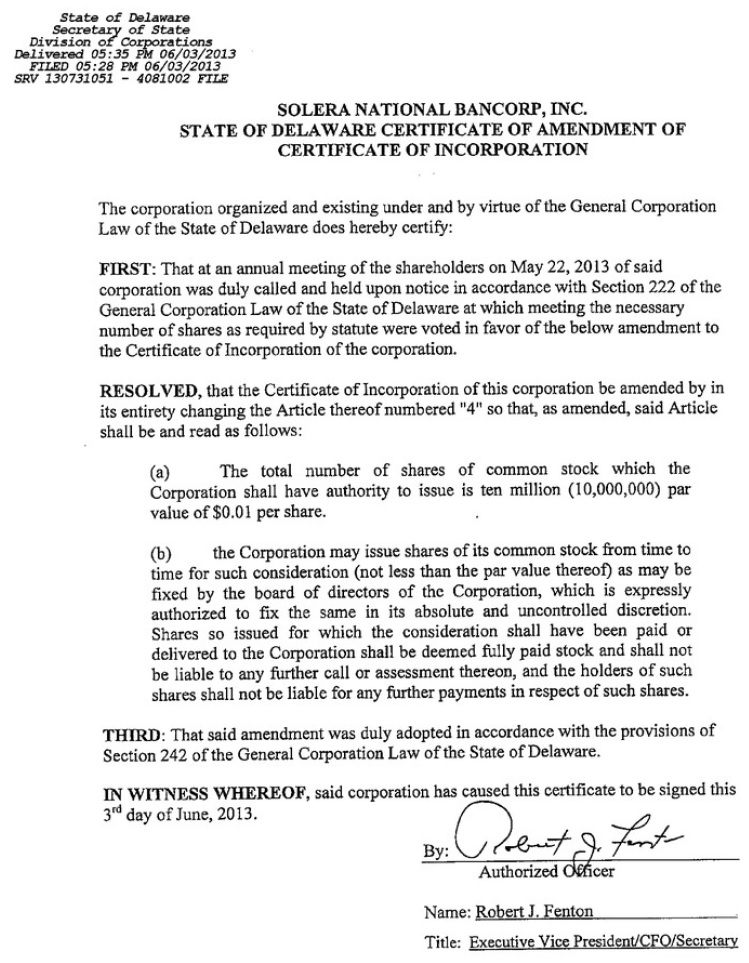
The shares of our common stock do not have preemptive rights. This means that you may not be entitled to buy additional shares if shares are offered to others in the future. We are authorized to issue 10,000,000 shares of common stock, and as of [•], 2017 we had 2,725,813 shares of our common stock outstanding, excluding treasury stock. Nothing restricts our ability to offer additional shares of stock for fair value to others in the future. Any issuances of common stock would dilute our stockholders’ ownership interests and may dilute the per share book value of our common stock.
Because we have discretion in the use of the proceeds, we may not apply these funds effectively which could have an adverse effect on our business.
We cannot specify with certainty the amounts we will spend on particular uses from the net proceeds we will receive from the offering. Our board of directors will have broad discretion in the application of the net proceeds. Our board of directors currently intends to use the net proceeds as described in “Use of Proceeds.” The failure by our board of directors to apply these funds effectively could have an adverse effect on our financial position, liquidity and results of operations by reducing or eliminating our net income from operations.
The offering may not be fully subscribed.
The rights offering is only being made to existing stockholders. However, there can be no assurance that all or any portion of the shares offered will be sold. To the extent that less than all of the shares offered are sold, we will have fewer funds for the uses described in “Use of Proceeds.”
Because we may terminate or cancel the offering at any time, your participation in the offering is not assured.
We may terminate or cancel the Rights Offering at any time before March 31, 2018 (or any extension thereof), for any reason. If the offering is terminated or cancelled for any reason, then we will not issue you any of the shares of common stock you may have subscribed for and we will not have any obligation with respect to the rights except to return any subscription price payments, as soon as practicable, without interest.
If you do not act promptly and follow the subscription instructions, then your exercise of rights may be rejected.
Stockholders who desire to purchase shares of common stock must act promptly to ensure that all required forms and payments are actually received before March 31, 2018 (or any extension thereof). If your shares are held through a broker, dealer, custodian bank or other nominee, as the record holder, then you must act promptly to ensure that your broker, dealer, bank or other nominee acts for you and that all required forms and payments are actually received by us before March 31, 2018. We will not be responsible if your broker, dealer, bank, financial institution or other nominee fails to ensure that all required forms and payments are actually received by us before March 31, 2018. If you fail to complete and sign the subscription agreement or the forms specified by your broker, dealer, custodian bank or other nominee, deliver an incorrect payment amount, pay by an unauthorized payment form, or otherwise fail to follow the subscription procedures that apply to your exercise of rights, then we may, depending on the circumstances, reject your subscription or accept it only to the extent of the payment
received. We will not undertake to contact you concerning an incomplete or incorrect subscription form or payment, nor are we under any obligation to correct such forms or payment. We have the sole discretion to determine whether a holder of rights exercise follows the proper procedures. You bear the risk of delivery of all documents and payments, and we do not have any responsibility for such documents and payments.
You will not receive interest on subscription funds, including any funds ultimately returned to you.
You will not earn any interest on your payment of the subscription price while it is being held by us pending the closing of the offering. In addition, if we cancel the offering, we will have no obligation with respect to the rights except to return to you, without interest, any payment of the subscription price.
Our directors and executive officers control a large amount of our stock, and your interests may not always be the same as those of the board and management.
As of [·], 2017, our directors and executive officers together with their affiliates beneficially owned approximately 33% of the Company’s outstanding voting stock. As a result, if all of these stockholders were to take a common position, they could be able to affect the election of directors as well as the outcome of corporate actions requiring stockholder approval, such as the approval of mergers or other business combinations. Such concentration may also have the effect of delaying or preventing a change in control of our company. In some situations, the interests of our directors and executive officers may be different from the stockholders. However, our directors and executive officers have a fiduciary duty to act in the best interest of the stockholders, rather than in their own best interests, when considering a proposed business combination or any of these types of matters.
Our use of Form 1-A and our reliance on Regulation A for this offering may make it more difficult to raise capital as and when we need it, as compared to if we were conducting a traditional initial public offering on Form S-1.
Because of the exemptions from various reporting requirements provided to us under Regulation A and because we are only permitted to raise up to $20 million in any 12 month period under a Tier 1 - Regulation A offering (although we may raise capital in other ways), we may be less attractive to investors and it may be difficult for us to raise additional capital as and when we need it. Investors may be unable to compare our business with other companies in our industry if they believe that our financial accounting is not as transparent as other companies in our industry. If we are unable to raise additional capital as and when we need it, our financial condition and results of operations may be materially and adversely affected.
Risks Related to Our Business
As a non-listed company conducting an exempt offering pursuant to Regulation A, we are not subject to a number of corporate governance requirements, including certain requirements relating to the board of directors or independent board committees.
As a non-listed company conducting an exempt offering pursuant to Regulation A, we are not subject to a number of corporate governance requirements that an issuer conducting an offering on Form S-1 or listing on a national stock exchange would be. Accordingly, we are not required to have: (i) a board of directors of which a majority consists of “independent” directors under the listing standards of a national stock exchange; (ii) an audit committee composed entirely of independent directors and a written audit committee charter meeting a national stock exchange’s requirements; (iii) a nominating/corporate governance committee composed entirely of independent directors and a written nominating/corporate governance committee charter meeting a national stock exchange’s requirements; (iv) a compensation committee composed entirely of independent directors and a written compensation committee charter meeting the requirements of a national stock exchange; or (v) independent audits of our internal controls. Accordingly, you may not have the same protections afforded to stockholders of companies that are subject to all of the corporate governance requirements of a national stock exchange.
We rely heavily on our management and directors, and the unexpected loss of key individuals may adversely affect our operations.
We are, and for the foreseeable future will be, dependent on the services of key management personnel, particularly Martin P. May, the Company’s President and Chief Executive Officer and Melissa K. Larkin, the Company’s Chief Financial Officer. The loss of any of them, or any other key employee, could have a material adverse effect on the condition, financial or otherwise, and results of our operations. No assurance can be given that we would be able to find replacement personnel of comparable ability were this to occur. Currently, none of our executive officers is subject to an employment agreement with the Company or the Bank.
Additionally, our directors’ community involvement, diverse backgrounds and extensive local business relationships are important to our success. If the composition of our board of directors changes materially, our banking business could suffer.
Our growth strategy involves operation and acquisition risks which may negatively impact our profits.
We face risks in our growth strategy, including the risks that we will be unable to expand our business by internal growth or through the acquisition of other financial institutions, bank branches or other assets. Our ability to grow profitably through internal growth involves the risks that the growth depends primarily on our identifying attractive markets, attracting and retaining qualified management and acquiring or establishing branch locations in those markets at reasonable costs. In addition, we must attract the necessary deposits and locate quality loans in those markets, and must attract and have sufficient qualified personnel to operate the new locations.
Acquiring other financial institutions, bank branches or other assets involves these same risks, as well as additional risks, including:
· adverse change in the results of operations of the acquired entities or assets;
· unforeseen liabilities or asset quality problems of the acquired entities or assets;
· greater than anticipated costs of integrating acquisitions;
· retention of employees;
· adverse personnel relations; and
· loss of customers.
The risks discussed above, including not securing all necessary legal and regulatory approvals, may inhibit or restrict our strategy to grow through acquisition and branch expansion, negatively impact our revenue growth and ultimately reduce or eliminate profits.
Our pace of growth may require us to attempt to raise additional capital in the future, but sufficient capital may not be available when it is needed, if at all, or on terms acceptable to us.
We are required by federal and state regulatory authorities to maintain adequate levels of capital to support our operations. Our regulators require that the Bank maintain a minimum Tier 1 leverage ratio and a minimum total risk-based capital ratio. There can be no assurance that we will be successful in maintaining such capital levels or that our regulators will not in the future increase capital requirements and thereby require us to raise additional capital.
We anticipate that our existing capital resources, including the net proceeds from this offering, will satisfy our immediately foreseeable capital requirements. However, to the extent we expand our asset base further, whether through organic growth or by acquisition, we will be required to support this growth by increasing our capital to acceptable regulatory levels. Accordingly, we may need to raise additional capital in the future to support continued asset growth. In addition, if we suffer operating losses, we may also need to raise capital to meet regulatory requirements.
Our ability to raise additional capital if we need it to meet regulatory requirements or to support loan growth in the future will depend on, among other things, conditions in the capital markets, which are outside of our control, and on our financial performance. Accordingly, we cannot assure you of our ability to raise additional capital when needed or on terms acceptable to us. If we cannot raise additional capital when needed, we will be subject to increased regulatory supervision and the imposition of restrictions on our growth and our business. These restrictions could negatively impact our ability to further expand our operations through acquisitions or the establishment or acquisition of additional branches and will likely result in increases in operating expenses and reductions in revenues that would negatively affect our operating results.
The short-term and long-term impact of the changing regulatory capital requirements and new capital rules is unknown.
In 2013, the FDIC, the OCC and the Federal Reserve Board approved a new rule that substantially amends the regulatory risk-based capital rules applicable to us. The final rule implements the “Basel III” regulatory capital reforms and changes required by the Dodd-Frank Act.
The final rule includes minimum risk-based capital and leverage ratios which became effective for us on January 1, 2015, and refines the definition of what constitutes “capital” for purposes of calculating these ratios. The minimum capital requirements to be considered “adequately capitalized” are: (i) a common equity Tier 1 capital ratio of 4.5%; (ii) a Tier 1 to risk-based assets capital ratio of 6.0%, which was increased from 4.0%; (iii) a total capital ratio of 8.0%, which was unchanged from the previous rules; and (iv) a Tier 1 leverage ratio of 4.0%. The final rule also established a “capital conservation buffer” of 2.5% above the regulatory minimum capital ratios, and when fully effective in 2019, will result in the following minimum capital ratios: (a) a common equity Tier 1 capital ratio of 7.0%; (b) a Tier 1 to risk-based assets capital ratio of 8.5%; and (c) a total capital ratio of 10.5%. The capital conservation buffer requirement began phasing in January 2016 at 0.625% of risk-weighted assets and will increase each year until fully implemented in January 2019. If an institution does not meet or exceed these minimum capital ratios it will be subject to limitations on paying dividends, engaging in share repurchases, and paying discretionary bonuses if its buffer level falls below the required buffer amount. These limitations will establish a maximum percentage of eligible retained income that can be utilized for such activities.
The application of more stringent capital requirements for us could, among other things, result in lower returns on equity, require the raising of additional capital, and result in regulatory actions such as a prohibition on the payment of dividends, the payment of bonuses to employees or the repurchase of shares if we were unable to comply with such requirements. Furthermore, the imposition of liquidity requirements in connection with the implementation of Basel III could result in our having to restructure our business models or increase our holdings of liquid assets. Implementation of changes in asset risk weightings for risk-based capital calculations, items included or deducted in calculating regulatory capital or additional capital conservation buffers could result in management modifying our business strategy.
The Company is currently subject to the Federal Reserve’s Small Bank Holding Company Policy Statement (the “Policy Statement”). The Policy Statement provides that the Basel III capital rules and reporting requirements will not apply to a bank holding company with under $1 billion in assets that: (a) is not engaged in significant non-bank activities; (b) has no significant off-balance sheet activities conducted through a non-bank subsidiary; and (c) subject to certain limited exceptions, has no material amount of registered debt or equity securities outstanding. As of September 30, 2017, the Company had $167.6 million in consolidated assets and satisfied the other criteria described above, and so the holding company is not subject to the Basel III capital rules and reporting requirements, however; the Bank is subject to Basel III capital rules.
There can be no assurance, however, that the Company’s assets will not increase above $1.0 billion or that the Company will fail to satisfy one of the other conditions required for non-applicability of Basel III. The application of more stringent capital requirements for the Company could, among other things, result in lower returns on equity, require the raising of additional capital, or result in regulatory actions such as a prohibition on the payment of dividends, the payment of bonuses to employees or the repurchase of shares if the Company were unable to comply with such requirements. Furthermore, the imposition of liquidity requirements in connection with the implementation of Basel III could result in the Company having to restructure the Company’s business models, or increase the Company’s holdings of liquid assets. Implementation of changes in asset risk the weightings for risk-
based capital calculations, items included or deducted in calculating regulatory capital or additional capital conservation buffers could result in management modifying the Company’s business strategy.
We may not be successful in implementing our internal growth strategy due to numerous factors that affect earnings.
We intend to pursue an organic growth strategy, the success of which is dependent on our ability to generate an increasing level of loans and deposits at acceptable risk levels without incurring corresponding increases in noninterest expense. We may not be successful in our organic growth strategy due to, among other factors, delays in introducing and implementing new products and services and other impediments resulting from regulatory oversight, lack of qualified personnel, and scarcity of branch sites or deficient site selection of bank branches. Further, the success of our internal growth strategy will depend on maintaining sufficient regulatory capital levels and on favorable economic conditions in our primary market area.
We face intense competition in all phases of our business from other banks and financial institutions.
We compete for deposits with a large number of depository institutions including commercial banks, savings and loan associations, credit unions, money market funds and other financial institutions and financial intermediaries serving our market area. Principal competitive factors with respect to deposits include interest rates paid on deposits, customer service, convenience and location. We compete for loans with other banks headquartered in our market area, with loan production offices of large money center banks headquartered in other states, as well as with savings and loan associations, credit unions, finance companies, mortgage bankers, leasing companies and other institutions. Competitive factors with respect to loans include interest rates charged, customer service and responsiveness in tailoring financial products to the needs of customers. Many of the entities that we compete with are substantially larger in size, and have greater financial and human resources than we do. In addition, many non-bank financial intermediaries are not subject to the regulatory restrictions applicable to the Bank.
Hedging against interest rate exposure may adversely affect our earnings, limit our gains or result in losses, which could adversely affect cash available for distribution to our stockholders.
We may enter into interest rate swap agreements or pursue other interest rate hedging strategies. Our hedging activity, if any, will continue to vary in scope based on the level of interest rates, the type of investments held, and other changing market conditions. Interest rate hedging may fail to protect or could adversely affect us because, among other things:
· interest rate hedging can be expensive, particularly during periods of rising and volatile interest rates;
· available interest rate hedging may not correspond directly with the interest rate risk for which protection is sought;
· the duration of the hedge may not match the duration of the related liability or asset;
· the credit quality of the party owing money on the hedge may be downgraded to such an extent that it impairs our ability to sell or assign our side of the hedging transaction;
· the party owing money in the hedging transaction may default on its obligation to pay; and
· we may purchase a hedge that turns out not to be necessary, i.e., a hedge that is out of the money.
Any hedging activity we engage in may adversely affect our earnings. Therefore, while we may enter into such transactions to seek to reduce interest rate risks, unanticipated changes in interest rates may result in poorer overall earnings than if we had not engaged in any such hedging transactions.
We are subject to significant governmental regulation.
We are subject to extensive regulation and supervision, in particular by the Federal Reserve and the OCC. Any change in applicable regulations or federal or state legislation could have a substantial impact on us and our operations as well as those of any banks we may acquire in the future. Such changes in applicable laws or in their application by regulatory agencies cannot necessarily be predicted, although recently enacted, proposed and future legislation and regulations have had, and likely will continue to have, a significant impact on the banking industry. Some of the legislative and regulatory changes may benefit us while others may increase our costs of doing business, assist our competitors, or otherwise have an adverse effect on our financial condition, results of operations and cash flows. Further, regulators have significant discretion and power to prevent or remedy unsafe or unsound practices or violations of laws by banks and bank holding companies in the performance of their supervisory and enforcement duties. The exercise of this regulatory discretion and power may have a negative impact on our financial position, results of operations and cash flows.
Our operations are also subject to a wide variety of state and federal consumer protection and similar statutes and regulations, including privacy regulations covering consumer financial information. Such federal and state regulatory restrictions limit the manner in which we may conduct business. Those laws and regulations can and do change significantly from time to time and any such change could adversely affect our business. See “Supervision and Regulation.”
Regulatory guidance and regulations on incentive compensation could adversely affect us.
In 2010, the federal bank regulators jointly issued final guidance on sound incentive compensation policies (“SICP”) intended to ensure that the incentive compensation policies of banking organizations do not undermine the safety and soundness of such organizations by encouraging imprudent risk-taking. The SICP guidance, which covers all employees that have the ability to materially affect the risk profile of an organization, either individually or as part of a group, is based upon the key principles that a banking organization’s incentive compensation arrangements should: (i) provide incentives that do not encourage employees to expose the organization to imprudent risk; (ii)be compatible with effective internal controls and risk management; and (iii) be supported by strong corporate governance, including active and effective oversight by the organization’s board of directors. Any identified deficiencies in compensation practices may be incorporated into an organization’s supervisory ratings, which can affect its ability to make acquisitions or perform other actions. The SICP guidance provides that enforcement actions may be taken against a banking organization if its incentive compensation arrangements or related risk-management, control or governance processes pose a risk to the organization’s safety and soundness, particularly when the organization is not taking prompt and effective measures to correct the deficiencies. In February 2011, the federal financial regulators issued joint proposed regulations to implement the Dodd-Frank Act requirement that the federal financial regulators prohibit, at any financial institution with consolidated assets of at least $1 billion, incentive pay that they determine encourages inappropriate risks.
In May 2016 the federal regulatory agencies issued for public comment revised proposed rules as part of a joint rule-making effort designed to prohibit certain incentive-based compensation arrangements deemed to encourage inappropriate risk taking by covered financial institutions by providing “excessive” compensation, fees or benefits or that could lead to material losses. Depending upon the outcome of the rule making process, the application of this rule to us could require us to revise our compensation strategy, increase our administrative costs and adversely affect our ability to recruit and retain qualified employees.
The scope and content of the U.S. banking regulators’ policies on executive compensation are continuing to develop and are likely to continue evolving in the near future. It cannot be determined at this time whether compliance with such policies will adversely affect our ability to hire, retain and motivate our key employees.
Our access to liquidity may be negatively impacted due to circumstances beyond our control, and we may not be able to meet the cash flow requirements of our depositors and borrowers.
While we aim to actively manage our liquidity risk and maintain liquidity at least sufficient to cover forecasted funding requirements, our liquidity may be adversely affected by unforeseen or extraordinary demands on cash and
our inability to access sources of deposits for the Bank. This situation may arise due to circumstances beyond our control.
Liquidity is the ability to meet current and future cash flow needs on a timely basis at a reasonable cost and is essential to our business. An inability to raise funds through deposits, borrowings, the sale of loans and other sources could have a substantial negative effect on our liquidity. Our liquidity is used to make loans and to repay deposit liabilities as they become due or are demanded by customers. We regularly monitor our overall liquidity position to ensure that various alternative strategies exist to cover unanticipated events that could affect liquidity. Potential alternative sources of liquidity include the sale of loans, the acquisition of national market, non-core deposits, the issuance of additional collateralized borrowings such as Federal Home Loan Bank (“FHLB”) advances, access to the Federal Reserve Bank discount window and the issuance of additional equity securities. We also maintain a portfolio of securities that can be used as a secondary source of liquidity. If such sources are unavailable or are not available on reasonable terms, our financial condition, growth and future prospects could be adversely affected.
In addition, if the Bank is at a future date not considered “well capitalized” under applicable prompt corrective action statutes and regulations, it would be unable to roll over or renew brokered deposits or accept any new brokered deposits and would not be able to solicit deposits by offering interests rates higher than those permissible for brokered deposits without regulatory approval, thereby further limiting its access to liquidity.
Although we believe that the Bank currently has sufficient liquidity and access to sources of additional liquidity, there can be no assurance that such level of, and access to sources of, liquidity will be available to the Bank in the future.
Concern of customers over deposit insurance may cause a decrease in deposits.
Customers have become in recent years more concerned and aware about the extent to which their deposits are insured by the FDIC. As a result, customers may either withdraw deposits or elect not to increase their deposits in an effort to ensure that the amount they have on deposit with any one bank is fully insured. Decreases in deposits may adversely affect our funding costs and net income.
Our deposit insurance premiums could increase in the future, which could have a material adverse effect on our future earnings.
The FDIC insures deposits at certain financial institutions, including the Bank, and charges insured financial institutions a premium to maintain the Deposit Insurance Fund (the “DIF”) at a certain level. Economic conditions in recent years have increased bank failures, in which case the FDIC ensures payments of deposits up to insured limits from the DIF.
In 2011, the FDIC implemented new rules required by the Dodd-Frank Act with respect to the FDIC assessments. In particular, the definition of an institution’s deposit insurance assessment base was changed from total deposits to total assets less tangible equity. In addition, the FDIC revised the deposit insurance assessment rates down. The new initial base assessment rates range from 5 to 9 basis points for Risk Category I banks to 35 basis points for Risk Category IV banks. Risk Category II and III banks have an initial base assessment rate of 14 and 23 basis points, respectively. There can be no assurance that the FDIC will not increase assessment rates in the future or that the Bank will not be subject to higher assessment rates as a result of a change in its risk category, either of which could have an adverse effect on our earnings.
In addition, the FDIC may terminate an institution’s deposit insurance if it determines that the institution involved has engaged in or is engaging in unsafe or unsound banking practices, is in an unsafe or unsound condition, or has violated applicable laws, regulations or orders.
Negative developments in the financial services industry and in the U.S. and global credit markets in recent years may continue to adversely impact our operations, financial condition and earnings.
Negative developments in the financial services industry from 2008 through 2011 resulted in uncertainty in the financial markets in general and an economic recession. As a consequence of the recession, businesses across a wide range of industries faced numerous challenges, including decreases in consumer spending, consumer confidence and
credit market liquidity. While conditions have gradually improved, many of these circumstances continue to represent challenges and continue to create a degree of economic uncertainty. In addition, declining oil prices, the implementation, repeal or replacement of the employer mandate under the Patient Protection and Affordable Care Act and the level of U.S. debt may have a destabilizing effect on financial markets.
As a result of these financial and economic crises, many lending institutions, including us, experienced declines in the performance of their loans. In addition, the values of real estate collateral supporting many commercial loans and home mortgages declined and may decline again in the future. The ability of banks to raise capital or borrow in the debt markets became more difficult compared to previous periods. As a result, bank regulatory agencies have been and are expected to continue to be very aggressive in responding to concerns and trends identified in examinations. The impact of legislation enacted in response to these developments may negatively impact our operations by restricting our business operations, including the Bank’s ability to originate or sell loans, and adversely impact our financial performance.
Negative economic developments, including another recession, may affect consumer confidence levels and may cause adverse changes in payment patterns, causing increases in delinquencies and default rates, which may impact the Bank’s charge-offs and provision for credit losses. Although economic conditions in Colorado and in the U.S. in general have improved, there can be no assurances that the economic environment will continue to improve in the near- or long-term. Declines in real estate values, home sales volumes and financial stress on borrowers as a result of the uncertain economic environment could have an adverse effect on the Bank’s borrowers or their customers, which could adversely our business, financial condition, results of operations and cash flows.
If economic conditions deteriorate, our revenues could decrease.
Declines in the local economies of the market area we serve could impair our ability to collect loans and would have a negative effect on our financial condition and our results of operations. Our financial results may be adversely affected by changes in prevailing economic conditions, including declines in real estate values, changes in interest rates and corresponding decreases in interest rate spreads, adverse employment conditions and the monetary and fiscal policies of the federal government. For example, declines in real estate values could adversely affect the value of property used as collateral.
In addition, substantially all of our loans are to individuals and businesses in the Denver metropolitan area. Any decline in these local economies or in the statewide economy could have an adverse impact on our financial performance. There can be no assurance that positive trends or developments will evolve or that negative trends or developments will not have significant downward effects on our revenues.
The small and medium-sized businesses that make up a portion of our target market may have insufficient financial resources to weather a sustained downturn in the economy.
We target the banking and financial services needs of small and medium-sized businesses. These businesses generally have fewer financial resources in terms of capital borrowing capacity than larger entities, have smaller market share than their competition, may be more vulnerable to economic downturns, often need substantial additional capital to expand or compete and may experience substantial volatility in operating results, any of which may impair a borrower’s ability to repay a loan. In addition, the success of a small or medium-sized business often depends on the managerial talents and efforts of one person or a small group of persons, and the death, disability or resignation of one or more of these persons would likely have an adverse impact on the business and its ability to repay its loan. If general economic conditions negatively impact these businesses in the markets in which we operate, our business, financial condition, and results of operation could be adversely affected.
Our business is subject to credit risks which may adversely affect our earnings.
There are inherent risks associated with our lending activities. These risks include, among other things, the impact of changes in interest rates. Increases in interest rates could adversely impact borrowers’ ability to repay outstanding loans or the value of the collateral securing these loans.
We seek to mitigate the risks inherent in our loan portfolio by adhering to conservative underwriting practices, including analyzing the credit risk, valuing the underlying collateral, monitoring loan concentration within specific
industries and geographic locations and obtaining periodic reviews of outstanding loans by our loan review and audit departments. Although we believe that our underwriting criteria are appropriate for the various kinds of loans we make, we may nevertheless incur losses on loans that meet our underwriting criteria and these losses may exceed the amounts set aside as reserves in our allowance for loan losses.
Should the economic climate deteriorate, borrowers may experience difficulty repaying loans, and the level of non-performing loans, charge-offs, and delinquencies could rise and require further increases in the provision for loan losses, which would adversely affect our business, financial condition, and results of operation.
A large percentage of our loans are secured by real estate, and adverse changes in the real estate market may result in losses.
As of September 30, 2017, approximately 80% of the Bank’s loan portfolio consisted of real estate loans. The majority of these real estate loans are located in Colorado, and the Bank’s loan portfolio may be affected by a downturn in the residential and commercial real estate market. Real estate values and real estate markets are generally affected by changes in national, regional or local economic conditions, fluctuations in interest rates and the availability of loans to potential purchasers, changes in tax laws and other governmental statutes, regulations and policies and acts of nature. Any decline in the real estate markets in our primary market area could adversely affect our business, results of operations and financial condition. If real estate values declined, the collateral for our loans would provide less security. As a result, our ability to recover on defaulted loans by selling the underlying real estate would be diminished and we would be more likely to suffer losses on defaulted loans. The events and conditions described in this risk factor could therefore have a material adverse effect on our business, results of operations and financial condition.
The level of our commercial real estate loan portfolio may subject us to heightened regulatory scrutiny.
The FDIC, the Federal Reserve and the Office of the Comptroller of the Currency have promulgated joint guidance on sound risk management practices for financial institutions with concentrations in commercial real estate lending. Under the guidance, a financial institution that, like us, is actively involved in commercial real estate lending should perform a risk assessment to identify potential concentrations in commercial real estate lending. A financial institution may have such a concentration if, among other factors: (i)total reported loans for construction, land development, and other land represent 100% or more of total risk-based capital (“CRE 1 Concentration”); or (ii)total reported loans for construction, land development and other land and loans secured by multifamily and non-owner occupied non-farm, non-residential properties (excluding loans secured by owner-occupied properties) represent 300% or more of total risk-based capital (“CRE 2 Concentration”) and the institution’s commercial real estate loan portfolio has increased by 50% or more during the prior 36-month period. In such an instance, management should employ heightened risk management practices, including board and management oversight and strategic planning, development of underwriting standards, risk assessment and monitoring through market analysis and stress testing.
As of September 30, 2017, the Bank’s CRE 1 Concentration level was 12% and its CRE 2 Concentration level was 193%. While each of these levels is beneath regulatory maximums, there can be no assurance that that will remain the case, and if the Bank is considered to have a concentration in the future and our risk management practices are found to be deficient, it could result in increased reserves and capital costs as well as potential regulatory enforcement action.
The Bank’s allowance for loan losses may prove to be insufficient to absorb losses in the Bank’s loan portfolio.
As a lender, the Bank is exposed to the risk that its borrowers may not repay their loans according to the terms of these loans and that the collateral securing the payment of a particular loan may be insufficient to fully compensate for the outstanding balance of the loan and the costs to dispose of the underlying collateral. The Bank maintains an allowance for loan losses, which is a reserve established through a provision for loan losses charged to expense, that represents management’s best estimate of probable incurred losses within the Bank’s existing portfolio of loans. Additional credit losses will likely occur in the future and may occur at a rate greater than the Bank has experienced to date. The level of the allowance reflects management’s ongoing evaluation of specific credit risks, loan loss experience, loan portfolio quality, economic conditions, loan industry concentrations, and other potential but
unidentifiable losses inherent in the current loan portfolio. The determination of the appropriate level of the allowance for loan losses inherently involves a high degree of subjectivity and judgment and requires management to make significant estimates of current credit risks, future trends, and general economic conditions, all of which may undergo material changes.
Further, the measure of the Bank’s allowance for loan losses is also dependent on the adoption of new accounting standards. The Financial Accounting Standards Board recently issued an Accounting Standards Update that presents a new credit impairment model, the Current Expected Credit Loss (“CECL”) model, which would require financial institutions to estimate and develop a provision for credit losses at origination for the lifetime of the loan, as opposed to reserving for incurred or probable losses up to the balance sheet date. Under the CECL model, credit deterioration would be reflected in the income statement in the period of origination or acquisition of the loan, with changes in expected credit losses due to further credit deterioration or improvement reflected in the periods in which the expectation changes. Accordingly, the CECL model could require financial institutions such as the Bank to increase their allowances for loan losses. Moreover, the CECL model could create more volatility in the Bank’s level of allowance for loan losses. The Bank is still evaluating the effects that CECL may have on its financial results, but anticipates that it will add complexity and cost to its current credit loss evaluation process.
Changes in economic conditions affecting borrowers, new information regarding existing loans, identification of additional problem loans and other factors, both within and outside of the Bank’s control, may require an increase in the allowance for loan losses. Likewise, increases in nonperforming loans have a significant impact on the Bank’s allowance for loan losses. If real estate values decline, the Bank could experience increased delinquencies and credit losses, particularly with respect to commercial real estate loans. Likewise, if management’s assumptions prove to be incorrect or if the Bank experiences significant loan losses in future periods, the Bank’s current level of allowance may not be sufficient to cover actual loan losses and adjustments may be necessary to allow for different economic conditions or adverse developments in the Bank’s loan portfolio. A material change to the allowance could cause net income and possibly capital to decrease.
In addition, federal and state regulators periodically review the Bank’s allowance for loan losses and may require the Bank to increase its allowance for loan losses or recognize loan charge-offs based on judgments different than those of management. Any increase in the Bank’s allowance for loan losses or charge-offs as required by these regulatory agencies could have a material adverse effect on our financial condition and results of operations.
Non-performing assets take significant time to resolve and may adversely affect our results of operations and financial condition, and could result in losses in the future.
As of September 30, 2017, we had no non-performing loans (which consist of nonaccrual loans and troubled debt restructurings on accrual status) or non-performing assets (which include foreclosed real estate). Non-performing assets adversely affect net income in various ways. We do not record interest income on non-accrual loans or on other real estate owned (“OREO”), thereby adversely affecting our income and increasing our loan administration costs. When we take collateral in foreclosures and similar proceedings, we are required to mark the related loan to the then fair market value of the collateral, which may result in a loss. These loans and OREO also increase our risk profile and the capital requirements that our regulators believe are appropriate in light of such risks. While the Company works to reduce its problem assets through workouts, restructurings and otherwise, decreases in the values of these assets, the underlying collateral, or in the borrowers’ performance or financial conditions, whether or not due to economic and market conditions beyond our control, could adversely affect our business, results of operations and financial condition. In addition, the resolution of non-performing assets requires significant commitments of time from management and directors, which can decrease their ability to perform their other responsibilities.
An additional risk related to OREO assets is our potential exposure to losses as a result of a decline in the fair market value of an individual OREO parcel. There can be no assurance that we will not experience increases in non-performing loans in the future, or that our non-performing assets will not result in losses in the future.
We are subject to interest rate risk.
Fluctuations in interest rates may negatively impact our banking business. Our primary source of income from operations is net interest income, which is the difference between the interest income received on interest-earning assets (usually loans and investment securities) and the interest expense incurred in connection with interest-bearing
liabilities (usually deposits and borrowings). The level of net interest income is primarily a function of the average balance of interest-earning assets, the average balance of interest-bearing liabilities and the spread between the yield on such assets and the cost of such liabilities. These factors are influenced by both the pricing and mix of interest-earning assets and interest-bearing liabilities which, in turn, are impacted by external factors such as the local economy, competition for loans and deposits, the monetary policy of the Federal Open Market Committee of the Federal Reserve System (the “FOMC”) and market interest rates.
The cost of our deposits and short-term wholesale borrowings is largely based on short-term interest rates, the level of which is driven primarily by the FOMC’s actions. However, the yields generated by our loans and securities are typically driven by longer-term interest rates, which are set by the market or, at times the FOMC’s actions, and generally vary from day to day. The level of net interest income is therefore influenced by movements in such interest rates and the pace at which such movements occur. If the interest rates on our interest-bearing liabilities increase faster than the interest rates on our interest-earning assets, our net interest income may decline and with it, a decline in our earnings may occur. Our net interest income and earnings would be similarly affected if the interest rates on our interest-earning assets declined faster than the interest rates on our interest-bearing liabilities. As a result, our business, results of operations or financial condition may be adversely affected, perhaps materially.
Changes in interest rates can also affect the slope of the yield curve. A decline in the current yield curve or a flatter or inverted yield curve could cause our net interest income and net interest margin to contract, which could have a material adverse effect on our net income and cash flows, as well as the value of our assets. An inverted yield curve may also adversely affect the yield on investment securities by increasing the prepayment risk of any securities purchased at a premium.
An increase in interest rates could also have a negative impact on our results of operations by reducing the ability of borrowers to make payments under their current adjustable-rate loan obligations. These circumstances could not only result in increased loan defaults, foreclosures and charge-offs, but also necessitate further increases to the allowance for loan losses, which may materially and adversely affect our business, results of operations or financial condition.
Prolonged lower interest rates may adversely affect our net income.
Prolonged lower interest rates, particularly medium and longer-term rates, may have an adverse impact on the composition of our earning assets, our net interest margin, our net interest income and our net income. Among other things, a period of prolonged lower rates may cause prepayments to increase as our clients seek to refinance existing home loans. Such an increase in prepayments and refinancing activity would likely result in a decrease in the weighted average yield of our earning assets, an increase in salary and bonus expense as a result of higher loan volume and an increase in provision expense for new loans added to the portfolio.
Our cost of funds may increase as a result of numerous factors, which may reduce our profitability and subject us to additional liquidity and funding risks.
Our cost of funds may increase because of, among other things, general economic conditions, unfavorable conditions in capital markets, changes in interest rates, government intervention and support of competitors, government price controls and competitive pressures. We obtain funds principally through deposits and, to a lesser extent, other borrowings. As a general rule, deposits are a cheaper and more stable source of funds than borrowings. Checking and savings account balances and other forms of deposits can decrease when our deposit customers perceive alternative investments, such as the stock market or other non-depository investments, as providing superior returns or seek to spread their deposits over multiple banks to maximize FDIC insurance coverage. Furthermore, technological and other changes have made it more convenient for bank customers to transfer funds into alternative investments, including products offered by other financial institutions and non-bank service providers. As a result, increases in short-term interest rates could increase transfers of deposits to higher yielding deposits. Efforts and initiatives we undertake to retain and increase deposits, including deposit pricing, can increase our costs. When bank customers move money out of bank deposits in favor of alternative investments or into higher yielding deposits, or spread their accounts over several banks, we can lose a relatively inexpensive source of funds, thus increasing our funding costs. If, as a result of general economic conditions, market interest rates, competitive pressures or other factors, our level of deposits decreases relative to our overall banking activities, we may need to
rely more heavily on borrowings and wholesale funding as sources of funds, and this may negatively impact our net interest margin and subject us to additional liquidity and funding risks.
The value of securities in our portfolio may be negatively affected by disruptions in securities markets.
The market for some of the investment securities held in our portfolio has been volatile in recent years. Volatile market conditions may negatively affect the value of these securities due to the perception of heightened credit and liquidity risks. There can be no assurance that the potential declines in market value associated with these disruptions will not result in other-than-temporary impairments of these assets, which would lead to impairment charges that could have a material adverse effect on our net income and capital levels.
We depend on the accuracy and completeness of information about clients and counterparties and our financial condition could be adversely affected if we rely on misleading information.
We rely heavily upon information supplied to us by third parties, including the information contained in credit applications, property appraisals, title information, equipment pricing and valuation and employment and income documentation, in deciding which loans we will originate, as well as the terms of those loans. If any of the information upon which we rely is misrepresented, either fraudulently or inadvertently, and the misrepresentation is not detected prior to asset funding, the value of the asset may be significantly lower than expected, we may fund a loan that we would not have otherwise funded or we may fund a loan on terms that we would not have otherwise extended. Whether a misrepresentation is made by the applicant or by another third party, we generally bear the risk of loss associated with the misrepresentation. A loan subject to a material misrepresentation is typically unsellable or subject to repurchase if it is sold prior to detection of the misrepresentation. The sources of the misrepresentation are often difficult to locate, and it is often difficult to recover any of the monetary losses we may suffer.
New lines of business or new products and services may subject us to additional risks.
From time to time, we may implement or may acquire new lines of business or offer new products and services within existing lines of business. There are substantial risks and uncertainties associated with these efforts, particularly in instances where the markets are not fully developed. In developing and marketing new lines of business and new products and services, we may invest significant time and resources. We may not achieve target timetables for the introduction and development of new lines of business and new products or services and price and profitability targets may not prove feasible. External factors, such as regulatory compliance obligations, competitive alternatives, and shifting market preferences, may also impact the successful implementation of a new line of business or a new product or service. Furthermore, any new line of business or new product or service could have a significant impact on the effectiveness of our system of internal controls. Failure to successfully manage these risks in the development and implementation of new lines of business or new products or services could have a material adverse effect on our business, results of operations and financial condition.
We could be adversely affected if we or any of our officers or directors fail to comply with bank or other laws and regulations.
As a bank holding company, we are subject to extensive regulation by U.S. federal and state regulatory agencies and face risks associated with investigations and proceedings by regulatory agencies, including those that we may believe to be immaterial. Like any company, we are also subject to risk arising from potential employee misconduct, including noncompliance with our internal policies. Any interventions by authorities may result in adverse judgments, settlements, fines, penalties, injunctions, suspension or expulsion of our officers or directors from the banking industry or other relief. In addition to the potential monetary consequences, these measures could, for example, impact our ability to engage in, or impose limitations on, certain aspects of our businesses. The number of these investigations and proceedings, as well as the amount of penalties and fines sought, has increased substantially in recent years with respect to many banks in the industry. Significant regulatory action against us or our officers or directors could materially and adversely affect our business, financial condition or results of operations or cause us significant reputational harm, which in turn could seriously harm our business.
Changes in tax law may adversely affect our net income, effective tax rate and our overall results of operations and financial condition.
Our financial performance is impacted by federal and state tax laws. The enactment of new tax legislation, or changes in the interpretation of existing law, including provisions impacting tax rates, apportionment, consolidation or combination, income, expenses, and credits, may have a material adverse effect on our financial condition and results of operations.
Our internal controls and procedures may not be adequate or may fail or be circumvented.
Management regularly reviews and updates our internal controls, disclosure controls and procedures, and corporate governance policies and procedures are based in part on certain assumptions and can provide only reasonable, not absolute, assurances that the objectives of the system will be met. Any failure or circumvention of our controls and procedures or failure to comply with regulations related to controls and procedures could have a material adverse effect on our business, results of operations, cash flows and financial condition.
We are exposed to risk of environmental liabilities with respect to properties to which we take title.
A significant portion of our loan portfolio is secured by real property. In the course of our business, we may own or foreclose on and take title to properties securing certain loans and could be subject to environmental liabilities with respect to these properties. In doing so, there is a risk that hazardous or toxic substances could be found on these properties. If hazardous or toxic substances are found, we may be held liable to a governmental entity or to third parties for property damage, personal injury, investigation costs and clean-up costs incurred by these parties in connection with the environmental contamination, or we may be required to investigate or clean up the hazardous or toxic substances. The costs associated with investigation or remediation activities could be substantial. Further, the discovery or presence of hazardous or toxic substances may materially reduce the affected property’s value or limit our ability to use or sell the affected property. In addition, as the owner or former owner of a contaminated site, we may be subject to common law claims by third parties based on damages and costs resulting from environmental contamination emanating from the property. If we ever become subject to significant environmental liabilities, our business, financial condition, cash flows, liquidity and results of operations could be materially and adversely affected.
We are subject to a variety of operational risks, including reputational risk, legal risk and compliance risk, and the risk of fraud or theft by employees or outsiders, which may adversely affect our business and results of operations.
We are exposed to many types of operational risks, including reputational risk, legal and compliance risk, the risk of fraud or theft by employees or outsiders, and the risk of unauthorized transactions or operational errors by employees, including clerical or record-keeping errors or errors resulting from faulty or disabled computer or telecommunications systems.
Because the nature of the financial services business involves a high volume of transactions, certain errors may be repeated or compounded before they are discovered and successfully rectified. Our necessary dependence upon automated systems to record and process transactions and our large transaction volume may further increase the risk that technical flaws or employee tampering or manipulation of those systems will result in losses that are difficult to detect. We also may be subject to disruptions of our operating systems arising from events that are wholly or partially beyond our control (for example, computer viruses or electrical or telecommunications outages, or natural disasters, disease pandemics or other damage to property or physical assets), which may give rise to disruption of service to customers and to financial loss or liability. We are further exposed to the risk that our external vendors may be unable to fulfill their contractual obligations (or will be subject to the same risk of fraud or operational errors by their respective employees as we are) and to the risk that we (or our vendors’) business continuity and data security systems prove to be inadequate. The occurrence of any of these risks could diminish our ability to operate our business (for example, by requiring us to expend significant resources to correct the defect), as well as result in potential liability to clients, reputational damage and regulatory intervention, which in turn could materially and adversely affect our business, financial condition and results of operations.
We are subject to security, transactional and operational risks relating to the use of technology that could damage our reputation and our business.
We rely heavily on communications and information systems to conduct our business, serving both internal and customer constituencies. Any failure, interruption or breach in security of these systems could result in failures or disruptions in our customer relationship management, general ledger, deposit, loan and other systems. While we have policies and procedures, security applications and fraud mitigation applications designed to prevent or limit the effect of a failure, interruption or security breach of, or a fraud attack on, our information systems, there can be no assurance that any such failures, interruptions, fraud attacks or security breaches will not occur or, if they do occur, that they will be adequately addressed. Additionally, we outsource our data processing to a third party. If our third party provider encounters difficulties or if we have difficulty in communicating with the third party, it will significantly impair our ability to adequately process and account for customer transactions, which would significantly affect our business operations. Furthermore, breaches of the third party provider’s technology may also cause reimbursable loss to our consumer and business customers through no fault of our own. Fraud attacks targeting customer-controlled devices, plastic payment card terminals and merchant data collection points provide another source of potential loss, again which would be through no fault of our own. The occurrence of any failures, interruptions or security breaches of, or fraud attacks on, information systems used to process customer transactions could damage our reputation, result in a loss of customer business, subject us to additional regulatory scrutiny, or expose us to civil litigation and possible financial liability, any of which could have a material adverse effect on our financial condition, results of operations and cash flows.
Unauthorized disclosure of sensitive or confidential customer information, whether through a cyber-attack, other breach of our computer systems or otherwise, could severely harm our business.
In the normal course of our business, we collect, process and retain sensitive and confidential customer information. Despite the security measures we have in place, our facilities and systems may be vulnerable to cyber-attacks, security breaches, acts of vandalism, computer viruses, misplaced or lost data, programming or human errors, and other similar events.
Information security risks for financial institutions such as us have increased recently in part because of new technologies, the use of the Internet and telecommunications technologies, including mobile devices, to conduct financial and other business transactions and the increased sophistication and activities of organized crime, perpetrators of fraud, hackers, terrorists and others. In addition to cyber-attacks or other security breaches involving the theft of sensitive and confidential information, hackers have engaged in attacks against financial institutions designed to disrupt key business services such as customer-facing web sites. We are not able to anticipate or implement effective preventive measures against all security breaches of these types. Although we employ detection and response mechanisms designed to contain and mitigate security incidents, early detection may be thwarted by sophisticated attacks and malware designed to avoid detection.
We also face risks related to cyber-attacks and other security breaches in connection with debit card transactions that typically involve the transmission of sensitive information regarding our customers through various third parties. Some of these parties have in the past been the target of security breaches and cyber-attacks, and because the transactions involve third parties and environments that we do not control or secure, future security breaches or cyber-attacks affecting any of these third parties could impact us through no fault of our own, and in some cases we may have exposure and suffer losses for breaches or attacks relating to them. We also rely on external vendors to conduct other aspects of our business operations and face similar risks relating to them. Irrespective of how much diligence we may conduct with respect to these external vendors, we cannot be sure that their information security protocols are sufficient to withstand a cyber-attack or other security breach.
Any cyber-attack or other security breach involving the misappropriation, loss or other unauthorized disclosure of confidential customer information could severely damage our reputation, erode confidence in the security our systems, products and services, expose us to the risk of litigation and liability, disrupt our operations and have a material adverse effect our business.
We continually encounter technological change.
The financial services industry is continually undergoing rapid technological change with frequent introductions of new technology driven products and services. The effective use of technology increases efficiency and enables financial institutions to better serve customers and to reduce costs. Our future success depends, in part, upon our ability to address the needs of our customers by using technology to provide products and services that will satisfy customer demands, as well as to create additional efficiencies in our operations. Many of our competitors have substantially greater resources to invest in technological improvements. We may not be able to effectively implement new technology-driven products and services or be successful in marketing these products and services to our customers. Failure to successfully keep pace with technological change affecting the financial services industry could have a material adverse impact on our business and, in turn, our financial condition, results of operations and cash flows.
General
We are offering up to 1,362,906 shares of our common stock, par value $0.01 per share. We are offering the shares first to our existing stockholders on a subscription rights basis and pursuant to a related over-subscription privilege. The purchase price in both cases is $7.25 per share. Stockholders must own at least two shares as of the record date to be eligible to participate in the rights portion of the offering. There is no minimum purchase requirement. Once you subscribe, your subscription is irrevocable.
Stockholders may subscribe for any number of shares being offered hereby, as described more fully below.
With respect to the over-subscription privilege, we reserve the right to reject any subscription, in whole or in part, in our sole discretion. In determining which over-subscriptions to accept, in whole or in part, we may take into account a subscriber’s potential to do business with, or to direct customers to, Solera National Bank, and the order in which such subscriptions are received.
In the event we reject all or a portion of a requested over-subscription, we will refund to the subscriber all, or the appropriate portion, of the amount remitted with the subscription agreement, without interest or deduction. We will decide which over-subscriptions to accept, and will mail all appropriate refunds, no later than 30 days after the expiration of the offering, when and as extended, or the partial closing of the offering relating to the period during which such subscription is received.
Stockholder subscription rights will expire if not exercised by 5:00 p.m., Mountain Time, on March 31, 2018 unless it is terminated earlier or either date is extended without notice to subscribers. Except in connection with subscription rights, we may, in our sole discretion, reject any subscriptions, in whole or in part, for any reason whatsoever. With respect to subscription rights exercised by rights holders and received by us no later than 5:00 p.m., Mountain Time, on March 31, 2018, we agree not to reject any such subscriptions unless we elect to withdraw the offering in its entirety, in which case payments received from holders in connection with the exercise of their subscription rights will be returned in full without interest or deduction.
We may cancel this offering at any time, and accepted subscriptions are subject to cancellation in the event that we elect to terminate the offering. With respect to the over-subscription privilege, we reserve the right to reject any subscription, in whole or in part, in our sole discretion.
Plan of Distribution
We are offering these shares on a “best efforts” basis through our directors and officers, who will not be compensated in connection with their procurement of subscriptions, but who will be reimbursed for any reasonable out-of-pocket expenses incurred in connection with the offering, if any. We do not expect that any such expenses will be material. We do not presently intend to engage an underwriter or placement agent in connection with this offering. We are offering the shares to existing stockholders on a subscription rights basis. See “Plan of Distribution” for further details.
Subscription Procedure
For Registered Stockholders
If you wish to exercise your subscription rights in this offering, and you are a “registered” stockholder, i.e., you hold your shares directly in certificate form, you must complete the following steps before March 31, 2018:
· Login to the website using the credentials included on your Notice of Rights Offering and electronically complete and sign the stockholder subscription agreement (a sample of which accompanies this offering circular);
· Make full payment of the entire purchase price for the shares subscribed for in U.S. currency by ACH, wire transfer, or check payable to “Solera National Bancorp, Inc. Stock Offering Account.”
· Wire Transfer Instructions:
Solera National Bank
ABA# 107007281
319 S. Sheridan Blvd
Lakewood, CO 80226
For Credit To: Solera National Bancorp Account No. 2012368, Attention: [INSERT YOUR NAME HERE] Stock Purchase
· ACH Instructions:
Bank Name: Solera National Bank
Routing No.: 107007281
Account Name: [INSERT YOUR NAME HERE] Stock Purchase
Account No.: 2012368
The number of shares covered by each stockholder’s subscription rights and the aggregate purchase price for the full exercise of such subscription rights are set forth on each stockholder’s subscription agreement. To exercise your subscription rights, your completed agreement and payment must be received by us by March 31, 2018, unless such date is extended. If you wish to subscribe for additional shares pursuant to your over-subscription privilege please so indicate on your subscription agreement.
Important: The full subscription price for the shares must be remitted with the stockholder subscription agreement in order to be valid. Failure to include the full purchase price will give us the right to reject the subscription. If we do not receive your stockholder subscription agreement and payment in full by 5:00 p.m., Mountain Time, on March 31, 2018, your subscription rights in this offering will be waived, unless such date is extended.
The subscription price will be deemed to have been received by us only upon: (i) receipt by us of any certified check or cashier’s check or money order; or (ii) receipt of ACH or wired funds in the stock offering account designated above.
Please note that all stockholders who currently own their shares in certificate form will automatically receive a statement for book-entry shares for the new shares they purchase, unless they specifically request a stock certificate instead.
If you have other questions regarding the Company, the Bank or the stock offering, please contact Melissa Larkin, EVP and Chief Financial Officer, at (303) 937-6423.
For “Street Name” Stockholders
If you do not hold your shares directly in certificate form, but hold them instead through a custodian bank, broker, dealer or other nominee, then your nominee is the record holder of the shares you own. If you are not contacted by your nominee, you should contact your nominee as soon as possible. Your nominee must exercise the subscription rights on your behalf for the shares of common stock you wish to purchase. You will not receive a stockholder
subscription agreement. Please follow the instructions of your nominee. Your nominee may establish a deadline that may be before the March 31, 2018 expiration date that we have established for the rights offering.
If you have other questions regarding the Company, the Bank or the stock offering, please contact Melissa Larkin, EVP and Chief Financial Officer, at (303) 937-6423.
Expiration Date
The subscription rights granted to stockholders of record as of [·], 2017 will expire if not validly exercised by 5:00 p.m., Mountain Time, on March 31, 2018, unless extended. We may also extend the expiration date without notice to subscribers. Any such extension shall not affect the rights of those who have already subscribed.
Closings and Issuance of Shares
The offering will close on March 31, 2018, which date may be extended in our sole discretion. In addition, we reserve the right to have multiple closings of the offering should we determine this to be advisable in our sole discretion.
If you currently hold your stock directly in certificate form, we will send, via electronic mail, information about how to login to your account to view your statement of ownership for your new book-entry shares. This information will be provided as soon as practicable after the close of the applicable portion of the offering. You may specifically request a stock certificate instead of a book-entry statement of ownership. If your shares as of [•], 2017 were held by a custodian bank, broker, dealer or other nominee, you will not receive stock certificates or statements of ownership from us for your new shares. Instead, your nominee will be credited with the shares of common stock you purchase, according to the same timeframe as described above with respect to stock certificates or book-entry shares.
Determination of the Offering Price
Prior to this offering there has been a very limited trading market in our common stock. See “MARKET INFORMATION AND DIVIDEND POLICY AND RELATED MATTERS — Trading History.” We determined the offering price after analyzing and taking into consideration several factors including, but not limited to, our current financial condition, recent trading prices and volumes of our common stock, book value per share, management’s analysis of our growth potential, the prices of shares of common stock of similarly situated independent banks, and our market position in the geographical areas in which we operate. The offering price will not necessarily reflect the market price of our common stock after this offering.
No Board Recommendation
An investment in the common stock must be made pursuant to each investor’s evaluation of such security. Accordingly, neither our board of directors nor management makes any recommendation to potential investors regarding whether they should subscribe for or purchase any shares.
The net proceeds to us from the sale of the common stock offered in the offering are expected to be approximately $9,831,000, net of offering expenses, assuming the sale of all shares offered hereby. The actual net proceeds to be raised in the offering will depend upon the number of shares sold in the offering and the actual amount of offering expenses incurred, which may differ from the foregoing estimate.
We intend to use the net proceeds from this offering for general and corporate working capital purposes, including funding for loans and to support future growth, and enabling our subsidiary, the Bank, to continue to meet applicable capital requirements. Some of these funds may be used to pay the salaries of our officers and employees in the ordinary course of business. Future growth may occur by establishing new branch offices or increasing loans and deposits at our existing branch. The amount and timing of the use of proceeds from this offering will depend on our capital needs and local loan demand, and we reserve the right to modify the use of proceeds accordingly. No
assurance can be given that any new branches will be established in the future or, if established, that the resulting impact on our financial condition will be favorable.
General
We are offering these shares on a “best efforts” basis through our directors and officers, who will not be entitled to receive any discounts or commissions for selling any shares, but may be reimbursed for any reasonable out-of-pocket expenses incurred in connection with the offering, if any. We do not expect that any such expenses will be material. The offering is not underwritten and we do not presently intend to engage an underwriter or placement agent in connection with this offering.
Distribution to Stockholders
Holders of record of our common stock as of the close of business on [·], 2017 are being given non-transferable subscription rights in this offering. Such stockholders will have subscription rights to purchase one share for every two shares owned of record on that date, at a purchase price of $7.25 per share, and an “over-subscription privilege” whereby they may subscribe for additional shares of our common stock unclaimed by other holders of rights in this offering at the same subscription price up to the number of shares owned as of the record date.
We believe that it is in our best interests and those of our stockholders to give these subscription rights, although our common stock does not carry any preemptive rights and such subscription rights are therefore not legally required. These subscription rights will enable stockholders to eliminate the potential dilution of their respective percentage ownership of our stock which may occur through this offering.
The number of shares for which each stockholder is entitled to subscribe by virtue of these subscription rights, along with the aggregate price required for full exercise of these subscription rights, are set forth in the stockholder subscription agreement accompanying this offering circular. If any stockholder loses or misplaces his or her subscription agreement, the number of shares for which each stockholder is entitled to subscribe can be calculated by dividing by two the number of shares owned of record by such stockholder as of [·], 2017. If the resulting number contains a fraction, the fraction should be rounded down to the nearest whole number.
If you have other questions regarding the Company, the Bank or the stock offering, please contact Melissa K. Larkin, EVP and Chief Financial Officer, at (303) 937-6423.
MARKET INFORMATION AND DIVIDEND POLICY AND RELATED MATTERS
Trading History
Shares of our common stock are not listed on any exchange or quoted by the Nasdaq Stock Market, although they are quoted on the OTC-Pink under the ticker symbol “SLRK.” Trades may also occur in unreported private transactions. The OTC-Pink is an electronic, screen-based market maintained and operated by the OTC Markets Group, which imposes considerably less stringent listing standards than the Nasdaq. The OTC-Pink is a regulated quotation service that displays real-time quotes, last-sale prices and volume information in over-the-counter equity securities.
Trading volume in the Company’s stock has not been extensive and such trades cannot be characterized as constituting an active trading market. There can be no assurance that a more active trading market will develop in the future, or if developed, that it will be maintained. Management is aware of the following securities dealers which make a market in the Company’s common stock: Raymond James and PCS Community Banking Group, Wedbush Securities.
The information in the following table indicates the high and low sales prices and approximate trading volume for our common stock for each quarterly period since January 1, 2015, and is based upon information provided by S&P Global Market Intelligence. The information does not include transactions for which no public records are available.
|
|
|
Sales Prices |
|
Approximate Number of |
| ||||
|
Calendar Quarter Ended |
|
High |
|
Low |
|
Shares Traded |
| ||
|
|
|
|
|
|
|
|
| ||
|
March 31, 2015 |
|
$ |
4.75 |
|
$ |
4.30 |
|
94,841 |
|
|
June 30, 2015 |
|
$ |
5.75 |
|
$ |
4.70 |
|
81,272 |
|
|
September 30, 2015 |
|
$ |
5.80 |
|
$ |
5.50 |
|
113,122 |
|
|
December 31, 2015 |
|
$ |
5.85 |
|
$ |
5.41 |
|
80,112 |
|
|
March 31, 2016 |
|
$ |
5.41 |
|
$ |
4.80 |
|
83,116 |
|
|
June 30, 2016 |
|
$ |
6.00 |
|
$ |
5.15 |
|
123,088 |
|
|
September 31, 2016 |
|
$ |
6.36 |
|
$ |
5.85 |
|
71,352 |
|
|
December 31, 2016 |
|
$ |
7.50 |
|
$ |
6.15 |
|
136,819 |
|
|
March 31, 2017 |
|
$ |
7.65 |
|
$ |
7.15 |
|
92,637 |
|
|
June 30, 2017 |
|
$ |
7.80 |
|
$ |
7.40 |
|
57,066 |
|
|
September 30, 2017 |
|
$ |
8.15 |
|
$ |
7.65 |
|
41,159 |
|
Holders
As of [·], 2017 there were approximately 730 stockholders of our common stock, including approximately 560 registered holders, and approximately 170 beneficial owners whose shares were held in street name.
Dividends
The Company has never declared or paid dividends on its common stock. In addition, the Company expects to retain future earnings, if any, for use in the operation and expansion of the Bank’s business and does not anticipate paying any cash dividends in the foreseeable future. Any determination to pay dividends in the future will be at the discretion of the Board of Directors and will, among other factors, depend upon regulatory requirements and restrictions, the Company’s results of operations, its financial condition and capital requirements.
Because it is a holding company, the Company conducts no material activities at this time other than holding the common stock of the Bank and its ability to pay dividends depends on the receipt of dividends from the Bank. The Board of Directors of the Bank intends to retain earnings to promote growth and build capital and to recover any losses incurred in prior periods. Accordingly, the Company does not expect to receive dividends from the Bank in the foreseeable future. In addition, banks and bank holding companies are both subject to certain regulatory restrictions on the payment of cash dividends. In the case of the holding company, for example, cash to pay dividends to stockholders of the holding company, is substantially dependent on the earnings of the Bank and the payment of dividends by the Bank to the holding company, as the Bank’s sole stockholder.
Stockholders are entitled to receive dividends only when and if declared by our board of directors. To date, we have not received cash dividends from the Bank. No assurance can be given that our earnings will permit the payment of dividends of any kind in the future.
The Bank’s ability to pay cash dividends to us is also subject to certain legal limitations under federal laws and regulations. No national bank may, pursuant to 12 U.S.C. Section 56, pay dividends from its capital; all dividends must be paid out of net profits then on hand, after deducting for expenses including losses and bad debts. The payment of dividends out of net profits of a national bank is further limited by 12 U.S.C. Section 60(a) which prohibits a bank from declaring a dividend on its shares of common stock until the surplus fund equals the amount of capital stock, or if the surplus fund does not equal the amount of capital stock, until one-tenth of the Bank’s net profits of the preceding half-year in the case of quarterly or semiannual dividends, or the preceding two consecutive half-year periods are transferred to the surplus fund before each dividend is declared.
Pursuant to 12 U.S.C. Section 60(b), the approval of the OCC is required if the total of all dividends declared by the Bank in any calendar year exceed the total of the Bank’s net profits for that year combined with its net profits for the
two preceding years, less any required transfers to surplus or a fund for the retirement of any preferred stock. The OCC has adopted guidelines which set forth factors which are to be considered by a national bank in determining the payment of dividends. A national bank, in assessing the payment of dividends, is to evaluate the bank’s capital position, its maintenance of an adequate allowance for loan losses, and the need to review or develop a comprehensive capital plan, complete with financial projections, budgets and dividend guidelines. Therefore, the payment of dividends by the Bank is also governed by its ability to maintain minimum required capital levels and an adequate allowance for loan and lease losses. Additionally, pursuant to 12 U.S.C. Section 1818(b), the OCC may prohibit the payment of any dividend which would constitute an unsafe and unsound banking practice.
We are incorporated in Delaware and are governed by the Delaware General Corporation Law. Delaware law allows a corporation to pay dividends only out of surplus, as determined under Delaware law or, if there is no surplus, out of net profits for the fiscal year in which the dividend was declared and for the preceding fiscal year. Under Delaware law, however, we cannot pay dividends out of net profits if, after we pay the dividend, our capital would be less than the capital represented by the outstanding stock of all classes having a preference upon the distribution of assets.
The following table shows the Company’s regulatory capital ratios (unaudited) as of September 30, 2017 on a historical basis, and on an as adjusted basis to reflect the sale of the Maximum Offering Amount in this offering. You should read the following table with the consolidated financial statements and notes that are included elsewhere in this document.
|
|
|
(Unaudited) |
| ||||
|
|
|
Actual |
|
As adjusted for the offering(2) |
| ||
|
|
|
(Dollars in thousands) |
| ||||
|
Stockholders’ Equity |
|
|
|
|
| ||
|
Common stock: par value $0.01 per share, 10 million share authorized; 2,753,588 shares issued and outstanding actual, and 4,116,494 total shares issued and outstanding as adjusted for this offering (1) |
|
27 |
|
41 |
| ||
|
Additional paid-in capital |
|
$ |
27,197 |
|
$ |
37,064 |
|
|
Retained earnings (accumulated deficit) |
|
(2,755 |
) |
(2,755 |
) | ||
|
Accumulated other comprehensive income (loss) |
|
(175 |
) |
(175 |
) | ||
|
Treasury stock, at cost |
|
(156 |
) |
(156 |
) | ||
|
Total Stockholders’ Equity |
|
$ |
24,138 |
|
$ |
34,019 |
|
|
|
|
|
|
|
| ||
|
Company’s Regulatory Capital Ratios: (2) |
|
|
|
|
| ||
|
Total risk-based capital ratio |
|
19.27 |
% |
25.08 |
% | ||
|
Common Equity Tier 1 capital ratio |
|
18.02 |
% |
23.93 |
% | ||
|
Tier 1 risk-based capital ratio |
|
18.02 |
% |
23.93 |
% | ||
|
Tier 1 leverage ratio |
|
13.90 |
% |
18.76 |
% | ||
(1) For purposes of the table above, it is assumed that the Maximum Offering Amount will be sold and issued in this offering. The shares issued and outstanding includes 25,776 shares of treasury stock, which is excluded from the total number of shares outstanding when calculating earnings per share.
(2) Assumes estimated net proceeds of $9,831,000 from the sale of the Maximum Offering Amount of Common Stock. Assumes entire amount is invested in the Bank. The Company’s capital ratios are those of the Bank’s.
The Company and the Bank
Solera National Bancorp, Inc. is a bank holding company headquartered in Lakewood, Colorado. Solera National Bank has been our wholly owned subsidiary since our formation. Our principal offices are located at 319 South Sheridan Boulevard, Lakewood, Colorado 80226. Our telephone number is (303) 209-8600, and our website address is www.solerabank.com.
Solera National Bancorp, Inc. was incorporated in 2006 to organize and serve as the holding company for Solera National Bank which opened for business on September 10, 2007. Solera National Bank is a traditional, community, commercial bank focused on serving the diverse local market. Solera National Bank currently operates one service location in Lakewood, Colorado.
We offer a broad range of commercial and consumer banking services to small and medium-sized businesses, licensed professionals and individuals who are particularly responsive to the personalized service that the Bank provides to its customers. We believe that local ownership and control allows the Bank to serve customers efficiently and effectively. The Bank competes on the basis of providing a personalized banking experience combined with a broad range of services, customized and tailored to fit the individual needs of its clients. The Company remains focused on executing its strategy since its inception of delivering prudent and controlled growth to efficiently leverage the Company’s capital and expense base with the goal of achieving sustained profitability.
The Company’s ultimate objective is to create stockholder value through its recognition as the premier community bank in Colorado. We are committed to running a lean and efficient organization that can execute on business decisions quickly. Additionally, the Company believes in providing transparent financial reporting to our stakeholders through publication of quarterly earnings releases and annual audited financial statements. The Company’s common stock is traded over-the-counter under the ticker symbol SLRK.
As a community-oriented bank, we offer a wide array of personal, consumer and commercial services generally offered by a locally-managed, independently-operated bank. We provide a broad range of deposit instruments and general banking services, including checking, savings accounts (including money market demand accounts), certificates of deposit for both business and personal accounts; internet banking services, such as cash management and Bill Pay; telebanking (banking by phone); courier services and mobile banking.
Since we operate in Colorado, our operating results are significantly influenced by economic conditions in Colorado, particularly the health of the real estate market. Additionally, we are subject to competition from other financial institutions and are impacted by fiscal and regulatory policies of the federal government as well as regulatory oversight by the Office of the Comptroller of the Currency, (the “OCC”).
Recent Accounting Pronouncements
Information on recent accounting pronouncements is contained in Note A to the 2016 consolidated financial statements included herein.
Market Area and Competition
The banking business in Colorado tends to be highly competitive, including in our specific market areas. Continued consolidation within the banking industry has contributed to the competitive environment in recent periods, following on the heels of a relatively large number of FDIC-assisted takeovers of failed banks and other acquisitions of troubled financial institutions in the aftermath of the Great Recession. There are also a number of unregulated companies competing for business in our markets with financial products targeted at profitable customer segments. Many of those companies are able to compete across geographic boundaries and provide meaningful alternatives to significant banking products and services. These competitive trends are likely to continue.
With respect to commercial bank competitors, the business is dominated by a relatively small number of major banks that operate a large number of offices within our geographic footprint. These banks have, among other
advantages, the ability to finance businesses and geographic area with effective advertising campaigns and to allocate their investment resources to regions of highest yield and demand. By virtue of their greater total capitalization, such banks also have substantially higher lending limits than the Company.
In addition to other banks, our competitors include savings institutions, credit unions, and numerous non-banking institutions such as finance companies, leasing companies, insurance companies, brokerage firms, asset management groups, mortgage banking firms and internet-based companies. Technological innovations have lowered traditional barriers of entry and enabled many of these companies to offer services that previously were considered traditional banking products, and we have witnessed increased competition from specialized companies, including those that circumvent the banking system by facilitating payments via the internet, wireless devices, prepaid cards, or other means.
Strong competition for deposits and loans among financial institutions and non-banks alike affects interest rates and other terms on which financial products are offered to customers. Mergers between financial institutions have created additional pressures within the financial services industry to streamline operations, reduce expenses, and increase revenues in order to remain competitive. Competition is also impacted by federal and state interstate banking laws which permit banking organizations to expand into other states.
In an effort to compete effectively, the Company provides quality, personalized service with prompt, local decision-making, which cannot always be matched by major banks. The Company relies on local promotional activities, personal relationships established by the Company’s officers, directors, and employees with the Company’s customers, and specialized services tailored to meet the needs of the Company’s primary service area.
The Company competes in its service area by using to the fullest extent possible the flexibility that its independent status and strong community ties permit. This status includes an emphasis on specialized services, local promotional activity, and personal contacts by the Company’s officers, directors, organizers and employees. Programs have and will continue to be developed which are specifically addressed to the needs of small businesses, professionals and consumers. If our customers’ loan demands exceed the Company’s lending limit, the Company is able to arrange for such loans on a participation basis with other financial institutions and intermediaries. The Company can also assist those customers requiring other services not offered by the Company to obtain such services from its correspondent banks.
Employees
As of September 30, 2017, the Bank had 20 full-time equivalent employees.
Properties
The Bank’s main office and administrative headquarters as well as the Company’s principal offices are located at 319 South Sheridan Boulevard, Lakewood, Colorado 80226. The Company leased the property until purchased on April 30, 2015 at a purchase price of $1.4 million. The building consists of approximately 6,100 square feet of space. The office has a vault, teller windows, customer parking and one automated teller machine located on the exterior of the building.
Changes in and Disagreements with Accountants on Accounting and Financial Disclosure
At a meeting on May 11, 2016, the Audit Committee dismissed Fortner, Bayens, Levkulich & Garrison, P.C. as the Company’s principal independent auditors. At the same meeting, the Audit Committee selected the accounting firm of Eide Bailly LLP as the independent auditors for the Company’s 2016 fiscal year.
Fortner, Bayens, Levkulich & Garrison, P.C. audited the Company’s consolidated financial statements for the fiscal years ended December 31, 2015 and 2014. Fortner, Bayens, Levkulich & Garrison, P.C.’s report on the Company’s financial statements for 2015 and 2014 did not contain an adverse opinion or disclaimer of opinion, nor were such reports qualified or modified as to uncertainty, audit scope or accounting principles.
During the subsequent interim period from January 1, 2016 through December 2016 and for the fiscal years ended December 31, 2015 and 2014, there were no disagreements between Fortner, Bayens, Levkulich & Garrison, P.C. and the Company on any matter of accounting principles or practices, financial statement disclosure, or auditing scope or procedure, which disagreements, if not resolved to the satisfaction of Fortner, Bayens, Levkulich & Garrison, P.C., would have caused it to make reference to the subject matter of the disagreements in connection with its reports.
Legal Proceedings
From time to time, the Company and the Bank may be involved in litigation relating to claims arising out of its normal course of business. As of the date of this offering circular, we did not have any material pending legal matters or litigation for either entity.
Supervision and Regulation
Banks and bank holding companies are heavily regulated by federal and state laws and regulations. Most banking regulations are intended primarily for the protection of depositors and the deposit insurance fund and not for the benefit of stockholders. The following is a summary of certain statutes, regulations and regulatory guidance affecting the Company and the Bank. This summary is not intended to be a complete explanation of such statutes, regulations and guidance, all of which are subject to change in the future, nor does it fully address their effects and potential effects on the Company and the Bank.
The Company’s activities are governed by the Bank Holding Company Act of 1956, as amended (“BHCA”). We are subject to regulation, supervision and examination by the Board of Governors of the Federal Reserve System (the “Federal Reserve”) pursuant to the BHCA. We file quarterly reports and other information with the Federal Reserve. Shares of our common stock are quoted on the OTC-Pink under the ticker symbol “SLRK.”
The Bank is organized as a national banking association under the National Bank Act, and is subject to regulation, supervision and examination by the Office of the Comptroller of the Currency (the “OCC”) and the FDIC as well as being subject to regulation by certain other federal and state agencies. The OCC has primary supervisory responsibility for the Bank and performs examinations concerning safety and soundness, the quality of management and directors, information technology and compliance with applicable laws and regulations. The Bank files quarterly reports of condition and income with the FDIC, which provides insurance for certain of the Bank’s deposits. In addition, Consumer Financial Protection Bureau (“CFPB”) regulations and guidance apply to all financial institutions, including the Bank, although only banks with $10 billion or more in assets are subject to examination by the CFPB. Banks with less than $10 billion in assets, including the Bank, are examined for compliance by their primary federal banking agency.
Bank Holding Company Regulation. The BHCA limits our business to banking, managing or controlling banks and other activities that the Federal Reserve has determined to be closely related to banking. We, through the Bank, engage in traditional banking activities that are deemed financial in nature. In order for us to undertake new activities permitted by the BHCA, we and the Bank must be considered “well capitalized” (as discussed below) and well managed, the Bank must have received a rating of at least satisfactory in its most recent examination under the Community Reinvestment Act and we would be required to notify the Federal Reserve within 30 days of engaging in the new activity.
Under Federal Reserve policy, now codified by the Dodd-Frank Wall Street Reform and Consumer Protection Act (“Dodd-Frank Act”), the Company is expected to act as a source of financial and managerial strength to the Bank and to commit resources to its support. Such support may be required at times when, absent this Federal Reserve policy, a holding company may not be inclined to provide it. The Company could in certain circumstances be required to guarantee the capital plan of the Bank if it became undercapitalized.
With certain limited exceptions, the BHCA prohibits a person or company or a group of persons deemed to be “acting in concert” from, directly or indirectly, acquiring more than 10% (5% if the acquirer is a bank holding company) of any class of our voting stock or obtaining the ability to control in any manner the election of a majority
of our directors or otherwise direct the management or policies of our company without prior notice or application to and the approval of the Federal Reserve.
If, in the opinion of the applicable federal bank regulatory authorities, a depository institution or holding company is engaged in or is about to engage in an unsafe or unsound practice (which could include the payment of dividends), such authority may require, generally after notice and hearing, that such institution or holding company cease and desist such practice. The federal banking agencies have indicated that paying dividends that deplete a depository institution’s or holding company’s capital base to an inadequate level would be such an unsafe or unsound banking practice. Moreover, the Federal Reserve and the FDIC have issued policy statements providing that financial holding companies and insured depository institutions generally should only pay dividends out of current operating earnings.
Regulation of the Bank by the OCC. National banks are subject to regulation, supervision and examination by the OCC. The OCC regulates or monitors all areas of a national bank’s operations, including security devices and procedures, adequacy of capitalization and loss reserves, accounting treatment and impact on capital determinations, loans, investments, borrowings, deposits, liquidity, mergers, issuances of securities, payment of dividends, interest rate risk management, establishment of branches, corporate reorganizations, maintenance of books and records, and adequacy of staff training to carry on safe and sound lending and deposit gathering practices. The OCC requires national banks to maintain specified capital ratios and imposes limitations on their aggregate investment in real estate, bank premises and furniture and fixtures. National banks are required by the OCC to file quarterly reports of their financial condition and results of operations and to obtain an annual audit of their financial statements in compliance with minimum standards and procedures prescribed by the OCC.
Capital Adequacy Requirements. Federal banking regulators have adopted a system using risk-based capital guidelines to evaluate the capital adequacy of banks and bank holding companies that is based upon the 1988 capital accord of the Bank for International Settlements’ Committee on Banking Supervision (the “Basel Committee”), a committee of central banks and bank regulators from the major industrialized countries that coordinates international standards for bank regulation. Under the guidelines, specific categories of assets and off-balance-sheet activities such as letters of credit are assigned risk weights, based generally on the perceived credit or other risks associated with the asset. Off-balance-sheet activities are assigned a credit conversion factor based on the perceived likelihood that they will become on-balance-sheet assets. These risk weights are multiplied by corresponding asset balances to determine a “risk weighted” asset base which is then measured against various measures of capital to produce capital ratios.
An organization’s capital is classified in one of two tiers, Core Capital, or Tier 1, and Supplementary Capital, or Tier 2. Tier 1 capital includes common stock, retained earnings, qualifying non-cumulative perpetual preferred stock, minority interests in the equity of consolidated subsidiaries, a limited amount of qualifying trust preferred securities and qualifying cumulative perpetual preferred stock at the holding company level, less goodwill and most intangible assets. Tier 2 capital includes perpetual preferred stock and trust preferred securities not meeting the Tier 1 definition, mandatory convertible debt securities, subordinated debt, and allowances for loan and lease losses. Each category is subject to a number of regulatory definitional and qualifying requirements.
The Basel Committee in 2010 released a set of recommendations for strengthening international capital and liquidity regulation of banking organizations, known as Basel III. In July 2013, the Federal Reserve published final rules for the adoption of the Basel III regulatory capital framework (the “Basel III Capital Rules”). The Basel III Capital Rules became effective for many financial institutions on January 1, 2015, with certain transition provisions phasing in over a period ending on January 1, 2019.
The Basel III Capital Rules, among other things, (i) specify a capital measure called “Common Equity Tier 1” (“CET1”), (ii) specify that Tier 1 capital consists of CET1 and “Additional Tier 1 capital” instruments meeting specified requirements, (iii) require that most deductions/adjustments to regulatory capital measures be made to CET1 and not to the other components of capital and (iv) define the scope of the deductions/adjustments to the capital measures.
The Basel III Capital Rules set risk-based capital requirements and the total risk-based requirements to a minimum of 6.0% and 8.0%, respectively, plus a capital conservation buffer of 2.5% producing targeted ratios of 8.5% and 10.5%, respectively. The leverage ratio requirement under the Basel III Capital Rules is 5.0%. In order to be well
capitalized under the rules now in effect, banks must maintain a CET1 capital ratio, Tier 1 capital ratio and total capital ratio that is equal to or greater than 6.5%, 8.0% and 10.0%, respectively.
Additionally, the Basel III Capital Rules specify a capital conservation buffer with respect to each of the CET1, Tier 1 and total capital to risk-weighted assets ratios, which provides for capital levels that exceed the minimum risk-based capital adequacy requirements. The capital conservation buffer is subject to a three year phase-in period that began on January 1, 2016 and will be fully phased-in on January 1, 2019 at 2.5%. The required phase-in capital conservation buffer during 2016 was 0.625%. A financial institution with a conservation buffer of less than the required amount is subject to limitations on capital distributions, including dividend payments and stock repurchases, and certain discretionary bonus payments to executive officers.
The Company is currently subject to the Federal Reserve’s Small Bank Holding Company Policy Statement (the “Policy Statement”). The Policy Statement provides that the Basel III capital rules and reporting requirements will not apply to a bank holding company with under $1 billion in assets that: (a) is not engaged in significant non-bank activities; (b) has no significant off-balance sheet activities conducted through a non-bank subsidiary; and (c) subject to certain limited exceptions, has no material amount of SEC-registered debt or equity securities outstanding. As of September 30, 2017, the Company had $167.6 million in consolidated assets and satisfied the other criteria described above, and so the Holding Company is not subject to the Basel III capital rules and reporting requirements, however; the Bank is subject to Basel III capital rules.
Regulators may change capital and liquidity requirements, including previous interpretations of practices related to risk weights, which could require an increase to the allocation of capital to assets held by the Bank. Regulators could also require us to make retroactive adjustments to financial statements to reflect such changes. A regulatory capital ratio or category may not constitute an accurate representation of the Bank’s overall financial condition or prospects. Our regulatory capital status is addressed in more detail under the heading “Capital Resources” within Management’s Discussion and Analysis of Financial Condition and Results of Operations and in Note U in the accompanying notes to the consolidated financial statements included elsewhere in this Offering Circular.
The Federal Deposit Insurance Corporation Improvement Act of 1991 (“FDICIA”) sets forth five capital categories for insured depository institutions under the prompt corrective action regulations:
· Well capitalized-equals or exceeds a 10% total risk-based capital ratio, 8% Tier 1 risk-based capital ratio, and 5% leverage ratio and is not subject to any written agreement, order or directive requiring it to maintain a specific level for any capital measure;
· Adequately capitalized-equals or exceeds an 8% total risk-based capital ratio, 6% Tier 1 risk-based capital ratio, and 4% leverage ratio;
· Undercapitalized-total risk-based capital ratio of less than 8%, or a Tier 1 risk-based ratio of less than 6%, or a leverage ratio of less than 4%;
· Significantly undercapitalized-total risk-based capital ratio of less than 6%, or a Tier 1 risk-based capital ratio of less than 4%, or a leverage ratio of less than 3%; and
· Critically undercapitalized-a ratio of tangible equity to total assets equal to or less than 2%.
Federal bank regulatory agencies are required to implement arrangements for “prompt corrective action” for institutions failing to meet minimum requirements to be at least adequately capitalized. FDICIA imposes an increasingly stringent array of restrictions, requirements and prohibitions as an organization’s capital levels deteriorate. An adequately capitalized institution may not accept or roll over brokered deposits without an FDIC waiver. A significantly undercapitalized institution is subject to mandated capital raising activities, restrictions on interest rates paid and transactions with affiliates, removal of management and other restrictions. The OCC has only very limited discretion in dealing with a critically undercapitalized institution and is virtually required to appoint a receiver or conservator (the FDIC) if the capital deficiency is not corrected promptly.
Under the Federal Deposit Insurance Act (“FDIA”), “critically undercapitalized” banks may not, beginning 60 days after becoming critically undercapitalized, make any payment of principal or interest on their subordinated debt (subject to certain limited exceptions). In addition, under Section 18(i) of the FDIA, banks are required to obtain the advance consent of the FDIC to retire any part of their subordinated notes. Under the FDIA, a bank may not pay
interest on its subordinated notes if such interest is required to be paid only out of net profits, or distribute any of its capital assets, while it remains in default on any assessment due to the FDIC.
Federal bank regulators may set capital requirements for a particular banking organization that are higher than the minimum ratios when circumstances warrant. Federal Reserve and OCC guidelines provide that banking organizations experiencing significant growth or making acquisitions will be expected to maintain strong capital positions substantially above the minimum supervisory levels, without significant reliance on intangible assets. Concentration of credit risks arising from non-traditional activities, as well as an institution’s ability to manage these risks, are important factors taken into account by regulatory agencies in assessing an organization’s overall capital adequacy.
The OCC and the Federal Reserve also use a leverage ratio as an additional tool to evaluate the capital adequacy of banking organizations. The leverage ratio is a company’s Tier 1 capital divided by its average total consolidated assets. A minimum leverage ratio of 3.0% is required for banks and bank holding companies that either have the highest supervisory rating or have implemented the appropriate federal regulatory authority’s risk-adjusted measure for market risk. All other banks and bank holding companies are required to maintain a minimum leverage ratio of 4.0%, unless a different minimum is specified by an appropriate regulatory authority. In order to be considered well capitalized the leverage ratio must be at least 5.0%.
The Bank’s leverage ratio was 13.90% at September 30, 2017 and, as a result, it is currently classified as “well capitalized” for purposes of the OCC’s prompt corrective action regulations.
The risk-based and leverage capital ratios established by federal banking regulators are minimum supervisory ratios generally applicable to banking organizations that meet specified criteria, assuming that they otherwise have received the highest regulatory ratings in their most recent examinations. Banking organizations not meeting these criteria are expected to operate with capital positions in excess of the minimum ratios. Regulators can, from time to time, change their policies or interpretations of banking practices to require changes in risk weights, which may require the Bank to obtain additional capital to support future growth or reduce asset balances in order to meet minimum acceptable capital ratios.
Gramm-Leach-Bliley Financial Modernization Act of 1999 (“Gramm-Leach-Bliley Act”). The Gramm-Leach-Bliley Act:
· allows bank holding companies meeting management, capital and Community Reinvestment Act standards to engage in a substantially broader range of non-banking activities than was permissible prior to enactment, including insurance underwriting and making merchant banking investments in commercial and financial companies;
· allows insurers and other financial services companies to acquire banks;
· removes various restrictions that applied to bank holding company ownership of securities firms and mutual fund advisory companies; and
· establishes the overall regulatory structure applicable to bank holding companies that also engage in insurance and securities operations.
The Gramm-Leach-Bliley Act also modified other financial laws, including laws related to financial privacy. The financial privacy provisions generally prohibit financial institutions, including us, from disclosing non-public personal financial information to non-affiliated third parties unless customers have the opportunity to “opt out” of the disclosure.
Community Reinvestment Act. The Community Reinvestment Act of 1977 (“CRA”) requires depository institutions to assist in meeting the credit needs of their market areas consistent with safe and sound banking practice. Under the CRA, each depository institution is required to help meet the credit needs of its market areas by, among other things, providing credit to low- and moderate-income individuals and communities. Depository institutions are periodically examined for compliance with the CRA and are assigned ratings. In order for a financial holding company to commence new activity permitted by the BHCA, each insured depository institution subsidiary
of the financial holding company must have received a rating of at least “satisfactory” in its most recent examination under the CRA.
The USA Patriot Act, the International Money Laundering Abatement and Financial Anti-Terrorism Act and the Bank Secrecy Act. A major focus of U.S. government policy regarding financial institutions in recent years has been combating money laundering, terrorist financing and other illegal payments. The USA Patriot Act of 2001 and the International Money Laundering Abatement and Financial Anti-Terrorism Act of 2001 substantially broadened the scope of United States anti-money laundering laws and penalties, specifically related to the Bank Secrecy Act of 1970, and expanded the extra-territorial jurisdiction of the U.S. government in this area. Regulations issued under these laws impose obligations on financial institutions to maintain appropriate policies, procedures and controls to detect, prevent and report money laundering and terrorist financing and to verify the identity of their customers. Failure of a financial institution to maintain and implement adequate programs to combat money laundering and terrorist financing, or to comply with relevant laws or regulations, could have serious legal, reputational and financial consequences for the institution. Because of the significance of regulatory emphasis on these requirements, we will continue to expend significant staffing, technology and financial resources to maintain programs designed to ensure compliance with applicable laws and regulations and an effective audit function for testing our compliance with the Bank Secrecy Act on an ongoing basis.
Safe and Sound Banking Practices; Enforcement. Banks and bank holding companies are prohibited from engaging in unsafe and unsound banking practices. Bank regulators have broad authority to prohibit and penalize activities of bank holding companies and their subsidiaries which represent unsafe and unsound banking practices or which constitute violations of laws, regulations or written directives of or agreements with regulators. Regulators have considerable discretion in identifying what they deem to be unsafe and unsound practices and in pursuing enforcement actions in response to them.
Enforcement actions against us, the Bank and our officers and directors may include the issuance of a written directive, the issuance of a cease-and-desist order that can be judicially enforced, the imposition of civil money penalties, the issuance of directives to increase capital, the issuance of formal and informal agreements, the issuance of removal and prohibition orders against institution-affiliated parties, the imposition of restrictions and sanctions under prompt corrective action provisions, the termination of deposit insurance (in the case of the Bank) and the appointment of a conservator or receiver for the Bank. Civil money penalties can be as high as $1.0 million for each day a violation continues.
Transactions with Affiliates and Insiders. The Bank is subject to Section 23A of the Federal Reserve Act which places limits on, among other covered transactions, the amount of loans or extensions of credit to affiliates that may be made by the Bank. Extensions of credit to affiliates must be adequately collateralized by specified amounts and types of collateral. Section 23A also limits the amount of loans or advances by the Bank to third party borrowers which are collateralized by our securities or obligations or those of our subsidiaries. The Bank also is subject to Section 23B of the Federal Reserve Act, which, among other things, prohibits an institution from engaging in transactions with affiliates unless the transactions are on terms substantially the same, or at least as favorable to such institution or its subsidiaries, as those prevailing at the time for comparable transactions with non-affiliates.
We are subject to restrictions on extensions of credit to executive officers, directors, principal stockholders and their related interests. These restrictions are contained in the Federal Reserve Act and Federal Reserve Regulation O and apply to all insured institutions as well as their subsidiaries and holding companies. These restrictions include limits on loans to one borrower and conditions that must be met before such loans can be made. There is also an aggregate limitation on all loans to insiders and their related interests, which cannot exceed the institution’s total unimpaired capital and surplus, unless the FDIC determines that a lesser amount is appropriate. Insiders are subject to enforcement actions for knowingly accepting loans in violation of applicable restrictions. Additional restrictions on transactions with affiliates and insiders are discussed in the Dodd-Frank Act section below.
Restrictions on Dividends and Repurchases. The primary source of funding of the Company’s financial obligations has been dividends paid by the Bank. The Bank is subject to statutory dividend restrictions. Under such restrictions, national banks may not, without the prior approval of the OCC, declare dividends in excess of the sum of the current year’s net profits plus the retained net profits from the prior two years, less any required transfers to surplus. Capital rules further limit the amount of dividends that may be paid by the Bank. In addition, under the
FDICIA, the Bank may not pay any dividend if it is undercapitalized or if payment would cause it to become undercapitalized.
Limits on Compensation. The Federal Reserve, OCC and FDIC in 2010 issued comprehensive final guidance on incentive compensation policies for executive management of banks and bank holding companies. This guidance was intended to ensure that the incentive compensation policies of banking organizations do not undermine their safety and soundness by encouraging excessive risk-taking. The objective of the guidance is to assure that incentive compensation arrangements (i) provide incentives that do not encourage excessive risk-taking, (ii) are compatible with effective internal controls and risk management and (iii) are supported by strong corporate governance, including oversight by the board of directors.
In 2016, the U.S. financial regulators proposed revised rules on incentive-based payment arrangements at specified regulated entities having at least $1 billion in total assets. The proposed revised rules would establish general requirements applicable to all covered entities, which would include: (i) prohibiting incentive arrangements that encourage inappropriate risks by providing excessive compensation; (ii) prohibiting incentive arrangements that encourage inappropriate risks that could lead to a material financial loss; (iii) establishing requirements for performance measures to appropriately balance risk and reward; (iv) requiring board of director oversight of incentive arrangements; and (v) mandating appropriate record-keeping. Under the proposed rule, larger financial institutions with total average consolidated assets of at least $50 billion would also be subject to additional requirements applicable to such institutions’ “senior executive officers” and “significant risk-takers”. These rules would not be directly applicable to the Company, which currently has less than $1 billion in assets.
The Dodd-Frank Act. The Dodd-Frank Act became law in 2010 and has had a broad impact on the financial services industry, imposing significant regulatory and compliance changes. A significant volume of financial services regulations required by the Dodd-Frank Act have not yet been finalized by banking regulators, Congress continues to consider legislation that would make significant changes to the law and courts are addressing significant litigation arising under the Act, making it difficult to predict the ultimate effect of the Dodd-Frank Act on our business. The following discussion provides a brief summary of certain provisions of the Dodd-Frank Act that may have an effect on us.
The Dodd-Frank Act significantly reduced the ability of national banks to rely upon federal preemption of state consumer financial laws. Although the OCC, as the primary regulator of national banks, has the ability to make preemption determinations where certain conditions are met, the broad rollback of federal preemption has the potential to create a patchwork of federal and state compliance obligations and enforcement. This could, in turn, result in significant new regulatory requirements applicable to us and certain of our lending activities, with potentially significant changes in our operations and increases in our compliance costs.
The Dodd-Frank Act made permanent the general $250,000 deposit insurance limit for insured deposits. Amendments to the FDIA also revised the assessment base against which an insured depository institution’s deposit insurance premiums paid to the FDIC’s deposit insurance fund (“DIF”) are calculated. The assessment base now consists of average consolidated total assets less average tangible equity. Additionally, the Dodd-Frank Act made changes to the minimum designated reserve ratio of the DIF, increasing the minimum from 1.15% to 1.35% of the estimated amount of total insured deposits, and eliminating the requirement that the FDIC pay dividends to depository institutions when the reserve ratio exceeds certain thresholds. These changes contributed to an increase in the FDIC deposit insurance premiums paid by us in 2015 and 2016 and may contribute to increasing and less predictable deposit insurance expense in future years.
The Dodd-Frank Act generally enhances the restrictions on transactions with affiliates under Sections 23A and 23B of the Federal Reserve Act, including an expansion of the definition of “covered transactions” and an increase in the amount of time for which collateral requirements regarding covered credit transactions must be satisfied. Insider transaction limitations are expanded through the strengthening of restrictions on loans to insiders and the expansion of the types of transactions subject to the various limits, including derivatives transactions, repurchase agreements, reverse repurchase agreements and securities lending or borrowing transactions. Restrictions are also placed on certain asset sales to and from an insider to an institution, including requirements that such sales be on market terms and, in certain circumstances, approved by the institution’s board of directors.
The Dodd-Frank Act increases the risk of “secondary actor liability” for lenders such as the Bank that provide financing or other services to customers offering financial products or services to consumers. The Act can impose liability on a service provider for knowingly or recklessly providing substantial assistance to a customer found to have engaged in unfair, deceptive or abusive practices that injure a consumer. This exposure contributes to increased compliance and other costs in connection with administration of credit extended to entities engaged in activities covered by the Dodd-Frank Act.
The Dodd-Frank Act may continue to impact the profitability of our business activities, require further changes to certain of our business practices, impose upon us more stringent compliance, capital, liquidity and leverage requirements or otherwise adversely affect our business. These developments may also require us to invest significant management attention and resources to evaluate and make changes to our business as necessary to comply with changing statutory and regulatory requirements.
The Volcker Rule. The Dodd-Frank Act amended the BHCA to require the federal financial regulatory agencies to adopt rules that prohibit banks and their affiliates from engaging in proprietary trading in designated types of financial instruments and from investing in and sponsoring certain hedge funds and private equity funds. The final rule became effective in July 2015. It is highly complex, and many aspects of its application remain uncertain. We do not currently anticipate that the Volcker Rule will have a material effect on our operations since we do not engage in the businesses prohibited by the Volcker Rule. Unanticipated effects of the Volcker Rule’s provisions or future interpretations may have an adverse effect on our business or services provided to the Bank by other financial institutions.
MANAGEMENT’S DISCUSSION AND ANALYSIS
OF FINANCIAL CONDITION AND RESULTS OF OPERATIONS
The following discussion should be read in conjunction with our consolidated financial statements and the related notes thereto included elsewhere in this Offering Circular. Our future operating results may be affected by various trends and factors that are beyond our control. These include the factors set forth in “Risk Factors” and “Cautionary Statement Regarding Forward-Looking Information.” Accordingly, past results and trends may not be reliable indicators of future results or trends. With the exception of historical information, the matters discussed below include forward-looking statements that involve risks and uncertainties. We caution readers that a number of important factors discussed below could affect our actual results and cause actual results to differ materially from those in the forward-looking statements.
Overview
We are a community bank offering full-service banking through our single branch location.
At September 30, 2017, our total consolidated assets were $167.6 million, representing an $11.5 million increase since December 31, 2016. At September 30, 2017, our total net loans were $114.7 million and our total deposits were $134.8 million compared to total net loans of $103.4 million and total deposits of $126.3 million at December 31, 2016.
Our net income for the year ended December 31, 2016 was $3.1 million compared to net income of $1.8 million for the year ended December 31, 2015, representing an increase of $1.3 million. The 2016 results included a full reversal of our deferred tax asset valuation allowance resulting in a one-time tax benefit of $2.2 million. Partially offsetting this one-time income tax benefit was a loss contingency of $515,000 as a result of a jury verdict awarding a severance payment and related interest to our former CEO. Our net income for the nine months ended September 30, 2017 was $788,000 compared to net income of $1.0 million for the nine months ended September 30, 2016. 2016 results were bolstered by a $125,000 gain earned on the sale of the guaranteed portion of an SBA loan and net gains realized on the sale of investment securities totaling $157,000. Additionally, there was no income tax expense recorded in the nine months ended September 30, 2016 compared to $412,000 recorded during the nine months ended September 30, 2017.
Significant Accounting Policies
The preparation of financial statements in conformity with accounting principles generally accepted in the United States requires management to make estimates and assumptions that affect the amounts reported in the financial statements and accompanying notes. While we base our estimates on historical experience, current information and other factors deemed to be relevant, actual results could differ from those estimates.
We consider accounting estimates to be critical to our reported financial results if: (a) the accounting estimate requires management to make assumptions about matters that are highly uncertain; and (b) different estimates that our management reasonably could have used for the accounting estimate in the current period, or changes in the accounting estimate that are reasonably likely to occur from period to period, would have a material impact on our financial statements. Accounting policies related to allowance for loan losses and loss contingencies are considered to be critical as these policies involve considerable subjective judgment and estimation by our management.
Significant accounting policies, and our procedures related to these policies, are described at Note A, “Summary of Significant Accounting Policies” in the notes to our consolidated financial statements included elsewhere in this Offering Circular.
Recent Financial Trends
Key Financial Measures and Results. The following tables set forth certain key financial measures and results for the Company for the periods indicated.
|
For the year ended and as of December 31, |
| |||||||||
|
(derived from audited statements) |
|
2016 |
|
2015 |
|
Change Favorable (Unfavorable) |
| |||
|
|
|
(Dollars in thousands, except per share) |
| |||||||
|
Income Statement Data: |
|
|
|
|
|
|
| |||
|
Net Income |
|
$ |
3,127 |
|
$ |
1,778 |
|
$ |
1,349 |
|
|
Earnings per share |
|
$ |
1.15 |
|
$ |
0.65 |
|
$ |
0.50 |
|
|
|
|
|
|
|
|
|
| |||
|
End of Period Balance Sheet Data: |
|
|
|
|
|
|
| |||
|
Total assets |
|
$ |
156,091 |
|
$ |
146,073 |
|
$ |
10,018 |
|
|
Gross loans, net of unearned fees |
|
104,983 |
|
82,109 |
|
22,874 |
| |||
|
Net loans |
|
103,384 |
|
80,591 |
|
22,793 |
| |||
|
Deposits |
|
126,325 |
|
120,839 |
|
5,486 |
| |||
|
Stockholders’ equity |
|
23,072 |
|
19,837 |
|
3,235 |
| |||
|
|
|
|
|
|
|
|
| |||
|
Performance Ratios: |
|
|
|
|
|
|
| |||
|
Net interest margin |
|
2.99 |
% |
3.13 |
% |
(0.14 |
)% | |||
|
Efficiency ratio (1) |
|
83.25 |
% |
66.94 |
% |
(16.31 |
)% | |||
|
Return on average assets |
|
2.12 |
% |
1.25 |
% |
0.87 |
% | |||
|
Return on average common equity |
|
14.42 |
% |
9.12 |
% |
5.30 |
% | |||
(1) Efficiency measures the ratio of noninterest expense to the sum of net interest income and noninterest income, excluding gain (loss) on sale of securities.
|
For the nine months ended and as of September 30, |
| |||||||||
|
(unaudited) |
|
2017 |
|
2016 |
|
Change |
| |||
|
|
|
(Dollars in thousands, except per share) |
| |||||||
|
Income Statement Data: |
|
|
|
|
|
|
| |||
|
Net Income |
|
$ |
788 |
|
$ |
1,042 |
|
$ |
(254 |
) |
|
Earnings per share |
|
$ |
0.29 |
|
$ |
0.38 |
|
$ |
(0.09 |
) |
|
|
|
|
|
|
|
|
| |||
|
End of Period Balance Sheet Data: |
|
|
|
|
|
|
| |||
|
Total assets |
|
$ |
167,634 |
|
$ |
149,277 |
|
$ |
18,357 |
|
|
Gross loans, net of unearned fees |
|
116,257 |
|
100,066 |
|
16,191 |
| |||
|
Net loans |
|
114,671 |
|
98,482 |
|
16,189 |
| |||
|
Deposits |
|
134,775 |
|
122,126 |
|
12,649 |
| |||
|
Stockholders’ equity |
|
24,138 |
|
21,492 |
|
2,646 |
| |||
|
|
|
|
|
|
|
|
| |||
|
Performance Ratios: |
|
|
|
|
|
|
| |||
|
Net interest margin |
|
3.07 |
% |
2.98 |
% |
0.09 |
% | |||
|
Efficiency ratio (1) |
|
67.21 |
% |
73.79 |
% |
6.58 |
% | |||
|
Return on average assets |
|
0.64 |
% |
0.96 |
% |
(0.32 |
)% | |||
|
Return on average common equity |
|
4.42 |
% |
6.55 |
% |
(2.13 |
)% | |||
(1) Efficiency measures the ratio of noninterest expense to the sum of net interest income and noninterest income, excluding gain (loss) on sale of securities.
|
|
|
As of December 31, |
|
Percent |
| ||
|
(derived from audited statements) |
|
2016 |
|
2015 |
|
(Decrease) |
|
|
|
|
|
|
|
|
|
|
|
Selected Balance Sheet Ratios(1) : |
|
|
|
|
|
|
|
|
Total risk based capital to risk weighted assets |
|
20.00 |
% |
20.00 |
% |
— |
% |
|
Tier 1 capital to average assets |
|
13.98 |
% |
13.19 |
% |
0.79 |
% |
|
Gross loans, net of unearned fees, to deposits |
|
83.10 |
% |
67.94 |
% |
15.16 |
% |
|
|
|
|
|
|
|
|
|
|
Selected Asset Quality Ratios: |
|
|
|
|
|
|
|
|
Non-performing loans (NPLs) to gross loans |
|
— |
% |
0.16 |
% |
(0.16 |
)% |
|
Non-performing assets to total assets |
|
— |
% |
0.09 |
% |
(0.09 |
)% |
|
Allowance for loan losses to gross loans |
|
1.52 |
% |
1.85 |
% |
(0.33 |
)% |
|
Criticized assets to total assets |
|
3.92 |
% |
3.36 |
% |
0.56 |
% |
(1) Capital ratios are presented for the bank only. Capital ratios are not presented on a consolidated basis, as they are only applicable for bank holding companies with consolidated assets of $500 million or more, or for those bank holding companies that are engaged in significant nonbanking activities.
|
|
|
As of September 30, |
|
Percent |
| ||
|
(unaudited) |
|
2017 |
|
2016 |
|
(Decrease) |
|
|
|
|
|
|
|
|
|
|
|
Selected Balance Sheet Ratios(1): |
|
|
|
|
|
|
|
|
Total risk based capital to risk weighted assets |
|
19.27 |
% |
20.40 |
% |
(1.13 |
)% |
|
Tier 1 capital to average assets |
|
13.90 |
% |
13.19 |
% |
0.71 |
% |
|
Gross loans, net of unearned fees, to deposits |
|
86.26 |
% |
81.94 |
% |
4.32 |
% |
|
|
|
|
|
|
|
|
|
|
Selected Asset Quality Ratios: |
|
|
|
|
|
|
|
|
Non-performing loans (NPLs) to gross loans |
|
— |
% |
— |
% |
— |
% |
|
Non-performing assets to total assets |
|
— |
% |
— |
% |
— |
% |
|
Allowance for loan losses to gross loans |
|
1.36 |
% |
1.58 |
% |
(0.22 |
)% |
|
Criticized assets to total assets |
|
2.83 |
% |
4.36 |
% |
(1.53 |
)% |
(1) Capital ratios are presented for the bank only. Capital ratios are not presented on a consolidated basis, as they are only applicable for bank holding companies with consolidated assets of $500 million or more, or for those bank holding companies that are engaged in significant nonbanking activities.
Return on Average Common Equity. Given the Company’s single class of common stock, all net income is net income available to stockholders. Net income for the year ended December 31, 2016 was $3.1 million compared to net income of $1.8 million for the year ended December 31, 2015. Return on average common equity for the year ended December 31, 2016 was 14.42% as compared to 9.12% for the year ended December 31, 2015, based on average common equity amounts of $21.7 million and $19.5 million, respectively. The increase in net income for 2016 was due to a full reversal of the Company’s deferred tax asset valuation allowance resulting in a one-time tax benefit of $2.2 million. Partially offsetting this one-time income tax benefit was a loss contingency of $515,000 as a result of a jury verdict awarding a severance payment and related interest to our former CEO.
Net income for the nine months ended September 30, 2017 was $788,000 compared to net income of $1.0 million for the nine months ended September 30, 2016. Return on average common equity for the nine months ended September 30, 2017 was 4.42% as compared to 6.55% for the nine months ended September 30, 2016, based on average common equity amounts of $23.8 million and $21.2 million, respectively. 2016 results were bolstered by a $125,000 gain on the sale of the guaranteed portion of an SBA 7(a) loan as well as $157,000 in gains on the sale of investment securities and no income tax expense. During the first nine months of 2017, the Company did not recognize any gains from the sale of loans or investment securities and recorded $412,000 of income tax expense.
Return on Average Assets (“ROAA”). ROAA for the year ended December 31, 2016 was 2.12% as compared to 1.25% for the year ended December 31, 2015, based on average total asset amounts of $147.2 million and $142.3 million, respectively. ROAA for the nine months ended September 30, 2017 was 0.64%, as compared to 0.96% for the nine months ended September 30, 2016, based on average total asset amounts of $162.9 million and $144.2 million, respectively.
Net Interest Margin. Net interest margin decreased from 3.13% for the year ended December 31, 2015 to 2.99% for the year ended December 31, 2016 primarily due to increased interest expense on time deposits given increases in both the average rate (up 8 basis points) and the average balance, up 18%, in 2016. This negative impact on net interest margin was mitigated by an increase in interest income on loans, due to increased volumes. Average loans increased $8.7 million, or 10%, in 2016. However, the average yield on loans decreased 32 basis points, or 6%, due to the mix of the loan portfolio. In 2016, the Company purchased an interest in a pool of rehabilitated student loans. These loans earn at a rate substantially below the rest of the loan portfolio, but they also have a lower risk of loss as approximately 98% of the balance is government guaranteed.
Net interest margin increased from 2.98% for the nine months ended September 30, 2016 to 3.08% for the nine months ended September 30, 2017 primarily due to a shift in earning assets from lower yielding investment securities to high yielding loans which . increased the yield on interest-earning assets by10 basis points. During this same period,
the cost of interest-bearing liabilities increased 5 basis points from 1.07% for the nine months ended September 30, 2016 to 1.12% for the nine months ended September 30, 2017. This was primarily driven by increases in the federal funds rate which raised the cost of deposits. The Federal Reserve raised the target federal funds rate four times since December 2015 when the target federal funds rate was 0.00% - 0.25%. As of September 30, 2017, the target federal funds rate is 1.00% - 1.25%. The Federal Reserve increased rates by 25 basis points in December 2015, December 2016, March 2017 and June 2017. The impact of the increased cost of interest-bearing liabilities was mitigated by the increase in noninterest-bearing deposits which increased $7.0 million on average from an average balance of $4.2 million for the nine months ended September 30, 2016 to an average balance of $11.2 million for the nine months ended Septebmer 30, 2017.
Asset Quality. For banks, asset quality plays a significant role in the overall financial condition of the institution and results of operations. The Company defines a non-performing loan as a loan past due 90 days or more and still accruing and nonaccrual loans. The Company does not include government guaranteed loans past due 90 days or more and still accruing as non-performing loans, as most of the principal and accrued interest will be recovered on these loans. Net charge-offs are calculated as the difference between charged-off loans and recovery payments received on previously charged-off loans. The Company had no non-performing loans, no other real estate owned (OREO) nor any foreclosed assets as of December 31, 2016, September 30, 2016 and September 30, 2017. As of December 31, 2015, the Company had one non-performing loan totaling $131,000 and no OREO or other foreclosed assets.
As of December 31, 2016, non-performing assets were $0 compared to $131,000 at December 31, 2015. Non-performing assets as a percentage of total assets were 0% as of December 31, 2016 compared to 0.09% as of December 31, 2015. For the year ended December 31, 2016, the Company recorded net recoveries of approximately, $81,000 or 0.08% recoveries as a percentage of average gross loans, net of unearned fees, compared to net charge-offs of $32,000 or 0.03% for the year ended December 31, 2015.
The Company had no non-performing assets as of September 30, 2017 or 2016. For the nine months ended September 30, 2017, the Company recorded net charge-offs of $13,000 compared to net recoveries of $66,000 for the nine months ended September 30, 2016.
The tables below present information regarding our provision and allowance for loan losses for the periods indicated:
|
|
|
At December 31, |
| ||||
|
(derived from audited statements) |
|
2016 |
|
2015 |
| ||
|
|
|
(Dollars in thousands) |
| ||||
|
Beginning allowance for loan losses |
|
$ |
1,518 |
|
$ |
1,600 |
|
|
|
|
|
|
|
| ||
|
Provision (reversal of) for loan losses |
|
— |
|
(50 |
) | ||
|
|
|
|
|
|
| ||
|
Loan charge-offs |
|
(1 |
) |
(117 |
) | ||
|
Recoveries |
|
82 |
|
85 |
| ||
|
Net recoveries (charge-offs) |
|
81 |
|
(32 |
) | ||
|
Ending allowance for loan losses |
|
$ |
1,599 |
|
$ |
1,518 |
|
|
|
|
|
|
|
| ||
|
ALLL to gross loans, net of unearned fees |
|
1.52 |
% |
1.84 |
% | ||
|
ALLL to non-performing loans |
|
— |
% |
— |
% | ||
|
Net (recoveries) charge-offs to average gross loans, net of unearned fees |
|
(0.08 |
)% |
0.04 |
% | ||
|
|
|
At September 30, |
| ||||
|
(unaudited) |
|
2017 |
|
2016 |
| ||
|
|
|
(Dollars in thousands) |
| ||||
|
|
|
|
|
|
| ||
|
Beginning allowance for loan losses |
|
$ |
1,599 |
|
$ |
1,518 |
|
|
|
|
|
|
|
| ||
|
Provision for loan losses |
|
— |
|
— |
| ||
|
|
|
|
|
|
| ||
|
Loan charge-offs |
|
(64 |
) |
(1 |
) | ||
|
Recoveries |
|
51 |
|
67 |
| ||
|
Net (charge-offs) recoveries |
|
(13 |
) |
66 |
| ||
|
Ending allowance for loan losses |
|
$ |
1,586 |
|
$ |
1,584 |
|
|
|
|
|
|
|
| ||
|
ALLL to gross loans, net of unearned fees |
|
1.36 |
% |
1.58 |
% | ||
|
ALLL to non-performing loans |
|
— |
% |
— |
% | ||
|
Net charge-offs (recoveries) to average gross loans, net of unearned fees |
|
0.01 |
% |
(0.07 |
)% | ||
The ratio of our allowance for loan and lease losses (ALLL) to gross loans, net of unearned fees, declined from 1.84% on December 31, 2015 to 1.52% on December 31, 2016 and from 1.58% on September 30, 2016 to 1.36% on September 30, 2017. The decline is partially due to the continued improvement in the credit quality of the loan portfolio and partially due to the volume of government guaranteed student loans within the loan portfolio as these loans have a substantially lower risk of loss than the remainder of the portfolio. As of December 31, 2015, the Bank had no government guaranteed student loans compared to balances of $14.5 million, $14.3 million and $11.7 million as of September 30, 2016, December 31, 2016 and September 30, 2017, respectively.
Asset and Deposit Growth. The ability to produce loans and generate deposits is fundamental to our growth. Our assets and liabilities are comprised primarily of loans and deposits, respectively. Total assets were $156.1 million at December 31, 2016, an increase of $10.0 million from $146.1 million at December 31, 2015. Total net loans increased $22.8 million, or 28%, to $103.4 million at December 31, 2016 from $80.6 million at December 31, 2015. Total deposits increased by $5.5 million to $126.3 million at December 31, 2016 from $120.8 million at December 31, 2015.
Total assets were $167.6 million at September 30, 2017, an increase of $18.4 million from $149.3 million at September 30, 2016. Total net loans increased to $114.7 million at September 30, 2017 from $98.5 million at September 30, 2016. Total deposits increased by $12.6 million to $134.8 million at September 30, 2017 from $122.1 million at September 30, 2016.
Loan Mix. At September 30, 2017, real estate-secured loans represented our largest concentration of loans by collateral type. Real estate loans were primarily comprised of commercial real estate loans, representing 55% of total gross loans. Construction and land development loans represented 2%, and loans secured by one-to-four family properties were 24%. Commercial and industrial loans represented 8% of total gross loans. Consumer-related loans, including government-guaranteed student loans represented 11% of total loans.
Deposit Mix. We are focused on maintaining and increasing core deposits to improve net interest margin. Noninterest-bearing demand deposit accounts increased from 4.7% of total deposits at December 31, 2016 to 15.2% of total deposits at September 30, 2017.
Operating Efficiency. Operating efficiency is measured in terms of how efficiently income before income taxes is generated as a percentage of revenue. Our efficiency ratio (noninterest expenses divided by the sum of net interest income and noninterest income, excluding gain (loss) on sale of securities) was 83.25% for the year ended December 31, 2016 as compared to 66.94% for the year ended December 31, 2015. The negative change in the 2016 efficiency ratio was primarily driven by increased noninterest expenses associated with a lawsuit between the Company and a former President and Chief Executive Officer which resulted in increased legal costs as well as a $515,000 expense as a result of a jury verdict awarding a severance payment and related interest to this former executive. Additionally, the efficiency ratio for 2015 was bolstered by a one-time bank owned life insurance benefit of $293,000.
The Company’s efficiency ratio for the nine months ended September 30, 2017 was 67.21% compared to 73.79% for the nine months ended September 30, 2016. The efficiency ratio for 2016 was bolstered by a $125,000 gain on the sale of the guaranteed portion of an SBA loan.
Asset Sensitive. Management uses various modeling strategies to manage the repricing characteristics of our assets and liabilities. These models contain a number of assumptions and cannot take into account all the various factors that influence the sensitivities of our assets and liabilities. Despite these limitations, based on our most recent analysis, our models indicate that our balance sheet is slightly liability sensitive. A company is considered to be
liability sensitive if the amount of its interest earning assets maturing or repricing within a certain time period are less than the amount of its interest-bearing liabilities also maturing or repricing within the same period. Being liability sensitive means generally that in times of rising interest rates, a company’s net interest income will decrease, and in times of falling interest rates, net interest income will increase.
Results of Operations
Our results of operations depend substantially on net interest income, which is the difference between interest income on interest-earning assets, consisting primarily of loans receivable, securities and other short-term investments, and interest expense on interest-bearing liabilities, consisting primarily of deposits and borrowings. Our results of operations are also dependent upon our generation of noninterest income, consisting of income from banking, deposit, and other service fees. Other factors contributing to our results of operations include our provisions for loan losses, gains or losses on sales of securities and income taxes, as well as the level of our noninterest expenses, such as compensation and benefits, occupancy and equipment and other miscellaneous operating expenses.
Year Ended December 31, 2016 Compared to Year Ended December 31, 2015
The following table sets forth a summary of our results of operations for the years ended December 31, 2016 and 2015:
|
|
|
|
|
|
|
Change |
| |||
|
|
|
|
|
|
|
(Unfavorable) |
| |||
|
(derived from audited statements) |
|
2016 |
|
2015 |
|
2016 v 2015 |
| |||
|
|
|
(Dollars in thousands) |
| |||||||
|
|
|
|
|
|
|
|
| |||
|
Results of Operations: |
|
|
|
|
|
|
| |||
|
Interest income |
|
$ |
5,477 |
|
$ |
5,342 |
|
$ |
135 |
|
|
Interest expense |
|
1,300 |
|
1,135 |
|
(165 |
) | |||
|
Net interest income |
|
4,177 |
|
4,207 |
|
(30 |
) | |||
|
|
|
|
|
|
|
|
| |||
|
Provision (reversal of) for loan losses |
|
— |
|
(50 |
) |
(50 |
) | |||
|
Net interest income after provision for loan losses |
|
4,177 |
|
4,257 |
|
(80 |
) | |||
|
|
|
|
|
|
|
|
| |||
|
Noninterest income |
|
522 |
|
745 |
|
(223 |
) | |||
|
Noninterest expense |
|
3,781 |
|
3,224 |
|
(557 |
) | |||
|
Income before income taxes |
|
918 |
|
1,778 |
|
(860 |
) | |||
|
|
|
|
|
|
|
|
| |||
|
Income tax (expense) benefit |
|
2,209 |
|
— |
|
2,209 |
| |||
|
Net income |
|
$ |
3,127 |
|
$ |
1,778 |
|
$ |
1,349 |
|
|
|
|
|
|
|
|
|
| |||
|
Earnings per share |
|
$ |
1.15 |
|
$ |
0.65 |
|
$ |
0.50 |
|
|
|
|
|
|
|
|
|
| |||
|
Weighted-average common shares outstanding, basic |
|
2,723,062 |
|
2,722,473 |
|
589 |
| |||
|
|
|
|
|
|
|
|
| |||
|
Return on average assets |
|
2.12 |
% |
1.25 |
% |
0.87 |
% | |||
|
Return on average equity |
|
14.42 |
% |
9.12 |
% |
5.30 |
% | |||
|
Average equity to average assets |
|
13.32 |
% |
12.57 |
% |
0.76 |
% | |||
Net income for the year ended December 31, 2016 was $3.1 million compared to net income of $1.8 million for the year ended December 31, 2015. The 2016 results included a full reversal of our deferred tax asset valuation allowance resulting in a one-time tax benefit of $2.2 million. Partially offsetting this one-time income tax benefit was a loss contingency of $515,000 as a result of a jury verdict awarding a severance payment and related interest to our former CEO. Our net interest income after provision for loan and lease losses decreased by $80,000 for the year ended December 31, 2016 compared to the year ended December 31, 2015. The Company recorded no provision for loan and lease losses in 2016 compared to a $50,000 credit to the provision for loan and lease losses in 2015. Our noninterest income decreased by $223,000 in 2016. This decline was due to a one-time bank owned life insurance benefit of $293,000 along with a higher gain on the sale of available-for-sale securities in 2015, partially offset by a gain on loans sold of $125,000 in 2016. Our noninterest expense increased by $557,000 as a result of the loss contingency and related legal expenses incurred to defend the lawsuit with our former CEO.
Net Interest Income and Net Interest Margin
Net interest income, which is our primary source of income, represents the difference between interest earned on assets and interest paid on liabilities. The interest rate spread is the difference between the yield on our interest-bearing assets and liabilities. Net interest margin is net interest income expressed as a percentage of average interest-earning assets.
The following table sets forth daily average balances, interest income and expense amounts, and average yields and cost of funds for our significant classes of interest-earning assets and interest-bearing liabilities for the periods indicated. The table also presents net interest income, net interest margin and net interest spread for the periods indicated. With respect to loans, average balances include loans which are on nonaccrual status.
|
|
|
Year Ended December 31, |
| ||||||||||||||
|
|
|
2016 |
|
2015 |
| ||||||||||||
|
(Dollars in thousands) |
|
Average |
|
Interest |
|
Average |
|
Average |
|
Interest |
|
Average |
| ||||
|
ASSETS: |
|
|
|
|
|
|
|
|
|
|
|
|
| ||||
|
Interest earning assets: |
|
|
|
|
|
|
|
|
|
|
|
|
| ||||
|
Gross loans, net of unearned fees(1) |
|
$ |
91,891 |
|
$ |
4,383 |
|
4.77 |
% |
$ |
83,231 |
|
$ |
4,237 |
|
5.09 |
% |
|
Investment securities |
|
45,335 |
|
1,036 |
|
2.29 |
|
48,633 |
|
1,044 |
|
2.15 |
| ||||
|
Federal funds sold |
|
982 |
|
5 |
|
0.51 |
|
635 |
|
2 |
|
0.31 |
| ||||
|
Other interest-earning assets |
|
1,340 |
|
53 |
|
3.96 |
|
1,731 |
|
59 |
|
3.41 |
| ||||
|
Total interest earning assets |
|
139,548 |
|
$ |
5,477 |
|
3.92 |
% |
134,230 |
|
$ |
5,342 |
|
3.98 |
% | ||
|
Non-earning assets: |
|
|
|
|
|
|
|
|
|
|
|
|
| ||||
|
Cash and due from banks |
|
687 |
|
|
|
|
|
802 |
|
|
|
|
| ||||
|
Other assets |
|
5,872 |
|
|
|
|
|
5,706 |
|
|
|
|
| ||||
|
Total assets |
|
$ |
146,107 |
|
|
|
|
|
$ |
140,738 |
|
|
|
|
| ||
|
|
|
|
|
|
|
|
|
|
|
|
|
|
| ||||
|
LIABILITIES AND STOCKHOLDERS’ EQUITY: |
|
|
|
|
|
|
|
|
|
|
|
|
| ||||
|
Interest-bearing liabilities: |
|
|
|
|
|
|
|
|
|
|
|
|
| ||||
|
Deposits |
|
|
|
|
|
|
|
|
|
|
|
|
| ||||
|
NOW |
|
$ |
7,937 |
|
$ |
60 |
|
0.76 |
% |
$ |
7,388 |
|
$ |
55 |
|
0.74 |
% |
|
Money market |
|
19,035 |
|
82 |
|
0.43 |
|
18,502 |
|
68 |
|
0.37 |
| ||||
|
Savings |
|
21,528 |
|
116 |
|
0.54 |
|
27,738 |
|
139 |
|
0.50 |
| ||||
|
Time deposits |
|
67,633 |
|
971 |
|
1.44 |
|
57,247 |
|
779 |
|
1.36 |
| ||||
|
Total interest-bearing deposits |
|
116,133 |
|
1,230 |
|
1.06 |
|
110,875 |
|
1,041 |
|
0.94 |
| ||||
|
Fed funds purchased |
|
3 |
|
— |
|
1.01 |
|
18 |
|
— |
|
0.79 |
| ||||
|
Federal home loan bank advances |
|
5,641 |
|
71 |
|
1.26 |
|
7,369 |
|
94 |
|
1.28 |
| ||||
|
Other borrowed funds |
|
47 |
|
— |
|
0.29 |
|
55 |
|
— |
|
0.30 |
| ||||
|
Total interest bearing liabilities |
|
$ |
121,824 |
|
$ |
1,300 |
|
1.07 |
% |
$ |
118,317 |
|
$ |
1,135 |
|
0.96 |
% |
|
Noninterest bearing liabilities: |
|
|
|
|
|
|
|
|
|
|
|
|
| ||||
|
Demand deposits |
|
4,490 |
|
|
|
|
|
4,413 |
|
|
|
|
| ||||
|
Other liabilities |
|
325 |
|
|
|
|
|
324 |
|
|
|
|
| ||||
|
Total liabilities |
|
126,639 |
|
|
|
|
|
123,054 |
|
|
|
|
| ||||
|
Stockholders’ equity |
|
19,468 |
|
|
|
|
|
17,684 |
|
|
|
|
| ||||
|
Total liabilities and stockholders’ equity |
|
$ |
146,107 |
|
|
|
|
|
$ |
140,738 |
|
|
|
|
| ||
|
Net interest income/ margin(2) |
|
|
|
$ |
4,177 |
|
2.99 |
% |
|
|
$ |
4,207 |
|
3.13 |
% | ||
|
Net interest spread(3) |
|
|
|
|
|
2.86 |
% |
|
|
|
|
3.02 |
% | ||||
|
Ratio of average interest-earning assets to average interest-bearing liabilities |
|
|
|
|
|
114.55 |
% |
|
|
|
|
113.45 |
% | ||||
(1) Average loans include nonaccrual loans of $11,000 and $163,000 in 2016 and 2015, respectively.
(2) Net interest margin is computed by dividing net interest income by total average earning assets.
(3) Net interest spread represents average yield earned on interest-earning assets less the average rate paid on interest-bearing liabilities.
Net interest income decreased $30,000 to $4.2 million in 2016. Net interest margin decreased to 2.99% for 2016 from 3.13% for 2015.
The yield on our average interest-earning assets was 3.92% for the year ended December 31, 2016, compared to 3.98% for the year ended December 31, 2015. The yields on our average loan balances and securities portfolio were 4.77% and 2.29%, respectively, for the year ended December 31, 2016, compared to 5.09% and 2.15%, respectively, for the year ended December 31, 2015. The decreased yield on loans was primarily due to the mix of the loan portfolio. In 2016, the Company purchased an interest in a pool of rehabilitated government-guaranteed student loans, which have earned an average rate of 2.86% during 2016. Additionally, the Company’s local environment is intensely competitive, which has driven down yields on high-quality loans. The increased yield on the investment portfolio is primarily due to the Company investing in longer, fixed rate bonds and reducing its concentration in lower-yielding residential agency mortgage-backed securities.
The cost of funds on our average interest-bearing liabilities was 1.07% for the year ended December 31, 2016, compared to 0.96% for the year ended December 31, 2015. The increase in cost of funds was primarily the impact of two Federal Reserve rate increases and an increase in both the volume and rate of time deposits. The Company is committed to increasing non-interest bearing deposits to help reduce the Company’s cost of funds. Progress has been made in this area during 2017.
|
|
|
Year ended December 31, 2016 |
| |||||||
|
|
|
Increase (Decrease) due to |
| |||||||
|
(derived from audited statements) |
|
Volume |
|
Rate |
|
Total |
| |||
|
|
|
(Dollars in thousands) |
| |||||||
|
Interest income: |
|
|
|
|
|
|
| |||
|
Gross loans, net of unearned fees |
|
$ |
370 |
|
$ |
(224 |
) |
$ |
146 |
|
|
Investment securities |
|
(165 |
) |
157 |
|
(8 |
) | |||
|
Federal funds |
|
1 |
|
2 |
|
3 |
| |||
|
Other interest-earning assets |
|
(21 |
) |
15 |
|
(6 |
) | |||
|
Total increase (decrease) in interest income |
|
$ |
185 |
|
$ |
(50 |
) |
$ |
135 |
|
|
|
|
|
|
|
|
|
| |||
|
Interest expense: |
|
|
|
|
|
|
| |||
|
Deposits: |
|
|
|
|
|
|
| |||
|
NOW |
|
$ |
4 |
|
$ |
1 |
|
$ |
5 |
|
|
Money market |
|
2 |
|
12 |
|
14 |
| |||
|
Savings |
|
(35 |
) |
12 |
|
(23 |
) | |||
|
Time deposits |
|
147 |
|
45 |
|
192 |
| |||
|
Federal funds purchased |
|
— |
|
— |
|
— |
| |||
|
Other borrowed funds |
|
(22 |
) |
(1 |
) |
(23 |
) | |||
|
Total increase (decrease) in interest expense |
|
96 |
|
69 |
|
165 |
| |||
|
Increase (decrease) in net interest income |
|
$ |
120 |
|
$ |
(150 |
) |
$ |
(30 |
) |
Nine Months Ended September 30, 2017 Compared to Nine Months Ended September 30, 2016
The following tables set forth summaries of our results of operations for the periods indicated:
|
|
|
Nine Months Ended |
|
Change |
| |||||
|
|
|
September 30, |
|
Favorable |
| |||||
|
(unaudited) |
|
2017 |
|
2016 |
|
(Unfavorable) |
| |||
|
|
|
(Dollars in thousands) |
| |||||||
|
Results of Operations: |
|
|
|
|
|
|
| |||
|
Interest income |
|
$ |
4,549 |
|
$ |
4,035 |
|
$ |
514 |
|
|
Interest expense |
|
1,057 |
|
965 |
|
(92 |
) | |||
|
Net interest income |
|
3,492 |
|
3,070 |
|
422 |
| |||
|
|
|
|
|
|
|
|
| |||
|
Provision for loan losses |
|
— |
|
— |
|
— |
| |||
|
Net interest income after provision for loan losses |
|
3,492 |
|
3,070 |
|
422 |
| |||
|
|
|
|
|
|
|
|
| |||
|
Noninterest income |
|
168 |
|
464 |
|
(296 |
) | |||
|
Noninterest expense |
|
2,460 |
|
2,492 |
|
32 |
| |||
|
Income before income taxes |
|
1,200 |
|
1,042 |
|
158 |
| |||
|
|
|
|
|
|
|
|
| |||
|
Income tax (expense) benefit |
|
(412 |
) |
— |
|
(412 |
) | |||
|
Net income |
|
$ |
788 |
|
$ |
1,042 |
|
(254 |
) | |
|
|
|
|
|
|
|
|
| |||
|
Earnings per share |
|
$ |
0.29 |
|
$ |
0.38 |
|
$ |
(0.09 |
) |
|
|
|
|
|
|
|
|
| |||
|
Weighted-average common shares outstanding |
|
2,724,080 |
|
2,723,063 |
|
|
| |||
|
|
|
|
|
|
|
|
| |||
|
Return on average assets |
|
0.64 |
% |
0.96 |
% |
(0.32 |
)% | |||
|
Return on average equity |
|
4.42 |
% |
6.55 |
% |
(2.13 |
)% | |||
|
Average equity to average assets |
|
13.97 |
% |
13.40 |
% |
0.57 |
% | |||
Net income for the nine months ended September 30, 2017 was $788,000 compared to net income of $1.0 million for the nine months ended September 30, 2016. The decline was primarily due to income tax expense of $412,000 recorded during 2017 compared to no income tax in 2016. Noninterest income decreased due to gains on loans sold and gains on sale of available-for sale securities recorded in 2016 of $125,000 and $157,000, respectively, compared to no activity in 2017.
The following table sets forth daily average balances, interest income and expense amounts, and average yields and cost of funds for our significant classes of interest-earning assets and interest-bearing liabilities for the nine months ended September 30, 2017 as compared to the nine months ended September 30, 2016. The table also presents net interest income, net interest margin and net interest spread for the periods indicated. With respect to loans, average balances include loans which are on nonaccrual status.
|
|
|
Nine Months Ended September 30, |
| ||||||||||||||
|
|
|
2017 |
|
2016 |
| ||||||||||||
|
(unaudited) |
|
Average |
|
Interest |
|
Average |
|
Average |
|
Interest |
|
Average |
| ||||
|
|
|
(Dollars in thousands) |
| ||||||||||||||
|
ASSETS: |
|
|
|
|
|
|
|
|
|
|
|
|
| ||||
|
Interest earning assets: |
|
|
|
|
|
|
|
|
|
|
|
|
| ||||
|
Gross loans, net of unearned fees(1) |
|
$ |
108,732 |
|
$ |
3,738 |
|
4.60 |
% |
$ |
88,742 |
|
$ |
3,208 |
|
4.83 |
% |
|
Investment securities |
|
40,250 |
|
760 |
|
2.52 |
|
46,468 |
|
783 |
|
2.25 |
| ||||
|
Federal funds sold |
|
1,188 |
|
9 |
|
1.01 |
|
1,202 |
|
4 |
|
0.44 |
| ||||
|
Other interest-earning assets |
|
1,456 |
|
42 |
|
3.86 |
|
1,340 |
|
40 |
|
3.99 |
| ||||
|
Total interest earning assets |
|
151,626 |
|
$ |
4,549 |
|
4.01 |
% |
137,752 |
|
$ |
4,035 |
|
3.91 |
% | ||
|
Non-earning assets: |
|
|
|
|
|
|
|
|
|
|
|
|
| ||||
|
Cash and due from banks |
|
926 |
|
|
|
|
|
672 |
|
|
|
|
| ||||
|
Other assets |
|
7,508 |
|
|
|
|
|
5,857 |
|
|
|
|
| ||||
|
Total assets |
|
$ |
160,060 |
|
|
|
|
|
$ |
144,281 |
|
|
|
|
| ||
|
|
|
|
|
|
|
|
|
|
|
|
|
|
| ||||
|
LIABILITIES AND STOCKHOLDERS’ EQUITY: |
|
|
|
|
|
|
|
|
|
|
|
|
| ||||
|
Interest-bearing liabilities: |
|
|
|
|
|
|
|
|
|
|
|
|
| ||||
|
Deposits |
|
|
|
|
|
|
|
|
|
|
|
|
| ||||
|
NOW |
|
$ |
7,953 |
|
$ |
48 |
|
0.81 |
% |
$ |
8,250 |
|
$ |
47 |
|
0.76 |
% |
|
Money market |
|
27,657 |
|
139 |
|
0.67 |
|
17,757 |
|
52 |
|
0.39 |
| ||||
|
Savings |
|
19,982 |
|
94 |
|
0.63 |
|
22,055 |
|
88 |
|
0.53 |
| ||||
|
Time deposits |
|
65,489 |
|
722 |
|
1.47 |
|
66,768 |
|
720 |
|
1.44 |
| ||||
|
Total interest-bearing deposits |
|
121,081 |
|
1,003 |
|
1.11 |
|
114,830 |
|
907 |
|
1.06 |
| ||||
|
Fed funds purchased |
|
5 |
|
— |
|
1.48 |
|
4 |
|
— |
|
1.02 |
| ||||
|
Federal Home Loan Bank advances |
|
4,974 |
|
54 |
|
1.45 |
|
5,552 |
|
58 |
|
1.37 |
| ||||
|
Other borrowed funds |
|
— |
|
— |
|
— |
|
55 |
|
— |
|
0.30 |
| ||||
|
Total interest bearing liabilities |
|
$ |
126,060 |
|
$ |
1,057 |
|
1.12 |
% |
$ |
120,441 |
|
$ |
965 |
|
1.07 |
% |
|
Noninterest bearing liabilities: |
|
|
|
|
|
|
|
|
|
|
|
|
| ||||
|
Demand deposits |
|
11,194 |
|
|
|
|
|
4,202 |
|
|
|
|
| ||||
|
Other liabilities |
|
450 |
|
|
|
|
|
311 |
|
|
|
|
| ||||
|
Total liabilities |
|
137,704 |
|
|
|
|
|
124,954 |
|
|
|
|
| ||||
|
Stockholders’ equity |
|
22,356 |
|
|
|
|
|
19,327 |
|
|
|
|
| ||||
|
Total liabilities and stockholders’ equity |
|
$ |
160,060 |
|
|
|
|
|
$ |
144,281 |
|
|
|
|
| ||
|
Net interest income / margin(2) |
|
|
|
$ |
3,492 |
|
3.08 |
% |
|
|
$ |
3,070 |
|
2.98 |
% | ||
|
Net interest spread(3) |
|
|
|
|
|
2.89 |
% |
|
|
|
|
2.84 |
% | ||||
|
Ratio of average interest-earning assets to average interest-bearing liabilities |
|
|
|
|
|
120.28 |
% |
|
|
|
|
114.37 |
% | ||||
(1) Average loans include nonaccrual loans of $0 and $14,000 for the nine months ended September 30, 2017 and 2016, respectively.
(2) Net interest margin is computed by dividing net interest income by total average earning assets.
(3) Net interest spread represents average yield earned on interest-earning assets less the average rate paid on interest-bearing liabilities.
Net interest margin increased from 2.98% for the nine-month ended September 30, 2016 to 3.08% for the same period of 2017. Net interest income increased to $3.5 million for the nine months ended September 30, 2017 as compared to $3.1 million for the nine months ended September 30, 2016. This increase was primarily attributable to an increased volume of loans for the nine months of 2017 as compared to the same period in 2016. This positive change was partially offset by an increase in the cost of interest-bearing deposits during the nine months ended September 30, 2017 due primarily to increases in short-term interest rates.
The table below demonstrates the relative impact on net interest income of changes in the volume of interest-earning assets and interest-bearing liabilities and changes in rates earned and paid by us on those assets and liabilities. Information is provided for each category of interest-earning assets and interest-bearing liabilities with respect to: (a) changes attributable to changes in volume (i.e., changes in average balances multiplied by the prior-period average rate); and (b) changes attributable to rate (i.e., changes in average rate multiplied by current-period average balances). For purposes of these tables, changes attributable to both rate and volume, which cannot be segregated, have been allocated proportionately to the change due to volume and the change due to rate.
|
|
|
Nine Months Ended September 30, 2017 |
| |||||||
|
|
|
Increase (Decrease) due to |
| |||||||
|
(unaudited) |
|
Volume |
|
Rate |
|
Total |
| |||
|
|
|
(Dollars in thousands) |
| |||||||
|
Interest income: |
|
|
|
|
|
|
| |||
|
Net loans |
|
$ |
672 |
|
$ |
(142 |
) |
$ |
530 |
|
|
Investment securities |
|
(223 |
) |
200 |
|
(23 |
) | |||
|
Federal funds |
|
— |
|
5 |
|
5 |
| |||
|
Other interest-earning assets |
|
3 |
|
(1 |
) |
2 |
| |||
|
Total increase in interest income |
|
$ |
452 |
|
$ |
62 |
|
$ |
514 |
|
|
|
|
|
|
|
|
|
| |||
|
Interest expense: |
|
|
|
|
|
|
| |||
|
Deposits: |
|
|
|
|
|
|
| |||
|
NOW |
|
$ |
(1 |
) |
$ |
2 |
|
$ |
1 |
|
|
Money market |
|
38 |
|
49 |
|
87 |
| |||
|
Savings |
|
(6 |
) |
12 |
|
6 |
| |||
|
Time deposits |
|
(23 |
) |
25 |
|
2 |
| |||
|
Federal funds purchased |
|
— |
|
— |
|
— |
| |||
|
Federal Home Loan Bank advances |
|
(9 |
) |
5 |
|
(4 |
) | |||
|
Total increase (decrease) in interest expense |
|
(1 |
) |
93 |
|
92 |
| |||
|
Increase (decrease) in net interest income |
|
$ |
453 |
|
$ |
(31 |
) |
$ |
422 |
|
Provision for Loan Losses - The provision for loan losses in each period is reflected as a charge against earnings in that period. The provision is equal to the amount required to maintain the allowance for loan losses at a level that, in our judgment, is adequate to absorb probable loan losses inherent in the loan portfolio.
We had no provision for loan losses for 2016 and we reversed $50,000 of provision in 2015. The Company charged-off loans totaling $1,000 in 2016 and $117,000 in 2015. The 2015 charge-off pertained to one commercial loan.
For the nine months ended September 30, 2016 and 2017, no provision for loan losses was recognized. The Company recorded $64,000 in charge-offs during the first nine months of 2017 related to the unguaranteed portion of the purchased student loan pool. Comparatively, the Company recorded $1,000 of charges-offs in the first nine months of 2016.
For further discussion of the methodology and factors impacting our estimate of the allowance for loan losses, see “Allowance for Loan Losses” below. For a discussion of impaired loans and associated collateral values, see “Non-performing Assets” and “Impaired Loans” below.
Noninterest Income - We earn noninterest income primarily through the following:
· Service charges on deposit accounts, including overdraft and non-sufficient fund charges;
· ATM and debit card income, including usage surcharges and interchange income; and
· Referral fees generated on referral of non-deposit investment activity (in other noninterest income).
The following table presents, for the periods indicated, amounts earned in the major categories of noninterest income:
|
|
|
For the Year Ended |
| |||||||
|
(derived from audited statements) |
|
2016 |
|
2015 |
|
Increase |
| |||
|
|
|
(Dollars in thousands) |
| |||||||
|
Noninterest income: |
|
|
|
|
|
|
| |||
|
Service charges and fees |
|
$ |
102 |
|
$ |
110 |
|
$ |
(8 |
) |
|
Other income |
|
138 |
|
449 |
|
(311 |
) | |||
|
Gain on loans sold |
|
125 |
|
— |
|
125 |
| |||
|
Gain on sale of available-for-sale securities, net |
|
157 |
|
186 |
|
(29 |
) | |||
|
Total noninterest income |
|
$ |
522 |
|
$ |
745 |
|
$ |
(223 |
) |
Noninterest income decreased by $223,000 in 2016 compared to 2015. This decline was due to a one-time bank owned life insurance benefit of $293,000 along with a higher gain on the sale of available-for-sale securities in 2015, partially offset by a gain on loans sold of $125,000 in 2016.
|
(unaudited) |
|
For the Nine Months Ended |
| |||||||
|
|
2017 |
|
2016 |
|
Increase |
| ||||
|
Noninterest income: |
|
|
|
|
|
|
| |||
|
Service charges and fees |
|
$ |
73 |
|
$ |
76 |
|
$ |
(3 |
) |
|
Other income |
|
95 |
|
106 |
|
(11 |
) | |||
|
Gain on loans sold |
|
— |
|
125 |
|
(125 |
) | |||
|
Gain on sale of available-for-sale securities, net |
|
— |
|
157 |
|
(157 |
) | |||
|
Total noninterest income |
|
$ |
168 |
|
$ |
464 |
|
$ |
(296 |
) |
The decrease of $296,000 in noninterest income for the nine months ended September 30, 2017 as compared to the same period in 2016 was primarily due to gains on loans sold and gains on sale of available-for-sale securities recorded in 2016 of $125,000 and $157,000, respectively, compared to no activity in 2017.
Noninterest Expense - We incur noninterest expense primarily through the following:
· Salaries, wages and employee benefits;
· Expenses related to occupancy of our facilities and use of equipment;
· Data processing;
· Professional, accounting and legal fees;
· Regulatory and reporting fees; and
· FDIC insurance premiums.
The following table presents, for the periods indicated, amounts spent in the major categories of noninterest expense:
|
(derived from audited statements) |
|
For the Year ended |
| |||||||
|
|
2016 |
|
2015 |
|
Increase |
| ||||
|
Noninterest Expense: |
|
|
|
|
|
|
| |||
|
Employee compensation and benefits |
|
$ |
1,617 |
|
1,581 |
|
$ |
36 |
| |
|
Occupancy and equipment |
|
233 |
|
203 |
|
30 |
| |||
|
Data processing |
|
515 |
|
524 |
|
(9 |
) | |||
|
Professional fees |
|
280 |
|
205 |
|
75 |
| |||
|
Regulatory and reporting fees |
|
127 |
|
115 |
|
12 |
| |||
|
FDIC insurance |
|
133 |
|
159 |
|
(26 |
) | |||
|
Other general and administrative expenses |
|
876 |
|
437 |
|
439 |
| |||
|
Total noninterest expense |
|
$ |
3,781 |
|
$ |
3,224 |
|
$ |
557 |
|
Noninterest expense increased by $557,000 when comparing 2016 to 2015. The primary reasons for the increase were the loss contingency of $515,000 recorded for the jury verdict awarding a severance payment and related interest to our former CEO and related legal expenses incurred to defend the lawsuit. All other expenses remained relatively stable between years.
|
(unaudited) |
|
For the Nine |
|
Increase |
| |||||
|
|
2017 |
|
2016 |
|
(Decrease) |
| ||||
|
Noninterest Expense: |
|
|
|
|
|
|
| |||
|
Employee compensation and benefits |
|
$ |
1,413 |
|
$ |
1,192 |
|
$ |
221 |
|
|
Occupancy and equipment |
|
143 |
|
180 |
|
(37 |
) | |||
|
Data processing |
|
370 |
|
383 |
|
(13 |
) | |||
|
Professional fees |
|
120 |
|
231 |
|
(111 |
) | |||
|
Regulatory and reporting fees |
|
87 |
|
97 |
|
(10 |
) | |||
|
FDIC insurance |
|
41 |
|
139 |
|
(98 |
) | |||
|
Other general and administrative expenses |
|
286 |
|
270 |
|
16 |
| |||
|
Total noninterest expense |
|
$ |
2,460 |
|
$ |
2,492 |
|
$ |
(32 |
) |
Noninterest expense decreased by $32,000 when comparing the nine months ended September 30, 2017 to the nine months ended September 30, 2016. The decrease was largely attributed to lower professional fees, primarily due to the resolution of the lawsuit which increased professional fees during 2016. Additionally, FDIC insurance decreased as a result of the termination of the Formal Agreement with the Office of the Comptroller of the Currency (“OCC”), the Bank’s primary regulator, during the first quarter of 2017. These decreases were offset by increased employee compensation and benefits expense during 2017, due primarily to an increase in the number of personnel on staff.
Income Taxes — During the twelve months ended December 31, 2016, the Company reversed the valuation allowance on its deferred tax asset. Realization of deferred tax assets is dependent upon the generation of sufficient future taxable income during the period that deductible temporary differences and carryforwards are expected to be available to reduce taxable income. After nine consecutive quarters of earnings, the Company believed it was more likely than not that the Company would generate sufficient taxable income to utilize the $2.5 million net deferred tax asset.
During the period ended December 31, 2015, the Company had a full valuation allowance reducing its $2.5 million net deferred tax asset to $0. The valuation allowance was established because the Company had not reported earnings sufficient enough to support the recognition of the deferred tax assets. For further information regarding income taxes, see Note K, “Income Taxes” in the notes to our consolidated financial statements included elsewhere in this Offering Circular.
Financial Condition
Total Assets
Our total assets as of December 31, 2016 and December 31, 2015 were $156.1 million and $146.1 million, respectively. The $10.0 million increase from December 31, 2015 to December 31, 2016 was due primarily to solid growth in gross loans of $23.1 million along with the release of the deferred tax asset valuation allowance, which recognized the Company’s deferred tax asset of approximately $2.5 million. These increases were partially offset by a $12.2 million decrease in investment securities available for sale.
Loans
Our gross loans, net of unearned fees as of December 31, 2016 and December 31, 2015 were $105.0 million and $82.1 million, respectively. The $22.9 million increase from December 31, 2015 to December 31, 2016 was due primarily to organic commercial loan growth coupled with the purchase of government guaranteed student loans.
Net loans, after ALLL, were $103.4 million at December 31, 2016 compared to $80.6 million at December 31, 2015. Net loans increased $22.8 million for the twelve months ended 2016 from loan originations of $28.2 million, coupled with a $15.0 million purchased participation interest in a pool of rehabilitated student loans. These were partially offset by loan payoffs and pay downs totaling $20.4 million.
The following tables show the amounts of loans outstanding by type of loan at the dates indicated:
|
(derived from audited statements) |
|
At December 31, |
| ||||
|
|
2016 |
|
2015 |
| |||
|
|
|
|
|
|
| ||
|
Commercial real estate (“CRE”) |
|
$ |
49,806 |
|
$ |
42,395 |
|
|
Residential real estate |
|
28,767 |
|
26,080 |
| ||
|
Commercial and industrial |
|
9,065 |
|
10,046 |
| ||
|
Construction and land development |
|
3,110 |
|
3,571 |
| ||
|
Consumer and other |
|
14,495 |
|
31 |
| ||
|
Subtotal |
|
105,243 |
|
82,123 |
| ||
|
Less: |
|
|
|
|
| ||
|
Allowance for loan losses |
|
(1,599 |
) |
(1,518 |
) | ||
|
Net deferred loan fees |
|
(260 |
) |
(15 |
) | ||
|
Loans, net |
|
$ |
103,384 |
|
$ |
80,590 |
|
|
(unaudited) |
|
At September 30, |
| ||||
|
|
2017 |
|
2016 |
| |||
|
|
|
|
|
|
| ||
|
Commercial real estate (“CRE”) |
|
$ |
63,430 |
|
$ |
47,899 |
|
|
Residential real estate |
|
27,451 |
|
27,147 |
| ||
|
Commercial and industrial |
|
10,835 |
|
8,039 |
| ||
|
Construction and land development |
|
2,903 |
|
2,495 |
| ||
|
Consumer and other |
|
11,879 |
|
14,756 |
| ||
|
Subtotal |
|
116,498 |
|
100,336 |
| ||
|
Less: |
|
|
|
|
| ||
|
Allowance for loan losses |
|
(1,586 |
) |
(1,584 |
) | ||
|
Net deferred loan fees |
|
(241 |
) |
(270 |
) | ||
|
Loans, net |
|
$ |
114,671 |
|
$ |
98,482 |
|
Loan Maturities. The following table shows the amounts of gross loans, net of unearned fees, outstanding at December 31, 2016, which, based on remaining scheduled repayments of principal, were due in one year or less, over one year through five years, and over five years. Demand or other loans having no stated maturity and no stated schedule of repayments are reported as due in one year or less. The table also presents, for loans with maturities over one year, the percentage of loans with a fixed interest rate versus the percentage of loans with a floating interest rate.
|
|
|
Maturity |
|
Rate structure for |
| ||||||||||||
|
(derived from audited statements) |
|
One |
|
One |
|
Over Five |
|
Total |
|
Fixed Rate |
|
Floating |
| ||||
|
|
|
|
|
(Dollars in thousands) |
|
|
|
|
|
|
| ||||||
|
CRE — owner occupied |
|
$ |
154 |
|
$ |
5,762 |
|
$ |
13,468 |
|
$ |
19,384 |
|
42 |
% |
58 |
% |
|
CRE — non-owner occupied |
|
3,006 |
|
7,706 |
|
19,601 |
|
30,313 |
|
32 |
% |
68 |
% | ||||
|
Residential real estate |
|
1,933 |
|
6,181 |
|
20,671 |
|
28,785 |
|
23 |
% |
77 |
% | ||||
|
Commercial and industrial |
|
2,492 |
|
4,166 |
|
928 |
|
7,586 |
|
44 |
% |
56 |
% | ||||
|
Construction and land development |
|
1,228 |
|
1,878 |
|
— |
|
3,106 |
|
100 |
% |
— |
% | ||||
|
Consumer and other |
|
5 |
|
0 |
|
17 |
|
22 |
|
100 |
% |
— |
% | ||||
|
Government guaranteed |
|
5 |
|
307 |
|
15,475 |
|
15,787 |
|
7 |
% |
93 |
% | ||||
|
Total gross loans |
|
$ |
8,823 |
|
$ |
26,000 |
|
$ |
70,160 |
|
$ |
104,983 |
|
|
|
|
|
Loan Concentrations. Our loan portfolio includes credit exposure to the commercial real estate industry. Overall, however, our real estate-related loan portfolio is relatively diversified across a number of collateral types. As of December 31, 2016 and December 31, 2015, real estate-related loans comprised 78% and 88% of total gross loans, respectively. Generally, these loans are secured by liens with an initial loan-to-value ratio of generally no more than 80%.
One-to-four family residential real estate loans have a lower risk than commercial real estate and construction and land development loans due to lower loan balances to single borrowers. Our policy for requiring collateral to secure a loan is to require collateral whenever it is available or desirable, depending upon the degree of risk we are willing to accept. Repayment of loans is expected from the borrower’s cash flows and/or from the sale proceeds of the collateral. Deterioration in the performance of the economy and real estate values in our primary market areas, in particular, could have had an adverse impact on collectability, and consequently have an adverse effect on our profitability. We have been executing a strategy which also focuses on serving the needs of commercial and industrial (C&I) customers and, in addition, we have been de-emphasizing our efforts in consumer lending. See “Risk Factors”.
Commercial Real Estate Concentrations. We have adopted the guidance set forth in the regulatory agencies’ final guidance entitled Concentrations in Commercial Real Estate Lending, Sound Risk Management Practices (December 6, 2006) and the Financial Institution Letter entitled Managing Commercial Real Estate Concentrations in a Challenging Environment (FIL-22-2008). In general, the guidelines establish two concentration levels. First, a concentration is deemed to exist if the institution’s total outstanding construction, land development and other land loans represent 100% or more of total risk-based capital (“CRE 1 Concentration”). Second, a concentration will be deemed to exist if total outstanding loans for construction, land development and other land and loans secured by multifamily and non-owner occupied non-farm, non-residential properties (excluding loans secured by owner-occupied properties) represent 300% or more of total risk-based capital (“CRE 2 Concentration”) and the institution’s commercial real estate loan portfolio has increased by 50% or more during the prior 36 month period. If an institution is deemed to have a concentration, management should employ heightened risk management practices, including board and management oversight and strategic planning, development of underwriting standards, risk assessment and monitoring through market analysis and portfolio stress testing. As of September 30, 2017, the Bank’s CRE 1 Concentration level was 12% and its CRE 2 Concentration level was 193%. We have concluded that we did not have a concentration in commercial real estate lending under the foregoing standards at September 30, 2017.
Non-Performing Assets. Non-performing assets include unguaranteed loans past due 90 days or more and still accruing interest, nonaccrual loans, and OREO. In general, loans are placed on nonaccrual status when we determine timely recognition of interest to be in doubt due to the borrower’s financial condition and collection efforts. OREO results from loans where we have received physical possession of the borrower’s assets. The Company had no OREO as of December 31, 2016 or 2015. Additionally, the Company had $0 and $131,000 in nonaccrual loans as of December 31, 2016 and 2015, respectively. The Company had no nonaccrual loans and no OREO as of September 30, 2017 or 2016.
Classified Assets. The quality of the Company’s loan portfolio is assessed as a function of the levels of past due loans and impaired loans, and internal credit quality ratings which are updated quarterly by management. The ratings on the Company’s internal credit scale are broadly grouped into the categories “non-classified” and “classified.” Non-classified loans are those loans with minimal identified credit risk, as well as loans with potential credit weaknesses which deserve management’s attention but for which full collection of contractual principal and interest is not significantly at risk. Classified loans include loans internally graded as “substandard”, “doubtful” and “loss” and are those loans that have well-defined weakness that put full collection of contractual principal or interest at risk. Classified loans for which it is probable that the Company will not collect all contractual principal or interest are also considered impaired. The credit quality ratings are an important part of our overall credit risk management process and are considered in the determination of the allowance for loan losses. Classified assets include classified loans, classified investments, OREO and other foreclosed real estate. The following tables summarize information relating to our classified assets:
|
(unaudited) |
|
September 30, |
|
September 30, |
|
December 31, |
|
December 31, |
| ||||
|
|
|
|
|
|
|
|
|
|
| ||||
|
Classified Loans |
|
$ |
3,660 |
|
$ |
3,935 |
|
$ |
4,364 |
|
$ |
2,531 |
|
|
Classified Investments |
|
591 |
|
596 |
|
595 |
|
1,140 |
| ||||
|
OREO and other foreclosed assets |
|
— |
|
— |
|
— |
|
— |
| ||||
|
Total classified assets |
|
$ |
4,251 |
|
$ |
4,531 |
|
$ |
4,959 |
|
$ |
3,671 |
|
|
|
|
|
|
|
|
|
|
|
| ||||
|
Classified assets to total assets |
|
2.54 |
% |
3.04 |
% |
3.17 |
% |
2.51 |
% | ||||
|
|
|
|
|
|
|
|
|
|
| ||||
|
Classified assets to Tier 1 Capital and ALLL |
|
17.29 |
% |
21.27 |
% |
21.42 |
% |
18.45 |
% | ||||
Impaired Loans. Impaired loans are all specifically identified loans for which it is probable that the Company will not collect all amounts due according to the contractual terms of the loan agreement. Factors considered by management in determining whether a loan is impaired include payment status, collateral value, the borrower’s financial condition and overall loan quality as determined by our internal loan grading system. Included in impaired loans are all nonaccrual loans and all accruing troubled debt restructurings. Loans that experience insignificant payment delays or payment shortfalls generally are not considered impaired. For impaired loans for which repayment is expected solely from the collateral, impairment is measured based on the fair value of the collateral. For other impaired loans, impairment may be measured based on the fair value of the collateral or on the present value of expected future cash flows discounted at the loan’s original effective interest rate. When the measure of the impaired loan is less than the recorded investment in the loan, the impairment is recorded through a valuation allowance.
As of September 30, 2017 and December 31, 2016, there were no loans classified as impaired.
Allowance for Loan Losses
Like all financial institutions, we must maintain an adequate allowance for loan losses. The allowance for loan losses is a valuation allowance for probable incurred credit losses, and is established through a provision for loan losses charged to earnings. Loan losses are charged against the allowance when management believes the uncollectibility of a loan balance is confirmed. Subsequent recoveries, if any, are credited to the allowance.
The allowance consists of specific and general components. The specific component relates to loans that are considered impaired, and is comprised of valuation allowances calculated on a loan-by-loan basis. Impaired loans are all specifically identified loans for which it is probable that the Company will not collect all amounts due according to the contractual terms of the loan agreement (see “Impaired Loans” above). Due to the credit concentration of our loan portfolio in real estate secured loans, the value of collateral is heavily dependent on real estate values in Colorado.
The general component relates to non-impaired loans, and is based on historical loss experience segmented by loans with similar risk parameters and types, adjusted for the effects of qualitative factors that are likely to cause estimated credit losses as of the evaluation date to differ from the portfolio’s historical loss experience. Qualitative factors include the following: economic and environmental conditions; portfolio concentrations; changes in lending policies and procedures; trends in the volume and terms of loans; the experience, ability and depth of lending staff; levels and trends in delinquencies and impaired loans; levels and trends in charge-off and recovery activity; and levels and trends of loan quality as determined by an internal loan grading system.
Although the allowance contains a specific component, the entire allowance is available for any loan that, in management’s judgment, should be charged off.
The quality of the Company’s loan portfolio is assessed as a function of the levels of past due loans and impaired loans, and internal credit quality ratings which are updated quarterly by management (see “Classified Assets” above). The credit quality ratings are an important part of our overall credit risk management process and are considered in the determination of the allowance for loan losses.
The allowance for loan losses is evaluated on a regular basis by management and is based upon management’s periodic review of the collectability of loans in light of historical experience, the nature and volume of the loan portfolio, adverse situations that may affect borrowers’ ability to repay, estimated value of any underlying collateral and prevailing economic conditions. This evaluation is inherently subjective as it requires estimates that are susceptible to significant revision as new information becomes available. In addition, regulators, as an integral part of their respective examination processes, periodically review our allowance for loan losses, and may require us to make additions to the allowance based on their judgment about information available to them at the time of their examinations.
The tables below present information regarding our provision and allowance for loan losses for the periods indicated:
(derived from audited statements)
|
|
|
Rollforward of Allowance for Loan and Lease Losses by Portfolio Segment |
| ||||||||||||||||
|
|
|
Twelve Months Ended December 31, 2016 |
| ||||||||||||||||
|
(in thousands) |
|
Commercial |
|
Residential |
|
Commercial |
|
Construction |
|
Consumer |
|
Total |
| ||||||
|
Balance at December 31, 2015 |
|
$ |
866 |
|
$ |
322 |
|
$ |
206 |
|
$ |
123 |
|
$ |
1 |
|
$ |
1,518 |
|
|
|
|
|
|
|
|
|
|
|
|
|
|
|
| ||||||
|
Provision for loan losses |
|
84 |
|
(41 |
) |
7 |
|
(95 |
) |
45 |
|
— |
| ||||||
|
Charge-offs |
|
— |
|
— |
|
— |
|
— |
|
(1 |
) |
(1 |
) | ||||||
|
Recoveries |
|
— |
|
35 |
|
3 |
|
44 |
|
|
|
82 |
| ||||||
|
Net (charge-offs) recoveries |
|
— |
|
35 |
|
3 |
|
44 |
|
(1 |
) |
81 |
| ||||||
|
|
|
|
|
|
|
|
|
|
|
|
|
|
| ||||||
|
Balance at December 31, 2016 |
|
$ |
950 |
|
$ |
316 |
|
$ |
216 |
|
$ |
72 |
|
$ |
45 |
|
$ |
1,599 |
|
The following tables detail the allocation of the allowance for loan losses to the various portfolio classes. The allocation is made for analytical purposes and it is not necessarily indicative of the portfolio classes in which future credit losses may occur. The allocations in the tables below were determined by a combination of the following factors: specific allocations made on loans considered impaired as determined by management and historical losses in each loan type category combined with a weighting of the current loan composition. While we have allocated the allowance to various portfolio classes for purposes of these tables, the allowance for loan losses is general and is available for the portfolio in its entirety.
|
|
|
At December 31, |
| ||||||||
|
|
|
2016 |
|
2015 |
| ||||||
|
(derived from audited statements) |
|
Allocation |
|
% of |
|
Allocation |
|
% of |
| ||
|
|
|
(Dollars in thousands) |
| ||||||||
|
|
|
|
|
|
|
|
|
|
| ||
|
CRE — owner occupied |
|
$ |
632 |
|
39.5 |
% |
$ |
594 |
|
39.1 |
% |
|
CRE — non-owner occupied |
|
318 |
|
19.9 |
% |
272 |
|
17.9 |
% | ||
|
Residential real estate |
|
316 |
|
19.8 |
% |
322 |
|
21.2 |
% | ||
|
Commercial and industrial |
|
211 |
|
13.2 |
% |
188 |
|
12.4 |
% | ||
|
Construction and land development |
|
72 |
|
4.5 |
% |
123 |
|
8.1 |
% | ||
|
Consumer and other |
|
— |
|
— |
% |
— |
|
— |
% | ||
|
Government guaranteed |
|
50 |
|
3.1 |
% |
19 |
|
1.3 |
% | ||
|
Total allowance for loan losses |
|
$ |
1,599 |
|
|
|
$ |
1,518 |
|
|
|
Investment Securities
Securities are identified as either held-to-maturity or available-for-sale based upon various factors, including asset/liability management strategies, liquidity and profitability objectives, and regulatory requirements. Held-to-maturity securities are carried at cost, adjusted for amortization of premiums or accretion of discounts. Available-for-sale securities are securities that may be sold prior to maturity based upon asset/liability management decisions. Securities identified as available-for-sale are carried at fair value. Unrealized gains or losses on available-for-sale securities are recorded as accumulated other comprehensive income in stockholders’ equity. Amortization
of premiums or accretion of discounts on mortgage-backed securities is periodically adjusted for estimated prepayments.
We use our investment securities portfolio to ensure liquidity for cash and pledging requirements, manage interest rate risk, provide a source of income and manage asset quality. At September 30, 2017, net unrealized losses in the available-for-sale portfolio were approximately $175,000. We evaluate our securities on a quarterly basis to determine whether or not any securities are subject to Other-Than-Temporary Impairment (OTTI). No securities were considered to be other-than-temporarily impaired as of September 30, 2017.
The following tables set forth the carrying values of our portfolio of investment securities at the dates indicated:
|
|
|
At December 31, |
| ||||||||
|
|
|
2016 |
|
2015 |
| ||||||
|
(derived from audited statements) |
|
Amount |
|
% of total |
|
Amount |
|
% of total |
| ||
|
|
|
(Dollars in thousands) |
| ||||||||
|
Securities Available-for-Sale: |
|
|
|
|
|
|
|
|
| ||
|
Corporate |
|
$ |
9,949 |
|
27 |
% |
$ |
6,524 |
|
14 |
% |
|
State and municipal |
|
9,474 |
|
26 |
% |
13,541 |
|
28 |
% | ||
|
Residential agency MBS and CMOs |
|
15,727 |
|
44 |
% |
26,292 |
|
54 |
% | ||
|
U.S. agency |
|
983 |
|
3 |
% |
2,017 |
|
4 |
% | ||
|
Total securities available-for-sale |
|
$ |
36,133 |
|
100 |
% |
$ |
48,374 |
|
100 |
% |
|
|
|
|
|
|
|
|
|
|
| ||
|
Securities Held-to-Maturity: |
|
|
|
|
|
|
|
|
| ||
|
Corporate |
|
$ |
4,500 |
|
100 |
% |
$ |
4,500 |
|
100 |
% |
|
Total securities held-to-maturity |
|
$ |
4,500 |
|
100 |
% |
$ |
4,500 |
|
100 |
% |
|
|
|
At September 30, |
| ||||||||
|
|
|
2017 |
|
2016 |
| ||||||
|
(unaudited) |
|
Amount |
|
% of total |
|
Amount |
|
% of total |
| ||
|
|
|
(Dollars in thousands) |
| ||||||||
|
Securities Available-for-Sale: |
|
|
|
|
|
|
|
|
| ||
|
Corporate |
|
$ |
9,622 |
|
29 |
% |
$ |
9,789 |
|
27 |
% |
|
State and municipal |
|
8,474 |
|
25 |
% |
9,769 |
|
27 |
% | ||
|
Residential agency MBS and CMOs |
|
14,318 |
|
43 |
% |
16,766 |
|
46 |
% | ||
|
U.S. agency |
|
982 |
|
3 |
% |
— |
|
— |
% | ||
|
Total securities available-for-sale |
|
$ |
33,396 |
|
100 |
% |
$ |
36,324 |
|
100 |
% |
|
|
|
|
|
|
|
|
|
|
| ||
|
Securities Held-to-Maturity: |
|
|
|
|
|
|
|
|
| ||
|
Corporate |
|
$ |
4,901 |
|
100 |
% |
$ |
4,500 |
|
100 |
% |
|
Total securities held-to-maturity |
|
$ |
4,901 |
|
100 |
% |
$ |
4,500 |
|
100 |
% |
The following table shows the amortized cost of held to maturity securities and the fair value of available for sale securities, maturities and approximated weighted average yield based on estimated annual income divided by the amortized cost of our securities portfolio as of December 31, 2016.
|
|
|
Within one year |
|
After one year but |
|
After five years but |
|
After ten years |
| ||||||||||||
|
(derived from audited statements) |
|
Amount |
|
Yield |
|
Amount |
|
Yield |
|
Amount |
|
Yield |
|
Amount |
|
Yield |
| ||||
|
|
|
(Dollars in thousands) |
| ||||||||||||||||||
|
Securities available-for-sale: |
|
|
|
|
|
|
|
|
|
|
|
|
|
|
|
|
| ||||
|
Corporate |
|
$ |
500 |
|
2.46 |
% |
$ |
3,181 |
|
2.52 |
% |
$ |
5,154 |
|
3.05 |
% |
$ |
1,114 |
|
3.68 |
% |
|
State and municipal |
|
502 |
|
5.43 |
% |
1,769 |
|
3.01 |
% |
5,483 |
|
2.85 |
% |
1,720 |
|
2.57 |
% | ||||
|
Residential agency MBS and CMOs |
|
— |
|
— |
|
— |
|
— |
|
892 |
|
1.32 |
% |
14,835 |
|
1.46 |
% | ||||
|
U.S. agency |
|
— |
|
— |
|
— |
|
— |
|
983 |
|
2.02 |
% |
— |
|
— |
| ||||
|
Total securities available-for-sale |
|
$ |
1,002 |
|
3.93 |
% |
$ |
4,950 |
|
2.70 |
% |
$ |
12,512 |
|
2.76 |
% |
$ |
17,669 |
|
1.72 |
% |
|
|
|
|
|
|
|
|
|
|
|
|
|
|
|
|
|
|
| ||||
|
Securities Held to Maturity: |
|
|
|
|
|
|
|
|
|
|
|
|
|
|
|
|
| ||||
|
Corporate |
|
$ |
— |
|
— |
|
$ |
— |
|
— |
|
$ |
2,750 |
|
3.50 |
% |
$ |
1,750 |
|
4.02 |
% |
|
Total securities held to maturity |
|
$ |
— |
|
— |
|
$ |
— |
|
— |
|
$ |
2,750 |
|
3.50 |
% |
$ |
1,750 |
|
4.02 |
% |
Deposits
As of September 30, 2017, total deposits were $134.8 million as compared to $126.3 million at December 31, 2016 and $120.8 million as of December 31, 2015. As of September 30, 2017, non-interest bearing deposits were $20.5 million, compared to $5.9 million as of December 31, 2016, and $4.0 million as of December 31, 2015. As of September 30, 2017, interest-bearing deposits were $114.2 million compared to $120.4 million as of December 31, 2016 and $116.8 million as of December 31, 2015. Interest-bearing deposits are comprised of NOW, savings, money market, and time deposit. Included in time deposits as of September 30, 2017 were $2.1 million in CDARS.
The following table presents average period-end balances, weighted average cost of funds and mix for major categories of deposits for the periods indicated:
|
|
|
|
|
Year Ended December 31, |
|
|
| ||||||||
|
|
|
2016 |
|
2015 |
| ||||||||||
|
(derived from audited statements) |
|
Average |
|
Average |
|
% of |
|
Average |
|
Average |
|
% of |
| ||
|
|
|
(Dollars in thousands) |
| ||||||||||||
|
|
|
|
|
|
|
|
|
|
|
|
|
|
| ||
|
Non-interest-bearing deposits |
|
$ |
4,490 |
|
— |
% |
4 |
% |
$ |
4,413 |
|
— |
% |
4 |
% |
|
Interest-bearing deposits: |
|
|
|
|
|
|
|
|
|
|
|
|
| ||
|
NOW |
|
7,937 |
|
0.76 |
% |
6 |
% |
7,388 |
|
0.74 |
% |
6 |
% | ||
|
Money market |
|
19,035 |
|
0.43 |
% |
16 |
% |
18,502 |
|
0.37 |
% |
16 |
% | ||
|
Savings |
|
21,528 |
|
0.54 |
% |
18 |
% |
27,738 |
|
0.50 |
% |
24 |
% | ||
|
Time deposits |
|
67,633 |
|
1.44 |
% |
56 |
% |
57,247 |
|
1.36 |
% |
50 |
% | ||
|
Total interest-bearing deposits |
|
116,133 |
|
1.06 |
% |
96 |
% |
110,875 |
|
0.94 |
% |
96 |
% | ||
|
|
|
|
|
|
|
|
|
|
|
|
|
|
| ||
|
Total deposits |
|
$ |
120,623 |
|
1.02 |
% |
100 |
% |
$ |
115,288 |
|
0.90 |
% |
100 |
% |
|
|
|
|
|
Nine Months Ended September 30, |
|
|
| ||||||||
|
|
|
2017 |
|
2016 |
| ||||||||||
|
(unaudited) |
|
Average |
|
Average |
|
% of |
|
Average |
|
Average |
|
% of |
| ||
|
|
|
(Dollars in thousands) |
| ||||||||||||
|
|
|
|
|
|
|
|
|
|
|
|
|
|
| ||
|
Non-interest-bearing deposits |
|
$ |
11,194 |
|
— |
|
8 |
% |
$ |
4,202 |
|
— |
|
4 |
% |
|
Interest-bearing deposits: |
|
|
|
|
|
|
|
|
|
|
|
|
| ||
|
NOW |
|
7,953 |
|
0.81 |
% |
6 |
% |
8,250 |
|
0.76 |
% |
7 |
% | ||
|
Money market |
|
27,657 |
|
0.67 |
% |
21 |
% |
17,757 |
|
0.39 |
% |
15 |
% | ||
|
Savings |
|
19,982 |
|
0.63 |
% |
15 |
% |
22,055 |
|
0.53 |
% |
18 |
% | ||
|
Time deposits |
|
65,489 |
|
1.47 |
% |
50 |
% |
66,768 |
|
1.44 |
% |
56 |
% | ||
|
Total interest-bearing deposits |
|
121,081 |
|
1.11 |
% |
92 |
% |
114,830 |
|
1.06 |
% |
96 |
% | ||
|
|
|
|
|
|
|
|
|
|
|
|
|
|
| ||
|
Total deposits |
|
$ |
132,275 |
|
1.01 |
% |
100 |
% |
$ |
119,032 |
|
1.02 |
% |
100 |
% |
The following table shows the remaining maturities for certificates of deposits as of the dates indicated:
|
|
|
As of |
| |||||||
|
(unaudited) |
|
December 31, |
|
December 31, |
|
September 30, |
| |||
|
|
|
(Dollars in thousands) |
| |||||||
|
Remaining maturity: |
|
|
|
|
|
|
| |||
|
Three months or less |
|
$ |
5,220 |
|
$ |
9,685 |
|
$ |
6,156 |
|
|
Over three months through six months |
|
7,609 |
|
5,149 |
|
7,602 |
| |||
|
Over six months through 12 months |
|
14,225 |
|
10,432 |
|
11,346 |
| |||
|
Over 12 months |
|
42,387 |
|
40,894 |
|
32,511 |
| |||
|
Total |
|
$ |
69,441 |
|
$ |
66,160 |
|
$ |
57,615 |
|
Capital Resources
Current risk-based regulatory capital standards generally require banks to maintain minimum capital ratios. Tier 1 risk-based capital ratio compares “Tier 1” or “core” capital, which consists principally of common equity, and risk-weighted assets for a minimum ratio of at least 8.0% to be considered “well capitalized.” Common equity Tier 1 capital ratio, a new ratio requirement under Basel III, must be at least 6.5%, and leverage ratio must be at least 5.0%. Total risk-based capital ratio compares total capital, which consists of Tier 1 capital, certain forms of subordinated debt, a portion of the allowance for loan losses, and preferred stock, to risk-weighted assets for a minimum ratio of at least 10.0% to be considered well capitalized. Risk-weighted assets are calculated by multiplying the balance in each category of assets by a risk factor, which generally ranges from zero to 150%, but may go as high as 1,250% and adding the products together.
At September 30, 2017, the Company was categorized as “well capitalized” under the regulatory framework outlined above. See Note U “Regulatory Matters” in the notes to our consolidated financial statements included elsewhere in this Offering Circular.
Indebtedness
As of September 30, 2017, we had available lines of credit through the Federal Home Loan Bank of Topeka (“FHLB”). These lines of credit are secured by investment securities or mortgage loans, and our borrowing capacity under these lines of credit is based on the value of the assets that we pledge with respect to them. The Company has an advance, pledge and security agreement with the FHLB and had pledged qualifying loans and securities in the
amount of $9.5 million at December 31, 2016 and $11.7 million at December 31, 2015. Information concerning borrowings on the FHLB line of credit is summarized below:
|
|
|
Year Ended |
| ||||
|
(derived from audited statements) |
|
2016 |
|
2015 |
| ||
|
|
|
(Dollars in thousands) |
| ||||
|
Average daily balance during the year |
|
$ |
5,641 |
|
$ |
7,369 |
|
|
Average interest rate during the year |
|
1.26 |
% |
1.28 |
% | ||
|
Maximum month-end balance during the year |
|
$ |
9,035 |
|
$ |
11,346 |
|
|
Balance at year-end |
|
$ |
5,815 |
|
$ |
5,000 |
|
Contractual Obligations and Off-Balance Sheet Arrangements
We are party to credit-related financial instruments with off-balance sheet risk in the normal course of business to meet the financing needs of our customers. These financial instruments include commitments to extend credit and stand-by letters of credit. Such commitments involve, to varying degrees, elements of credit and interest rate risk in excess of the amount recognized in the consolidated balance sheets. Our exposure to credit loss is represented by the contractual amount of these commitments. We follow the same credit policies in making commitments as we do for on-balance sheet instruments.
We had outstanding loan commitments associated with outstanding commitments to extend credit and undisbursed funds on recorded loans of $26.3 million as of September 30, 2017. Most of these commitments were associated with unfunded commitments outstanding commitments on loans secured by real estate.
We routinely enter into contracts for services in the conduct of ordinary business operations, which may require payment for services to be provided in the future and may contain penalty clauses for early termination of the contracts. We do not believe that these off-balance sheet arrangements have or are reasonably likely to have a material effect on our financial condition, revenues or expenses, results of operations, liquidity, capital expenditures, or capital resources. However, there can be no assurance that such arrangements will not have a future effect.
Liquidity
The ability to have readily available funds sufficient to repay fully maturing liabilities is of primary importance to depositors, creditors and regulators. Our liquidity, represented by cash and due from banks, federal funds sold and available-for-sale securities, is a result of our operating, investing and financing activities and related cash flows. In order to ensure funds are available at all times, on at least a monthly basis, we project the amount of funds that will be required and maintain relationships with a diversified customer base so funds are accessible. Liquidity requirements can also be met through short-term borrowings or the disposition of short-term assets. As of September 30, 2017, we maintained cash on deposit with the Federal Reserve or other banks totaling approximately $3.7 million, which could be liquidated within 24 hours.
DIRECTORS AND EXECUTIVE OFFICERS
The following table sets forth the name, age, and position of our executive officers and directors. Executive officers are elected annually by our Board of Directors. Each executive officer holds his office until he resigns, is removed by the Board, or his successor is elected and qualified. Directors are elected annually by our stockholders at the annual meeting.
|
Name |
|
Age |
|
Position(s) Held with |
|
Position(s) Held with |
|
Director |
|
Robert J. Fenton |
|
60 |
|
Director |
|
Director |
|
2014 |
|
Melissa K. Larkin |
|
38 |
|
Chief Financial Officer and Secretary; Director |
|
Chief Financial Officer and Secretary; Director |
|
2017 |
|
Martin P. May |
|
52 |
|
Chief Executive Officer and Director |
|
Chief Executive Officer and Director |
|
2015 |
|
Rene Morin |
|
63 |
|
Director |
|
Director |
|
2014 |
|
Michael D. Quagliano |
|
55 |
|
Chairman and Director |
|
Chairman and Director |
|
2014 |
|
Philip J. Randell |
|
61 |
|
Director |
|
Director |
|
2016 |
|
Alan D. Weel |
|
58 |
|
Director |
|
Director |
|
2015 |
(1) Each director holds his office until his successor is elected and qualified or his earlier resignation or removal.
Robert J. Fenton
Mr. Fenton joined the Company in January 2005 as a co-founder and organizer and then as a full-time consultant in April 2005. Mr. Fenton served as Executive Vice President, Chief Financial Officer and Secretary of the Company and as the Bank’s Executive Vice President, Chief Financial Officer, Chief Operating Officer and Secretary from September 2007 until March 2014. In July 2014, Mr. Fenton was named interim President and Chief Executive Officer, and was appointed to the Board of Directors. Mr. Fenton served as interim President and Chief Executive Officer until November 2015. Since November 2015, he has been serving on the Company’s and Bank’s Boards of Directors and working to advance the mission of Wellspring Community, a 501(c)(3) non-profit organization dedicated to serving adults with developmental disabilities, which he and his wife co-founded in 2008. Prior to joining the Company, Mr. Fenton was the CFO of Visa Debit Processing Services, a division of Visa USA, from October 2002 through July 2004. Prior to joining Visa, Mr. Fenton was the CFO of E*TRADE Bank from January 2001 through October 2002. Before joining E*TRADE, Mr. Fenton held several leadership positions, domestically and internationally, during his 15 years with Citicorp/Citibank (now Citigroup). Mr. Fenton is a CPA (expired license) and has an MBA in Finance from Pace University and a Bachelor of Science in Accounting from Ithaca College in Ithaca, New York.
Melissa K. Larkin
Ms. Larkin joined Solera National Bank in September 2007 as Vice President, Controller. In July 2014, Ms. Larkin was promoted to Senior Vice President, Chief Financial Officer and Secretary of the Company and Solera National Bank. Currently, Ms. Larkin serves as the Company’s and the Bank’s Executive Vice President, Chief Financial Officer and Secretary. Prior to joining the bank, Ms. Larkin was a Regional Controller for WestStar Bank, a subsidiary of Vail Banks, Inc. from November 2004 to December 2006. Prior to that, Ms. Larkin was a Senior Auditor with KPMG in their Denver office. She also spent one year working as a post- graduate technical assistant for the Financial Accounting Standards Board after completing her Masters of Accountancy from the University of Denver in June 2001. Ms. Larkin currently serves on the Audit Committee of the Catholic Archdiocese of Denver. She obtained her Certified Public Accountant’s license in October 2002.
Martin P. May
Mr. May joined the Company in August 2015. He was named President and Chief Executive Officer of the Company and of the Bank in November 2015 and was appointed to the Board of Directors at that time. Prior to joining the Company, Mr. May served as the President of First Western Trust’s Cherry Creek (Denver) Colorado office from January 2014 to August 2015. Prior to that, he was a Market President for Front Range Bank from March 2011 to December 2013. He also served in senior executive roles at American National Bank, Colorado Capital Bank, and Commercial Federal Bank. He has played an active role in the Denver area community where he serves on the non-profit Board of Directors of the Colorado Humane Society and Pet Aid Colorado. Mr. May has also served as a director for the Denver Dumb Friends League and was the former Treasurer for the Denver Sailing Association. Mr. May holds a certificate from the Graduate School of Banking at Colorado and a Bachelor’s of Science in Applied Economics from the University of San Francisco.
Rene Morin
Mr. Morin joined the board of directors in July 2014. Mr. Morin is a petroleum engineer, a career he started after graduating college in 1978 and joining Chevron USA Inc. Currently, he is Vice President and Partner of RIM Operating, Inc., a company he helped form in 1991 to acquire oil and gas properties. He is also owner of Bluebonnet Energy Corporation which he started in 1985. Additionally, Mr. Morin is Vice President of RIM Offshore Inc. and General Partner of RIM LLLP and RIM Nominee Partnership. Mr. Morin was an original investor in the Company and is very involved in the Hispanic community in Denver. Although no longer serving on the Latin American Education Foundation (LAEF) Board of Directors, Mr. Morin was President of LAEF in 2014 and served on the Board from 2007 - 2015.
Michael D. Quagliano
Mr. Quagliano was appointed to the board of directors in June 2014. Since 1982, Mr. Quagliano has owned and operated various businesses and investments, including restaurant franchises and real estate investments. Such businesses are conducted under various names, including Best Buy of Hiram, Inc., Best Buy of Cedar Rapids, Inc., BBQ Too, Inc., Serendipitous, Inc., Rainmaker Management, Inc., A Shapiro, LLC, QHQ Partnership and in Mr. Quagliano’s own name. Mr. Quagliano has been involved with the Company since its inception including serving on the Company’s Board of Directors from December 2008 through May 2009 and continues to serve today after his appointment to the Board in June 2014.
Phillip J. Randell
Mr. Randell joined the Board of Directors in September 2016, after retiring from a lengthy banking career that began in 1978 with Illinois National Bank. Mr. Randell currently continues to manage his family farm operation located in East Central Illinois, as he has done since 2007, upon the death of his father. He also currently provides consulting services to businesses in a variety of areas. Mr. Randell’s banking career most recently included Commercial Market President for CoreFirst Bank & Trust in Denver, Colorado, a position he held from April 2009 until his retirement in March 2016. Prior to that, Mr. Randell was Executive Vice President and Denver Regional President for Community Banks of Colorado from June 2006 to February 2008 where he started a commercial lending group that specialized in commercial and industrial loans for working capital, equipment, and owner-occupied real estate. Additionally, he also provided consulting services to the bank in the areas of renewable energy financing and conservation easements. While at Community Banks of Colorado, Mr. Randell and his team of lenders and bankers managed a portfolio of $300 million in loans and $350 million in deposits. Additionally, Mr. Randell was the State Commercial Banking Manager for Commercial Federal Bank in Denver, CO from November, 2001 to December, 2005, where Randell and his team of lenders and bankers managed a loan portfolio with over a billion dollars of loan commitments and over $800 million in loans outstanding. Mr. Randell holds a Bachelor of Science degree in Agribusiness from Illinois State University. He also completed the Graduate School of Banking in 1987 at Southern Methodist University in Dallas, Texas. Mr. Randell is a past member of the Economic Development Group with the South Denver Metro Chamber and has served as the Treasurer and Board Member for Bonfils Blood Center Foundation.
Alan D. Weel
Mr. Weel joined the Board of Directors in July 2015. Mr. Weel is currently Senior Vice President — Commercial Real Estate for Wintrust Bank in Chicago ($1.6 billion in assets) which he joined in 2009. He manages a team of five individuals responsible for a $300+ million loan portfolio. Wintrust Bank is a charter of Wintrust Financial Corp, a $25 billion publicly-traded holding company headquartered in Rosemont, Illinois. Prior to joining Wintrust Bank, Mr. Weel was Senior Vice President — Commercial Real Estate for MB Financial Bank from 2002 to 2009. Mr. Weel holds two Bachelor’s degrees from MacMurray College in Jacksonville, IL, one in business administration and one in physical education.
EXECUTIVE OFFICER AND DIRECTOR COMPENSATION
Summary Executive Compensation Information
The following table sets forth certain summary compensation information with respect to the Company’s Chief Executive Officer and its only other executive officers whose total compensation for the fiscal year ended December 31, 2016 exceeded $100,000 (the “Named Executive Officers”):
|
Name and Principal |
|
Year |
|
Salary |
|
Bonus |
|
Non-equity |
|
All Other |
|
Total |
|
|
Melissa K. Larkin, EVP, Chief Financial Officer |
|
2016 |
|
124,038 |
|
10,000 |
|
— |
|
3,902 |
|
137,940 |
|
|
Peter D. Lindquist, EVP, Chief Credit Officer |
|
2016 |
|
135,000 |
|
5,000 |
|
— |
|
3,427 |
|
143,427 |
|
|
Marty P. May, President and Chief Executive Officer |
|
2016 |
|
129,721 |
|
— |
|
— |
|
3,892 |
|
133,612 |
|
(1) Represents employer contributions to the officer’s 401(k) plan.
Employment Agreements
The Company does not enter into employment agreements. All employees, including executives, are at-will employees. Ms. Larkin and Mr. Lindquist are paid their annual salary and are entitled to a discretionary annual bonus based on their individual performance as well as the performance of the Bank. As long as Mr. May is employed as Chief Executive Officer, he will receive a 10% increase in salary on the first six anniversaries from his date of hire; the first of such increases occurred on August 10, 2016. There is no additional performance bonus above this 10% annual increase. Mr. May was granted 250,000 non-qualified stock options on his date of hire at an exercise price of $7.00 per share. The options will vest 16.67% each year on the anniversary of hire. The options scheduled to vest over the first five years will expire five years and 30 days after the grant date. The options scheduled to vest in year six will expire six years and thirty days after the grant date. Currently, 83,333 stock options are vested. In September 2017, the Company and Mr. May entered into a written agreement evidencing the grant of options.
Compensation of Directors
In 2016, the Company granted 1,000 shares of performance-based restricted stock to Messrs. Fenton, Morin and Weel and one then-director who did not stand for re-election, and 750 shares of performance-based restricted stock to Mr. Randell as compensation for their service. On June 21, 2017, these shares vested for Messrs. Fenton, Weel and Randell. The shares granted to Mr. Morin and the then-director who did not stand for re-election did not vest as they did not meet the performance criteria. Beginning in June 2017, each independent director will earn $300 per Board meeting attended and $100 per committee meeting attended.
Mr. Quagliano has elected not to receive compensation for his service and Mr. May and Ms. Larkin do not receive any additional compensation for their services as directors.
Certain of the Company’s executive officers and directors and the companies with which they are associated have been customers of, and have had banking transactions with the Bank in the ordinary course of the Bank’s business and the Bank expects to continue to have such banking transactions in the future. All loans and commitments to lend included in such transactions were made in the ordinary course of business and were made on substantially the same terms, including interest rates and collateral, as those prevailing at the time for comparable loans with other persons not related to the Bank, and in the opinion of the Board of Directors, did not involve more than the normal risk of repayment or present any other unfavorable features. There have been no transactions in the last two fiscal years that exceeded, nor is there any currently proposed transactions between a related party and the Company or the Bank that would exceed $50,000.
SECURITY OWNERSHIP OF CERTAIN BENEFICIAL OWNERS AND MANAGEMENT
The following table sets forth certain information regarding the beneficial ownership of the Company’s Common Stock as of October 25, 2017 for: (a) each of our directors; (b) each person known by us to own beneficially more than 5% of the Company’s outstanding Common Stock; (c) each of our executive officers; and (d) such executive officers, directors and 5% stockholders as a group.
|
|
|
|
|
Number of Shares Beneficially |
|
Percent |
| ||||
|
Name and Address* of Beneficial Owners |
|
Common |
|
Stock |
|
Restricted |
|
Total |
|
of |
|
|
Greater Than 5% Stockholder: |
|
|
|
|
|
|
|
|
|
|
|
|
Michael D. Quagliano (also a director) |
|
840,084 |
|
— |
|
— |
|
840,084 |
|
30.8 |
% |
|
Directors and Named Executive Officers: |
|
|
|
|
|
|
|
|
|
|
|
|
Robert J. Fenton |
|
36,925 |
|
— |
|
— |
|
36,925 |
|
1.4 |
% |
|
Melissa K. Larkin |
|
2,000 |
|
3,500 |
|
— |
|
5,500 |
|
|
(3) |
|
Peter D. Lindquist |
|
— |
|
— |
|
— |
|
— |
|
|
(3) |
|
Martin P. May |
|
9,400 |
|
83,333 |
|
— |
|
92,733 |
|
3.3 |
% |
|
Rene Morin |
|
20,000 |
|
— |
|
— |
|
20,000 |
|
|
(3) |
|
Philip J. Randell |
|
920 |
|
— |
|
— |
|
920 |
|
|
(3) |
|
Alan D. Weel |
|
1,400 |
|
— |
|
— |
|
1,400 |
|
|
(3) |
|
All directors and executive officers as a group (8 persons) |
|
910,729 |
|
86,833 |
|
— |
|
997,562 |
|
35.5 |
% |
* The address of each of our directors and named executive officers is c/o Solera National Bancorp, Inc., 319 South Sheridan Blvd., Lakewood, Colorado 80226.
(1) Includes all vested options and the number of unvested shares of common stock that the director/named executive will have the right to acquire within sixty days of October 30, 2017, pursuant to the scheduled vesting of stock options.
(2) Calculated based on 2,725,813 shares of common stock outstanding as of October 30, 2017 plus options and warrants exercisable within sixty days of October 30, 2017 for the individual or the group, as applicable.
(3) Less than 1%.
The following discussion summarizes some of the important rights of our stockholders. This discussion does not purport to be a complete description of these rights and may not contain all of the information regarding our common stock that is important to you. These rights can be determined in full only by reference to federal and state banking laws and regulations, the Delaware General Corporation Law and our certificate of incorporation and bylaws.
General
Our certificate of incorporation authorizes our Board of Directors, without stockholder approval, to issue up to 10,000,000 shares of common stock. In addition, we have reserved 760,734 shares of common stock for issuance under our stock incentive plans.
All shares of our common stock are entitled to share equally in dividends from legally available funds, when, as, and if declared by our board of directors. We have not historically and do not anticipate in the near future that we will pay any cash dividends on our common stock. If we were to voluntarily or involuntarily liquidate or dissolve, all shares of our common stock would be entitled to share equally in all of our remaining assets available for distribution to our stockholders. Each holder of common stock will be entitled to one vote for each share on all matters submitted to the stockholders. Holders of our common stock do not have any preemptive right to acquire any authorized but unissued shares of our capital stock. No cumulative voting, redemption, sinking fund or conversion rights or provisions apply to our common stock.
Authorized but Unissued Shares
The authorized but unissued shares of our common stock are available for future issuance without stockholder approval. These additional shares may be used for a variety of corporate purposes, including future public or private offerings to raise additional capital, corporate acquisitions, and employee benefit plans. The existence of authorized but unissued and unreserved shares of our common stock may enable our Board of Directors to issue shares to persons friendly to current management, which could render more difficult or discourage any attempt to obtain control of our corporation by means of a proxy contest, tender offer, merger or otherwise, and thereby protect the continuity of management and possibly deprive the stockholders of opportunities to sell their shares of common stock for prices higher than prevailing market prices.
Dividends
As a bank holding company, we conduct no material activities other than holding the common stock of Solera National Bank, and our ability to pay dividends depends on the receipt of dividends from the Bank. We expect that for the foreseeable future, the Bank will retain all of its earnings to support its operations and to expand its business. Additionally, Solera National Bancorp and Solera National Bank are subject to significant regulatory restrictions on the payment of cash dividends. The payment of future dividends and the dividend policies of Solera National Bancorp and Solera National Bank depends on our earnings, capital requirements and financial condition, as well as other factors that our respective Boards of Directors consider relevant. See “Supervision and Regulation” beginning on page 38 for additional discussion of legal and regulatory restrictions on the payment of dividends.
Selected Provisions of Our Certificate of Incorporation and Bylaws
Protective Provisions. Certain provisions of our certificate of incorporation and bylaws highlighted below may be deemed to have anti-takeover effects and may delay, prevent or make more difficult unsolicited tender offers or takeover attempts that a stockholder may consider to be in his or her best interest, including those attempts that might result in a premium over the market price for the shares held by stockholders. These provisions may also have the effect of making it more difficult for third parties to cause the replacement of our current management. These provisions include:
· the availability of authorized but unissued shares for issuance from time to time at the discretion of our Board of Directors;
· bylaw provisions enabling our Board of Directors to increase, between annual meetings, the number of persons serving as Directors and to fill the vacancies created as a result of the increase by a majority vote of the Directors present at the meeting;
· bylaw provisions establishing an advance notice procedure with regard to business to be brought before an annual or special meeting of stockholders and with regard to the nomination of candidates for election as Directors, other than by or at the direction of the Board of Directors; and
· bylaw provisions allowing the Board of Directors, or the President of the company to call special meetings of shareholders of the Bank. A special meeting of shareholders may be called by the shareholders, provided that shareholders representing at least twenty-five percent (25%) of all of the votes entitled to be cast join in the request.
Although our bylaws do not give our Board of Directors any power to approve or disapprove stockholder nominations for the election of Directors or proposals for action, they may have the effect of precluding a contest for the election of Directors or the consideration of stockholder proposals if the established procedures are not followed, and of discouraging or deterring a third party from conducting a solicitation of proxies to elect its own slate of Directors or to approve its proposal without regard to whether consideration of the nominees or proposals might be harmful or beneficial to us and our stockholders.
Indemnification. Our certificate of incorporation provides generally that we shall indemnify and hold harmless each of our Directors and Executive Officers and may indemnify any other person acting on our behalf in connection with any actual or threatened action, proceeding or investigation, subject to limited exceptions. For example, we will not indemnify any person from or against expenses, liabilities, judgments, fines, penalties or other payments resulting from matters for which the person is determined to be liable for willful or intentional misconduct in the performance of his duty to the corporation, unless and only to the extent that a court shall determine indemnification to be fair despite the adjudication of liability.
In addition, to the extent that indemnification for liabilities arising under the Securities Act of 1933 may be permitted to our Directors, officers and controlling persons, we have been advised that, in the opinion of the Commission, this indemnification is against public policy as expressed in the Securities Act and is, therefore, unenforceable.
Limitation of Liability. Our certificate of incorporation limits the personal liability of our Directors and officers in actions brought on our behalf or on behalf of our stockholders for monetary damages as a result of a Director’s or officer’s acts or omissions while acting in a capacity as a Director or officer, with certain exceptions. Consistent with the Delaware General Corporation Law, as amended, our certificate of incorporation does not limit the personal liability of our Directors and officers in connection with:
· the breach of the Director’s duty of loyalty to the corporation or its stockholders;
· any act or omission not in good faith or which involves intentional misconduct or knowing violation of law; or
· any transaction from which the Director derives an improper personal benefit.
Our certificate of incorporation also contains a provision that, in the event that Delaware law is amended in the future to authorize corporate action further eliminating or limiting the personal liability of Directors or eliminating or limiting the personal liability of officers, the liability of a Director or officer of the corporation will be eliminated or limited to the fullest extent permitted by law. Our certificate of incorporation does not eliminate or limit our right or the right of our stockholders to seek injunctive or other equitable relief not involving monetary damages.
Shares Eligible for Future Sale
Assuming the sale of the maximum number of shares available in this offering, 1,362,906, upon completion of the offering, we will have 4,088,719 shares of common stock outstanding, excluding 25,776 shares of treasury stock. These shares of common stock will be freely tradable without restriction, except our “affiliates” must comply with the resale limitations of Rule 144 under the Securities Act. An “affiliate” is a person who directly or indirectly controls, is controlled by, or is under common control with, Solera National Bancorp. Inc. Affiliates of a company generally include its directors, executive officers and principal stockholders.
In general, under Rule 144, affiliates will be entitled to sell within any three-month period a number of shares that does not exceed the greater of the following:
· 1% of the outstanding shares of common stock; or
· the average weekly trading volume during the four calendar weeks preceding his or her sale.
Sales under Rule 144 are also subject to provisions regarding the manner of sale, notice requirements and the availability of current public information about us. Affiliates will not be subject to the volume restrictions and other limitations under Rule 144 beginning 90 days after their status as an affiliate ends.
Prior to the offering, the market for the common stock has not been active, and we cannot predict the effect, if any, that the sale of shares or the availability of shares for sale will have on the market price prevailing from time to time. Nevertheless, sales of substantial amounts of common stock in the public market could adversely affect prevailing market prices and our ability to raise equity capital in the future.
Certain legal matters, including the validity of common shares offered hereby, have been passed upon for us by Shapiro Bieging Barber Otteson LLP.
The consolidated financial statements of the Company as of December 31, 2016 included in this offering circular have been so included in reliance on the report of Eide Bailly LLP, an independent public accounting firm, given on the authority of such firm as experts in accounting and auditing. The consolidated financial statements of the Company as of December 31, 2015 included in this offering circular have been so included in reliance on the report of Fortner, Bayens, Levkulich & Garrison, P.C., an independent public accounting firm, given on the authority of such firm as experts in accounting and auditing.
|
|
Page |
|
Unaudited Interim Financial Statements |
|
|
I-1 | |
|
I-2 |
|
|
Page |
|
Audited Consolidated Financial Statements of Solera National Bancorp, Inc. as of December 31, 2016 and 2015 and for the Two Years Ended December 31, 2016 and 2015 |
|
|
F-2 | |
|
Consolidated Balance Sheets as of December 31, 2016 and 2015 |
F-4 |
|
Consolidated Statements of Comprehensive Income for the Years Ended December 31, 2016 and 2015 |
F-5 |
|
F-6 | |
|
Consolidated Statements of Cash Flows for the Years Ended December 31, 2016 and 2015 |
F-7 |
|
F-9 | |
|
F-42 |
|
|
Page |
|
Audited Consolidated Financial Statements of Solera National Bancorp, Inc. as of December 31, 2015 and 2014 and for the Two Years Ended December 31, 2015 and 2014 |
|
|
F-48 | |
|
Consolidated Balance Sheets as of December 31, 2015 and 2014 |
F-49 |
|
Consolidated Statements of Comprehensive Income for the Years Ended December 31, 2015 and 2014 |
F-50 |
|
F-51 | |
|
Consolidated Statements of Cash Flows for the Years Ended December 31, 2015 and 2014 |
F-52 |
|
F-54 | |
|
F-91 |
SOLERA NATIONAL BANCORP, INC.
(unaudited)
|
($000s) |
|
9/30/2017 |
|
6/30/2017 |
|
3/31/2017 |
|
12/31/2016 |
|
9/30/2016 |
| |||||
|
ASSETS |
|
|
|
|
|
|
|
|
|
|
| |||||
|
Cash and due from banks |
|
$ |
1,383 |
|
$ |
1,097 |
|
$ |
2,126 |
|
$ |
719 |
|
$ |
825 |
|
|
Federal funds sold |
|
2,105 |
|
210 |
|
185 |
|
80 |
|
— |
| |||||
|
Interest-bearing deposits with banks |
|
261 |
|
1,261 |
|
261 |
|
261 |
|
261 |
| |||||
|
Investment securities, available-for-sale |
|
33,396 |
|
35,222 |
|
34,645 |
|
36,133 |
|
36,324 |
| |||||
|
Investment securities, held-to-maturity |
|
4,901 |
|
4,900 |
|
4,899 |
|
4,500 |
|
4,500 |
| |||||
|
FHLB and Federal Reserve Bank stocks, at cost |
|
1,073 |
|
987 |
|
861 |
|
879 |
|
1,027 |
| |||||
|
Gross loans |
|
116,498 |
|
111,990 |
|
105,363 |
|
105,243 |
|
100,336 |
| |||||
|
Net deferred (fees)/expenses |
|
(241 |
) |
(246 |
) |
(249 |
) |
(260 |
) |
(270 |
) | |||||
|
Allowance for loan and lease losses |
|
(1,586 |
) |
(1,588 |
) |
(1,601 |
) |
(1,599 |
) |
(1,584 |
) | |||||
|
Net loans |
|
114,671 |
|
110,156 |
|
103,513 |
|
103,384 |
|
98,482 |
| |||||
|
Premises and equipment, net |
|
1,781 |
|
1,783 |
|
1,803 |
|
1,831 |
|
1,861 |
| |||||
|
Accrued interest receivable |
|
855 |
|
794 |
|
816 |
|
798 |
|
768 |
| |||||
|
Bank-owned life insurance |
|
4,583 |
|
4,554 |
|
4,525 |
|
4,495 |
|
4,464 |
| |||||
|
Other assets |
|
2,625 |
|
3,025 |
|
3,460 |
|
3,011 |
|
765 |
| |||||
|
TOTAL ASSETS |
|
$ |
167,634 |
|
$ |
163,989 |
|
$ |
157,094 |
|
$ |
156,091 |
|
$ |
149,277 |
|
|
|
|
|
|
|
|
|
|
|
|
|
| |||||
|
LIABILITIES AND STOCKHOLDERS’ EQUITY |
|
|
|
|
|
|
|
|
|
|
| |||||
|
Noninterest-bearing demand deposits |
|
$ |
20,538 |
|
$ |
12,134 |
|
$ |
8,689 |
|
$ |
5,941 |
|
$ |
5,189 |
|
|
Interest-bearing demand deposits |
|
7,684 |
|
7,855 |
|
8,016 |
|
8,374 |
|
6,997 |
| |||||
|
Savings and money market deposits |
|
48,938 |
|
49,434 |
|
43,473 |
|
42,569 |
|
38,558 |
| |||||
|
Time deposits |
|
57,615 |
|
63,031 |
|
67,865 |
|
69,441 |
|
71,382 |
| |||||
|
Total deposits |
|
134,775 |
|
132,454 |
|
128,043 |
|
126,325 |
|
122,126 |
| |||||
|
|
|
|
|
|
|
|
|
|
|
|
| |||||
|
Accrued interest payable |
|
158 |
|
151 |
|
131 |
|
103 |
|
144 |
| |||||
|
Short-term FHLB borrowings |
|
964 |
|
4,029 |
|
1,466 |
|
2,415 |
|
1,125 |
| |||||
|
Long-term FHLB borrowings |
|
7,400 |
|
3,400 |
|
3,400 |
|
3,400 |
|
4,000 |
| |||||
|
Accounts payable and other liabilities |
|
199 |
|
178 |
|
654 |
|
776 |
|
390 |
| |||||
|
TOTAL LIABILITIES |
|
143,496 |
|
140,212 |
|
133,694 |
|
133,019 |
|
127,785 |
| |||||
|
|
|
|
|
|
|
|
|
|
|
|
| |||||
|
Common stock |
|
27 |
|
27 |
|
27 |
|
27 |
|
27 |
| |||||
|
Additional paid-in capital |
|
27,197 |
|
27,190 |
|
27,180 |
|
27,170 |
|
27,160 |
| |||||
|
Accumulated deficit |
|
(2,755 |
) |
(3,051 |
) |
(3,343 |
) |
(3,543 |
) |
(5,628 |
) | |||||
|
Accumulated other comprehensive gain (loss) |
|
(175 |
) |
(233 |
) |
(308 |
) |
(426 |
) |
89 |
| |||||
|
Treasury stock, at cost |
|
(156 |
) |
(156 |
) |
(156 |
) |
(156 |
) |
(156 |
) | |||||
|
TOTAL STOCKHOLDERS’ EQUITY |
|
24,138 |
|
23,777 |
|
23,400 |
|
23,072 |
|
21,492 |
| |||||
|
TOTAL LIABILITIES AND STOCKHOLDERS’ EQUITY |
|
$ |
167,634 |
|
$ |
163,989 |
|
$ |
157,094 |
|
$ |
156,091 |
|
$ |
149,277 |
|
SOLERA NATIONAL BANCORP, INC.
CONSOLIDATED STATEMENTS OF OPERATIONS (unaudited)
|
|
|
Three Months Ended |
|
Nine Months Ended |
| |||||||||||||||||
|
($000s, except per share data) |
|
9/30/2017 |
|
6/30/2017 |
|
3/31/2017 |
|
12/31/2016 |
|
9/30/2016 |
|
9/30/2017 |
|
9/30/2016 |
| |||||||
|
Interest and dividend income |
|
|
|
|
|
|
|
|
|
|
|
|
|
|
| |||||||
|
Interest and fees on loans |
|
$ |
1,331 |
|
$ |
1,239 |
|
$ |
1,168 |
|
$ |
1,175 |
|
$ |
1,144 |
|
$ |
3,738 |
|
$ |
3,209 |
|
|
Investment securities |
|
255 |
|
249 |
|
256 |
|
254 |
|
242 |
|
760 |
|
783 |
| |||||||
|
Dividends on bank stocks |
|
14 |
|
11 |
|
11 |
|
12 |
|
12 |
|
36 |
|
33 |
| |||||||
|
Other |
|
5 |
|
7 |
|
3 |
|
1 |
|
2 |
|
15 |
|
10 |
| |||||||
|
Total interest income |
|
1,605 |
|
1,506 |
|
1,438 |
|
1,442 |
|
1,400 |
|
4,549 |
|
4,035 |
| |||||||
|
Interest expense |
|
|
|
|
|
|
|
|
|
|
|
|
|
|
| |||||||
|
Deposits |
|
341 |
|
340 |
|
322 |
|
320 |
|
315 |
|
1,003 |
|
907 |
| |||||||
|
FHLB borrowings |
|
28 |
|
14 |
|
12 |
|
15 |
|
18 |
|
54 |
|
58 |
| |||||||
|
Total interest expense |
|
369 |
|
354 |
|
334 |
|
335 |
|
333 |
|
1,057 |
|
965 |
| |||||||
|
Net interest income |
|
1,236 |
|
1,152 |
|
1,104 |
|
1,107 |
|
1,067 |
|
3,492 |
|
3,070 |
| |||||||
|
Provision for loan and lease losses |
|
— |
|
— |
|
— |
|
— |
|
— |
|
— |
|
— |
| |||||||
|
Net interest income after provision for loan and lease losses |
|
1,236 |
|
1,152 |
|
1,104 |
|
1,107 |
|
1,067 |
|
3,492 |
|
3,070 |
| |||||||
|
Noninterest income |
|
|
|
|
|
|
|
|
|
|
|
|
|
|
| |||||||
|
Customer service and other fees |
|
24 |
|
26 |
|
23 |
|
26 |
|
28 |
|
73 |
|
76 |
| |||||||
|
Other income |
|
31 |
|
32 |
|
32 |
|
32 |
|
32 |
|
95 |
|
106 |
| |||||||
|
Gain on loans sold |
|
— |
|
— |
|
— |
|
— |
|
— |
|
— |
|
125 |
| |||||||
|
Gain on sale of available-for-sale securities |
|
— |
|
— |
|
— |
|
— |
|
36 |
|
— |
|
157 |
| |||||||
|
Total noninterest income |
|
55 |
|
58 |
|
55 |
|
58 |
|
96 |
|
168 |
|
464 |
| |||||||
|
Noninterest expense |
|
|
|
|
|
|
|
|
|
|
|
|
|
|
| |||||||
|
Employee compensation and benefits |
|
480 |
|
447 |
|
486 |
|
425 |
|
410 |
|
1,413 |
|
1,192 |
| |||||||
|
Occupancy |
|
52 |
|
42 |
|
49 |
|
53 |
|
59 |
|
143 |
|
180 |
| |||||||
|
Professional fees |
|
55 |
|
26 |
|
39 |
|
49 |
|
129 |
|
120 |
|
231 |
| |||||||
|
Other general and administrative |
|
252 |
|
265 |
|
267 |
|
762 |
|
299 |
|
784 |
|
889 |
| |||||||
|
Total noninterest expense |
|
839 |
|
780 |
|
841 |
|
1,289 |
|
897 |
|
2,460 |
|
2,492 |
| |||||||
|
Net Income (Loss) Before Taxes |
|
$ |
452 |
|
$ |
430 |
|
$ |
318 |
|
$ |
(124 |
) |
$ |
266 |
|
$ |
1,200 |
|
$ |
1,042 |
|
|
Income Tax (Expense) Benefit |
|
(156 |
) |
(138 |
) |
(118 |
) |
2,209 |
|
— |
|
(412 |
) |
— |
| |||||||
|
Net Income |
|
$ |
296 |
|
$ |
292 |
|
$ |
200 |
|
$ |
2,085 |
|
$ |
266 |
|
$ |
788 |
|
$ |
1,042 |
|
|
|
|
|
|
|
|
|
|
|
|
|
|
|
|
|
| |||||||
|
Income Per Share |
|
$ |
0.11 |
|
$ |
0.11 |
|
$ |
0.07 |
|
$ |
0.77 |
|
$ |
0.10 |
|
$ |
0.29 |
|
$ |
0.38 |
|
|
Tangible Book Value Per Share |
|
$ |
8.79 |
|
$ |
8.66 |
|
$ |
8.52 |
|
$ |
8.39 |
|
$ |
7.80 |
|
$ |
8.79 |
|
$ |
7.80 |
|
|
Net Interest Margin |
|
3.11 |
% |
3.06 |
% |
3.04 |
% |
3.04 |
% |
2.96 |
% |
3.08 |
% |
2.98 |
% | |||||||
|
Efficiency Ratio |
|
64.99 |
% |
64.46 |
% |
72.56 |
% |
110.64 |
% |
79.59 |
% |
67.21 |
% |
73.79 |
% | |||||||
|
Return on Average Assets |
|
0.71 |
% |
0.73 |
% |
0.51 |
% |
5.46 |
% |
0.73 |
% |
0.64 |
% |
0.96 |
% | |||||||
|
Return on Average Equity |
|
4.94 |
% |
4.95 |
% |
3.44 |
% |
37.43 |
% |
4.96 |
% |
4.42 |
% |
6.55 |
% | |||||||
|
|
|
|
|
|
|
|
|
|
|
|
|
|
|
|
| |||||||
|
Asset Quality: |
|
|
|
|
|
|
|
|
|
|
|
|
|
|
| |||||||
|
Non-performing loans to gross loans |
|
— |
% |
— |
% |
— |
% |
— |
% |
— |
% |
|
|
|
| |||||||
|
Non-performing assets to total assets |
|
— |
% |
— |
% |
— |
% |
— |
% |
— |
% |
|
|
|
| |||||||
|
Allowance for loan losses to gross loans |
|
1.36 |
% |
1.42 |
% |
1.52 |
% |
1.52 |
% |
1.58 |
% |
|
|
|
| |||||||
|
|
|
|
|
|
|
|
|
|
|
|
|
|
|
|
| |||||||
|
Criticized loans/assets: |
|
|
|
|
|
|
|
|
|
|
|
|
|
|
| |||||||
|
Special mention |
|
$ |
486 |
|
$ |
1,176 |
|
$ |
1,210 |
|
$ |
1,164 |
|
$ |
1,984 |
|
|
|
|
| ||
|
Substandard: Accruing |
|
3,660 |
|
4,128 |
|
4,320 |
|
4,364 |
|
3,935 |
|
|
|
|
| |||||||
|
Substandard: Nonaccrual |
|
— |
|
— |
|
— |
|
— |
|
— |
|
|
|
|
| |||||||
|
Doubtful |
|
— |
|
— |
|
— |
|
— |
|
— |
|
|
|
|
| |||||||
|
Total criticized loans |
|
$ |
4,146 |
|
$ |
5,304 |
|
$ |
5,530 |
|
$ |
5,528 |
|
$ |
5,919 |
|
|
|
|
| ||
|
Other real estate owned |
|
— |
|
— |
|
— |
|
— |
|
— |
|
|
|
|
| |||||||
|
Investment securities |
|
591 |
|
593 |
|
594 |
|
595 |
|
596 |
|
|
|
|
| |||||||
|
Total criticized assets |
|
$ |
4,737 |
|
$ |
5,897 |
|
$ |
6,124 |
|
$ |
6,123 |
|
$ |
6,515 |
|
|
|
|
| ||
|
Criticized assets to total assets |
|
2.83 |
% |
3.60 |
% |
3.90 |
% |
3.92 |
% |
4.36 |
% |
|
|
|
| |||||||
|
|
|
|
|
|
|
|
|
|
|
|
|
|
|
|
| |||||||
|
Selected Financial Ratios: (Solera National Bank Only) |
|
|
|
|
|
|
|
|
|
|
|
|
|
|
| |||||||
|
Tier 1 leverage ratio |
|
13.9 |
% |
14.2 |
% |
13.7 |
% |
14.0 |
% |
13.2 |
% |
|
|
|
| |||||||
|
Tier 1 risk-based capital ratio |
|
18.0 |
% |
18.5 |
% |
18.7 |
% |
18.7 |
% |
19.1 |
% |
|
|
|
| |||||||
|
Total risk-based capital ratio |
|
19.3 |
% |
19.7 |
% |
19.9 |
% |
20.0 |
% |
20.4 |
% |
|
|
|
| |||||||
INDEPENDENT AUDITOR’S REPORT
CONSOLIDATED FINANCIAL STATEMENTS AND
INDEPENDENT AUDITOR’S REPORT
SOLERA NATIONAL BANCORP, INC.
AND SUBSIDIARY
December 31, 2016 and 2015


To the Audit Committee and Board of Directors Solera National Bancorp, Inc. and Subsidiary Lakewood, Colorado
Report on the Consolidated Financial Statements
We have audited the accompanying consolidated financial statements of Solera National Bancorp, Inc. and Subsidiary, which comprise the consolidated balance sheets as of December 31, 2016, and the related consolidated statements of comprehensive income, changes in stockholders’ equity, and cash flows for the year then ended, and the related notes to the consolidated financial statements.
Management’s Responsibility for the Consolidated Financial Statements
Management is responsible for the preparation and fair presentation of these consolidated financial statements in accordance with accounting principles generally accepted in the United States of America; this includes the design, implementation, and maintenance of internal control relevant to the preparation and fair presentation of consolidated financial statements that are free from material misstatement, whether due to fraud or error.
Auditor’s Responsibility
Our responsibility is to express an opinion on these consolidated financial statements based on our audit. We conducted our audit in accordance with auditing standards generally accepted in the United States of America. Those standards require that we plan and perform the audit to obtain reasonable assurance about whether the consolidated financial statements are free from material misstatement.
An audit involves performing procedures to obtain audit evidence about the amounts and disclosures in the consolidated financial statements. The procedures selected depend on the auditor’s judgment, including the assessment of the risks of material misstatement of the consolidated financial statements, whether due to fraud or error. In making those risk assessments, the auditor considers internal control relevant to the entity’s preparation and fair presentation of the consolidated financial statements in order to design audit procedures that are appropriate in the circumstances, but not for the purpose of expressing an opinion on the effectiveness of the entity’s internal control. Accordingly, we express no such opinion. An audit also includes evaluating the appropriateness of accounting policies used and the reasonableness of significant accounting estimates made by management, as well as evaluating the overall presentation of the consolidated financial statements.
We believe that the audit evidence we have obtained is sufficient and appropriate to provide a basis for our audit opinion.
Opinion
In our opinion, the consolidated financial statements referred to above present fairly, in all material respects, the financial position of Solera National Bancorp, Inc. and Subsidiary as of December 31, 2016, and the results of their operations and their cash flows for the year then ended in accordance with accounting principles generally accepted in the United States of America.
www. eidebailly. com
7001 E Belleview Ave., Ste. 700 | Denver, CO 80237 | TF 877.882.9856 | T 303.770.5700 | F 303.770.7581 | EOE
Report on Supplementary Information
Our audit was conducted for the purpose of forming an opinion on the consolidated financial statements as a whole. The supplementary information on pages F-42 through F-46 is presented for the purposes of additional analysis and is not a required part of the consolidated financial statements. Such information is the responsibility of management and was derived from and relates directly to the underlying accounting and other records used to prepare the consolidated financial statements. The information has been subjected to the auditing procedures applied in the audit of the consolidated financial statements and certain additional procedures, including comparing and reconciling such information directly to the underlying accounting and other records used to prepare the financial statements or to the consolidated financial statements themselves, and other additional procedures in accordance with auditing standards generally accepted in the United States of America. In our opinion, the information is fairly stated in all material respects in relation to the consolidated financial statements as a whole.
Other Matter
The consolidated financial statements of Solera National Bancorp, Inc. and Subsidiary as of December 31, 2015, were audited by other auditors, whose report dated March 11, 2016, expressed an unmodified opinion on those statements.

Denver, Colorado March 22, 2017
Solera National Bancorp, Inc. and Subsidiary
December 31,
|
|
|
2016 |
|
2015 |
| ||
|
|
|
(in thousands, except for shares outstanding) |
| ||||
|
ASSETS |
|
|
|
|
| ||
|
Cash and cash equivalents |
|
$ |
799 |
|
$ |
2,489 |
|
|
Interest-bearing deposits with banks |
|
261 |
|
750 |
| ||
|
Investment securities, available-for-sale |
|
36,133 |
|
48,374 |
| ||
|
Investment securities, held-to-maturity |
|
4,500 |
|
4,500 |
| ||
|
Loans held for sale |
|
— |
|
1,039 |
| ||
|
Loans, net |
|
103,384 |
|
80,590 |
| ||
|
Nonmarketable equity securities |
|
879 |
|
874 |
| ||
|
Bank-owned life insurance |
|
4,495 |
|
4,369 |
| ||
|
Premises and equipment, net |
|
1,831 |
|
1,918 |
| ||
|
Accrued interest receivable |
|
798 |
|
571 |
| ||
|
Deferred tax asset, net |
|
2,483 |
|
— |
| ||
|
Other assets |
|
528 |
|
599 |
| ||
|
Total Assets |
|
$ |
156,091 |
|
$ |
146,073 |
|
|
|
|
|
|
|
| ||
|
LIABILITIES AND |
|
|
|
|
| ||
|
STOCKHOLDERS’ EQUITY |
|
|
|
|
| ||
|
Liabilities |
|
|
|
|
| ||
|
Deposits |
|
|
|
|
| ||
|
Noninterest-bearing demand |
|
$ |
5,941 |
|
$ |
3,954 |
|
|
Interest-bearing demand |
|
8,374 |
|
8,405 |
| ||
|
Savings and money market |
|
42,569 |
|
42,320 |
| ||
|
Time deposits |
|
69,441 |
|
66,160 |
| ||
|
Total deposits |
|
126,325 |
|
120,839 |
| ||
|
|
|
|
|
|
| ||
|
Accrued interest payable |
|
103 |
|
88 |
| ||
|
Accounts payable and other liabilities |
|
776 |
|
309 |
| ||
|
FHLB advances |
|
5,815 |
|
5,000 |
| ||
|
Total liabilities |
|
133,019 |
|
126,236 |
| ||
|
|
|
|
|
|
| ||
|
Commitments and contingencies (see Notes H, Q, R) |
|
|
|
|
| ||
|
|
|
|
|
|
| ||
|
Stockholders’ equity |
|
|
|
|
| ||
|
Common stock (1) |
|
27 |
|
27 |
| ||
|
Additional paid-in capital |
|
27,170 |
|
27,137 |
| ||
|
Accumulated deficit |
|
(3,543 |
) |
(6,670 |
) | ||
|
Accumulated other comprehensive loss |
|
(426 |
) |
(501 |
) | ||
|
Treasury stock, at cost; 25,776 shares |
|
(156 |
) |
(156 |
) | ||
|
Total stockholders’ equity |
|
23,072 |
|
19,837 |
| ||
|
Total Liabilities and Stockholders’ Equity |
|
$ |
156,091 |
|
$ |
146,073 |
|
(1) 10,000,000 shares of $0.01 par value authorized; 2,753,588 and 2,773,838 shares outstanding as of December 31, 2016 and 2015, respectively.
The accompanying notes are an integral part of these consolidated financial statements.
Solera National Bancorp, Inc. and Subsidiary
Consolidated Statements of Comprehensive Income
Years ended December 31,
|
|
|
2016 |
|
2015 |
| ||
|
|
|
(in thousands) |
| ||||
|
Interest income |
|
|
|
|
| ||
|
Interest and fees on loans |
|
$ |
4,384 |
|
$ |
4,237 |
|
|
Interest on investment securities |
|
1,037 |
|
1,044 |
| ||
|
Dividends on nonmarketable equity securities |
|
45 |
|
46 |
| ||
|
Other interest income |
|
11 |
|
15 |
| ||
|
Total interest income |
|
5,477 |
|
5,342 |
| ||
|
Interest expense |
|
|
|
|
| ||
|
Deposits |
|
1,227 |
|
1,039 |
| ||
|
FHLB advances |
|
73 |
|
96 |
| ||
|
Total interest expense |
|
1,300 |
|
1,135 |
| ||
|
Net interest income |
|
4,177 |
|
4,207 |
| ||
|
Provision for loan losses |
|
— |
|
(50 |
) | ||
|
Net interest income after provision for loan losses |
|
4,177 |
|
4,257 |
| ||
|
|
|
|
|
|
| ||
|
Noninterest income |
|
|
|
|
| ||
|
Service charges and fees |
|
102 |
|
110 |
| ||
|
Other income |
|
138 |
|
449 |
| ||
|
Gain on loans sold |
|
125 |
|
— |
| ||
|
Gain on sale of available-for-sale securities, net |
|
157 |
|
186 |
| ||
|
Total noninterest income |
|
522 |
|
745 |
| ||
|
Noninterest expense |
|
|
|
|
| ||
|
Employee compensation and benefits |
|
1,617 |
|
1,581 |
| ||
|
Occupancy and equipment |
|
233 |
|
203 |
| ||
|
Professional fees |
|
280 |
|
205 |
| ||
|
Other general and administrative |
|
1,651 |
|
1,235 |
| ||
|
Total noninterest expense |
|
3,781 |
|
3,224 |
| ||
|
Income before income taxes |
|
918 |
|
1,778 |
| ||
|
Income tax benefit |
|
(2,209 |
) |
— |
| ||
|
Net income |
|
$ |
3,127 |
|
$ |
1,778 |
|
|
|
|
|
|
|
| ||
|
Comprehensive income |
|
|
|
|
| ||
|
Net change in unrealized losses on securities |
|
(18 |
) |
(213 |
) | ||
|
Income tax effect |
|
192 |
|
— |
| ||
|
Reclassification adjustment for net gains realized in net income |
|
(157 |
) |
(186 |
) | ||
|
Income tax effect |
|
58 |
|
— |
| ||
|
Total other comprehensive income (loss) |
|
75 |
|
(399 |
) | ||
|
Total comprehensive income |
|
$ |
3,202 |
|
$ |
1,379 |
|
The accompanying notes are an integral part of these consolidated financial statements.
Solera National Bancorp, Inc. and Subsidiary
Consolidated Statements of Changes in Stockholders’ Equity
Years ended December 31, 2016 and 2015
|
|
|
|
|
|
|
|
|
|
|
|
|
Accumulated |
|
|
| ||||||
|
|
|
|
|
|
|
Additional |
|
|
|
|
|
Other |
|
|
| ||||||
|
|
|
Shares |
|
Common |
|
Paid- |
|
Accumulated |
|
Treasury |
|
Comprehensive |
|
|
| ||||||
|
|
|
Outstanding |
|
Stock |
|
in Capital |
|
Deficit |
|
Stock |
|
Loss |
|
Total |
| ||||||
|
|
|
(in thousands, except for shares outstanding) |
| ||||||||||||||||||
|
|
|
|
|
|
|
|
|
|
|
|
|
|
|
|
| ||||||
|
Balance at December 31, 2014 |
|
2,772,422 |
|
$ |
27 |
|
$ |
27,120 |
|
$ |
(8,448 |
) |
$ |
(156 |
) |
$ |
(102 |
) |
$ |
18,441 |
|
|
Options exercised |
|
1,416 |
|
— |
|
5 |
|
— |
|
— |
|
— |
|
5 |
| ||||||
|
Stock-based compensation |
|
— |
|
— |
|
12 |
|
— |
|
— |
|
— |
|
12 |
| ||||||
|
Net income |
|
— |
|
— |
|
— |
|
1,778 |
|
— |
|
— |
|
1,778 |
| ||||||
|
Other comprehensive loss |
|
— |
|
— |
|
— |
|
— |
|
— |
|
(399 |
) |
(399 |
) | ||||||
|
Balance at December 31, 2015 |
|
2,773,838 |
|
$ |
27 |
|
$ |
27,137 |
|
$ |
(6,670 |
) |
$ |
(156 |
) |
$ |
(501 |
) |
$ |
19,837 |
|
|
Stock-based compensation |
|
— |
|
— |
|
27 |
|
— |
|
— |
|
— |
|
27 |
| ||||||
|
Stock compensation awards/(forfeitures), net |
|
(20,250 |
) |
— |
|
6 |
|
— |
|
— |
|
— |
|
6 |
| ||||||
|
Net income |
|
— |
|
— |
|
— |
|
3,127 |
|
— |
|
— |
|
3,127 |
| ||||||
|
Other comprehensive income |
|
— |
|
— |
|
— |
|
— |
|
— |
|
75 |
|
75 |
| ||||||
|
Balance at December 31, 2016 |
|
2,753,588 |
|
$ |
27 |
|
$ |
27,170 |
|
$ |
(3,543 |
) |
$ |
(156 |
) |
$ |
(426 |
) |
$ |
23,072 |
|
The accompanying notes are an integral part of these consolidated financial statements.
Solera National Bancorp, Inc. and Subsidiary
Consolidated Statements of Cash Flows
Years ended December 31,
|
|
|
2016 |
|
2015 |
| ||
|
|
|
(in thousands) |
| ||||
|
Cash flows from operating activities |
|
|
|
|
| ||
|
Net income |
|
$ |
3,127 |
|
$ |
1,778 |
|
|
Adjustments to reconcile net income to net cash used by operating activities: |
|
|
|
|
| ||
|
Depreciation and amortization |
|
224 |
|
159 |
| ||
|
Provision for loan losses |
|
— |
|
(50 |
) | ||
|
Net amortization of premiums on investment securities |
|
614 |
|
743 |
| ||
|
Recognition of stock-based compensation on stock options/restricted stock awards |
|
33 |
|
12 |
| ||
|
Gain on sale of available-for-sale securities, net |
|
(157 |
) |
(186 |
) | ||
|
Loss on disposal of premises and equipment |
|
7 |
|
34 |
| ||
|
Deferred income tax benefit |
|
(2,242 |
) |
— |
| ||
|
Federal Home Loan Bank stock dividend |
|
(11 |
) |
(15 |
) | ||
|
Increase in bank-owned life insurance cash surrender value |
|
(126 |
) |
(136 |
) | ||
|
Net change in: |
|
|
|
|
| ||
|
Accrued interest receivable |
|
(227 |
) |
45 |
| ||
|
Other assets |
|
(42 |
) |
270 |
| ||
|
Accrued interest payable |
|
15 |
|
26 |
| ||
|
Accounts payable and other liabilities |
|
522 |
|
(247 |
) | ||
|
Net cash provided by operating activities |
|
1,737 |
|
2,433 |
| ||
|
|
|
|
|
|
| ||
|
Cash flows from investing activities |
|
|
|
|
| ||
|
Purchases of investment securities held to maturity |
|
— |
|
(4,500 |
) | ||
|
Activity in securities available for sale: |
|
|
|
|
| ||
|
Purchases |
|
(18,080 |
) |
(26,234 |
) | ||
|
Maturities, prepayments, and calls |
|
6,645 |
|
6,796 |
| ||
|
Sales |
|
23,044 |
|
23,008 |
| ||
|
Redemption (purchase) of nonmarketable equity securities, net |
|
5 |
|
(79 |
) | ||
|
Redemption of bank-owned life insurance |
|
— |
|
229 |
| ||
|
Loan (originations) / principal collections, net |
|
(21,755 |
) |
(2,329 |
) | ||
|
Proceeds from the sale of OREO |
|
— |
|
1,392 |
| ||
|
Purchases of premises and equipment |
|
(22 |
) |
(1,402 |
) | ||
|
Proceeds from the sale of premises and equipment |
|
— |
|
5 |
| ||
|
Purchase of interest bearing deposits in banks |
|
— |
|
(493 |
) | ||
|
Maturity of interest bearing deposits in banks |
|
490 |
|
— |
| ||
|
Net cash used by investing activities |
|
(9,673 |
) |
(3,607 |
) | ||
The accompanying notes are an integral part of these consolidated financial statements.
Solera National Bancorp, Inc. and Subsidiary
Consolidated Statements of Cash Flows (Continued)
Years ended December 31,
|
|
|
2016 |
|
2015 |
| ||
|
|
|
(in thousands) |
| ||||
|
Cash flows from financing activities |
|
|
|
|
| ||
|
Net change in repurchase agreements and federal funds purchased |
|
$ |
(55 |
) |
$ |
— |
|
|
Net change in deposits |
|
5,486 |
|
1,726 |
| ||
|
Net change in short-term FHLB advances |
|
2,415 |
|
— |
| ||
|
Repayment of long-term FHLB borrowings |
|
(1,600 |
) |
(1,500 |
) | ||
|
Proceeds from stock options exercised |
|
— |
|
5 |
| ||
|
Net cash provided by financing activities |
|
6,246 |
|
231 |
| ||
|
|
|
|
|
|
| ||
|
Net change in cash and cash equivalents |
|
(1,690 |
) |
(943 |
) | ||
|
|
|
|
|
|
| ||
|
Cash and cash equivalents at beginning of year |
|
2,489 |
|
3,432 |
| ||
|
Cash and cash equivalents at end of year |
|
$ |
799 |
|
$ |
2,489 |
|
|
|
|
|
|
|
| ||
|
Supplemental Disclosures of Cash Flow Information: |
|
|
|
|
| ||
|
Cash paid during the year for interest |
|
$ |
1,285 |
|
$ |
1,109 |
|
|
Cash paid during the year for income taxes |
|
33 |
|
— |
| ||
|
Supplemental Disclosure of Noncash Activities: |
|
|
|
|
| ||
|
Loans transferred to held for sale |
|
$ |
— |
|
$ |
1,039 |
|
The accompanying notes are an integral part of these consolidated financial statements.
Solera National Bancorp, Inc. and Subsidiary
Notes to Consolidated Financial Statements
December 31, 2016 and 2015
NOTE A — SUMMARY OF SIGNIFICANT ACCOUNTING POLICIES
Organization
Solera National Bancorp, Inc. (the “Holding Company”) is a Delaware corporation that was incorporated to organize and serve as the holding company for Solera National Bank (the “Bank”), which opened for business in 2007. Solera National Bank is a full-service commercial bank headquartered in Lakewood. The entities collectively are referred to as “the Company”.
The Company offers a broad range of commercial and consumer banking services to small and medium-sized businesses, licensed professionals and individuals who are particularly responsive to the personalized service that Solera National Bank provides to its customers. The Company believes that local ownership and control allows the Bank to serve customers efficiently and effectively. Solera National Bank competes on the basis of providing a personalized banking experience combined with a broad range of services, customized and tailored to fit the individual needs of its clients. The Company remains focused on executing its strategy of delivering prudent and controlled growth to efficiently leverage the Company’s capital while controlling its expense base to achieve sustained profitability.
The Company’s ultimate objective is to create shareholder value through its recognition as the premier community bank in Colorado. We are committed to running a lean and efficient organization that can execute on business decisions quickly. Additionally, the Company believes in providing transparent financial reporting to our stakeholders through publication of quarterly earnings releases and annual audited financial statements. The Company’s common stock is traded over-the-counter under the ticker symbol SLRK.
Since the Company operates in Colorado, the operating results are significantly influenced by economic conditions in Colorado, particularly the health of the real estate market. Additionally, the Company is subject to competition from other financial institutions and is impacted by fiscal and regulatory policies of the federal government as well as regulatory oversight by the Office of the Comptroller of the Currency, (the “OCC”) and the Federal Reserve Bank of Kansas City (the “FRB”).
Basis of Presentation and Consolidation
The accompanying consolidated financial statements include the accounts of Solera National Bancorp, Inc. and its wholly-owned subsidiary, Solera National Bank. All significant intercompany balances and transactions have been eliminated in consolidation. Certain reclassifications have been made to the consolidated financial statements and related notes of prior periods to conform to the current presentation. These reclassifications had no impact on stockholders’ equity or net income for the periods. The accounting and reporting policies of the Company are in accordance with accounting principles generally accepted in the United States of America (“U.S. GAAP”) and prevailing practices within the banking industry.
Use of Estimates
In preparing financial statements in conformity with accounting principles generally accepted in the United States of America, management is required to make estimates and assumptions that affect the reported amounts of assets and liabilities as of the date of the balance sheet and reported amounts of revenues and expenses during the reporting period. Actual results could differ from those estimates.
Material estimates that are particularly susceptible to significant change in the near-term relate to the determination of the allowance for loan losses and the fair value of financial instruments.
In connection with the determination of the allowance for loan losses, management obtains independent appraisals for significant properties and assesses estimated future cash flows from borrowers’ operations and the liquidation of loan collateral. Management believes that the allowance for loan losses and the valuation of other real estate owned, if any, are adequate. While management uses available information to recognize
Solera National Bancorp, Inc. and Subsidiary
Notes to Consolidated Financial Statements
December 31, 2016 and 2015
losses on loans and other real estate owned, changes in economic conditions may necessitate revisions in future years.
Business Segments
The Company uses the “management approach” for reporting information about segments and has determined that during 2016 and 2015, its business was comprised of one operating segment: community banking.
Presentation of Cash Flows
For the purposes of reporting cash flows, cash and cash equivalents includes cash, balances due from banks and federal funds sold. Generally, federal funds are sold for one day periods. Cash flows from loans, deposits, and securities sold under agreements to repurchase and federal funds purchased are reported net. For purposes of the consolidated statements of cash flows, cash and cash equivalents include cash, balances due from banks and federal funds sold.
The Company may maintain amounts due from banks, which exceed federally insured limits. The Company has not experienced nor does it anticipate any losses in such accounts.
Investment Securities
Securities are classified as held-to-maturity and carried at amortized cost when management has the positive intent and ability to hold them to maturity. Investments to be held for an indefinite amount of time, but not necessarily to maturity, are classified as available-for-sale and reported at fair value using Level 2 inputs. For these securities, the Company obtains fair value measurements from independent pricing services. The fair value measurements consider observable data that may include dealer quotes, market spreads, cash flows, the U.S. Treasury yield curve, live trading levels, trade execution data, market consensus prepayment speeds, credit information and the bonds’ terms and conditions, among other things. Unrealized gains and losses are reported as a separate component of accumulated other comprehensive income. Premiums or discounts are amortized or accreted into income using the interest method. Realized gains or losses are recorded using the specific identification method.
Investment securities are evaluated for impairment on at least a quarterly basis and more frequently when economic or market conditions warrant such an evaluation to determine whether a decline in their value below amortized cost is other-than temporary. Securities are evaluated for impairment utilizing criteria such as the magnitude and duration of the decline, current market conditions, payment history, the credit worthiness of the obligor, the intent of the Company to retain the security or whether it is more likely than not that the Company will be required to sell the security before recovery of the value, as well as other qualitative factors. If a decline in value below amortized cost is determined to be other-than-temporary, which does not necessarily indicate that the decline is permanent, but indicates that the prospects for a near-term recovery of value is not favorable, the security is reviewed in more detail in order to determine the portion of the impairment that relates to credit (resulting in a charge to earnings) versus the portion of the impairment that is noncredit related (resulting in a charge to accumulated other comprehensive income). If it is more likely than not that sale of the security will be required prior to recovery of its amortized cost, the entire impairment is recognized in earnings equal to the difference between the amortized cost basis and the fair value. A credit loss is determined by comparing the amortized cost basis to the present value of cash flows expected to be collected, computed using the original yield as the discount rate.
Loans Held for Sale
Particular loans may be considered held for sale as of the Company’s balance sheet date. From time to time, the Company sells SBA guaranteed loans and may designate select classified or nonaccrual loans as held for sale as part of the Company’s strategy to dispose of non-earning assets. Once the decision to sell a loan has been made, the loan is designated held for sale and is carried at the lower of cost or fair value, with any required write-down being charged to earnings at the time of the reclassification.
Solera National Bancorp, Inc. and Subsidiary
Notes to Consolidated Financial Statements
December 31, 2016 and 2015
Loan Commitments and Related Financial Instruments
In the ordinary course of business, the Company has entered into off-balance-sheet financial instruments consisting of commitments to extend credit, commercial letters of credit, and standby letters of credit as described in Note Q. Such financial instruments are recorded in the financial statements when they are funded or related fees are incurred or received.
Loans Held for Investment
Loans receivable that the Company has the intent and ability to hold for the foreseeable future or until maturity or payoff are reported at their outstanding unpaid principal balances net of any deferred fees or costs, and reduced by any charge-offs and the allowance for loan losses.
Credit and loan decisions are made by management and the Board of Directors’ Credit Committee in conformity with established loan policies. The Company’s practice is to charge-off any loan or portion of a loan when the loan is determined to be uncollectible due to the borrower’s failure to meet repayment terms, the borrower’s deteriorated financial condition, the depreciation of the underlying collateral, the loan’s classification as a loss, or for other reasons.
The Company considers a loan to be impaired when it is probable that the Company will be unable to collect all amounts due (principal and interest) according to the contractual terms of the loan agreement. Measurement of impairment is based on the expected future cash flows of an impaired loan, which are to be discounted at the loan’s effective interest rate, or measured by reference to an observable market value, if one exists, or the fair value of the collateral for a collateral-dependent loan. The Company selects the measurement method on a loan-by-loan basis except that collateral-dependent loans for which foreclosure is probable are measured at the fair value of the collateral. The Company recognizes interest income on impaired loans based on its existing methods of recognizing interest income on nonaccrual loans (see Interest and Fees on Loans, below).
Troubled debt restructurings are loans for which concessions in terms have been made as a result of the borrower experiencing financial difficulty. Generally, concessions granted to customers include lower interest rates and modification of the payment stream to lower or defer payments. Interest on troubled debt restructurings is accrued under the new terms if the loans are performing and full collection of principal and interest is expected. However, interest accruals are discontinued on troubled debt restructurings that meet the Company’s nonaccrual criteria.
Generally, loans are charged off in whole or in part on a loan-by-loan basis after they become significantly past due and based upon management’s review of the collectability of all or a portion of the loan unless the loan is in the process of restructuring. Charge off amounts are determined based upon the carrying amount of loans and the amount estimated to be collectible as determined by analyses of expected future cash flows and the liquidation of loan collateral.
Interest and Fees on Loans
Interest income is recognized daily in accordance with the terms of each note based on the outstanding principal balance. Loans on which the accrual of interest has been discontinued are designated as nonaccrual loans. Generally, the accrual of interest on loans is discontinued when principal or interest is 90 days past due based on the contractual terms of the loan or when, in the opinion of management, there is reasonable doubt as to collectability. When loans are placed on nonaccrual status, all interest previously accrued but not collected is reversed against current period interest income. Income on nonaccrual loans is subsequently recognized only to the extent that cash is received and the Company’s recorded investment in the loan (the customer’s balance less any partial charge-offs) is deemed collectible. Interest accruals are resumed on such loans only when they are brought current and when, in the judgment of management, the loans are estimated to be fully collectible as to all interest and the Company’s recorded investment.
Solera National Bancorp, Inc. and Subsidiary
Notes to Consolidated Financial Statements
December 31, 2016 and 2015
Generally, for all classes of loans, loans are considered past due when contractual payments are delinquent by 30 days or more. Loan origination fees and certain direct origination costs are capitalized and recognized as an adjustment of the yield of the related loan using the effective interest method and without anticipating prepayments.
Provision and Allowance for Loan Losses
Implicit in the Company’s lending activities is the fact that loan losses will be experienced and that the risk of loss will vary with the type of loans being made and the creditworthiness of the borrowers over the terms of the loans. The allowance for loan losses represents the Company’s recognition of the risks of extending credit and its evaluation of the loan portfolio. The evaluation of the allowance is inherently subjective as it requires estimates that are susceptible to significant revision as more information becomes available. The allowance for loan losses is maintained at a level considered adequate to provide for probable loan losses based on management’s assessment of various factors affecting the loan portfolio, including a review of problem loans, business conditions, historical loss experience, evaluation of the quality of the underlying collateral, and holding and disposal costs. The allowance for loan losses is increased by provisions charged to expense and reduced by loans charged-off, net of recoveries. Loan losses are charged against the allowance for loan losses when management believes the balance is uncollectible.
The Company has established a formal process for determining an adequate allowance for loan losses. The allowance for loan losses calculation has two components. The first component represents the allowance for loan losses for impaired loans; that is, loans where the Company believes collection of the contractual principal and interest payments is not probable. To determine this component of the calculation, impaired loans and leases are individually evaluated by either discounting the expected future cash flows or determining the fair value of the collateral, if repayment is expected solely from collateral. The fair value of the collateral is determined using internal analyses as well as third-party information, such as appraisals. That value, less estimated costs to sell, is compared to the recorded investment in the loan and any shortfall is charged-off. Unsecured loans and loans that are not collateral-dependent are evaluated by calculating the discounted cash flow of the payments expected over the life of the loan using the loan’s effective interest rate and giving consideration to currently existing factors that would impact the amount or timing of the cash flows. The shortfall between the recorded investment in the loan and the discounted cash flows, or the fair value of the collateral less estimated costs to sell, represents the first component of the allowance for loan losses.
The second component of the allowance for loan losses represents contingent losses — the estimated probable losses inherent within the portfolio due to uncertainties. To determine this component, management calculates an historical loss rate based on the Bank’s actual loss rate over its history. Management then adjusts the loss rate for environmental factors which include, but are not limited to, 1) historical and current trends in downgraded loans; 2) the level of the allowance in relation to total loans; 3) the levels and trends in non-performing and past due loans; and 4) management’s assessment of economic conditions and certain qualitative factors as defined by bank regulatory guidance, including but not limited to, changes in the size, composition and concentrations of the loan portfolio, changes in the legal and regulatory environment, and changes in lending management. The qualitative factors also consider the risk elements within each segment of the loan portfolio.
The risk of loss on any particular loan is primarily influenced by the difference between the expected and actual cash flows of the borrower and the type of collateral securing the loan. For real estate secured loans, conditions in the real estate markets as well as the general economy influence real estate values and may impact the Company’s ability to recover its investment due to declines in the fair value of the underlying collateral. The risks in non-real estate secured loans include general economic conditions as well as interest rate changes.
Additionally, classified and criticized loans, which are closely monitored by management, are taken out of their original category for calculating their contingent loss rate and are assigned an appropriate loss rate. The aggregate of the above described segments represents the contingent losses in the loan portfolio.
Solera National Bancorp, Inc. and Subsidiary
Notes to Consolidated Financial Statements
December 31, 2016 and 2015
The recorded allowance for loan losses is the aggregate of the impaired loan component and the contingent loss component. The Company aggregates loans into five portfolio segments: Commercial Real Estate; Residential Real Estate; Commercial and Industrial; Construction and Land Development; and Consumer. These segments are based upon the loan’s categorization in the Consolidated Report of Condition and Income, as set forth by banking regulators, (the “Call Report”). The methodology for estimating the allowance has not changed materially during the current or prior reporting period and is consistent across all portfolio segments and classes of loans.
At December 31, 2016, the Company had an allowance for loan losses of approximately $1.6 million. The Company believes that this is adequate to cover probable losses based on currently available information. Future additions to the allowance for loan losses may be required based on management’s continuing evaluation of the inherent risks in the portfolio. Additional provisions for loan losses may be needed if the economy declines, asset quality deteriorates, or the loss experience changes.
Nonmarketable Equity Securities
The Bank is a member of the Federal Home Loan Bank of Topeka (“FHLB”) and the Federal Reserve Bank of Kansas City (“FRB”). In both banks, members are required to own a certain amount of stock. As such, the Bank owns stock in both the FHLB and FRB. Bank stocks are carried at cost, classified as restricted securities and periodically reviewed for impairment. Both cash and stock dividends are reported as income in the period declared.
Other Real Estate Owned
Other real estate owned represents real estate acquired through foreclosure or deed in lieu of foreclosure and is carried at its fair value less estimated costs to sell. Prior to foreclosure, the value of the underlying loan is written down to the fair market value of the real estate to be acquired by a charge to the allowance for loan losses, if necessary. Any subsequent write-downs are taken as a valuation allowance and charged to earnings as an operating expense. Operating income of such properties, net of related expenses, are included in other noninterest income. There was no other real estate owned as of December 31, 2016 or 2015.
Premises and Equipment
Land is carried at cost. Buildings, equipment and software are carried at cost less accumulated depreciation and amortization computed on the straight-line method over the estimated useful life of the asset. Building and leasehold improvements carry an estimated useful life of 39 years and equipment and software carry estimated useful lives ranging from one to seven years. Expenditures for leasehold improvements or major repairs are capitalized and those for ordinary repairs and maintenance are charged to noninterest expense when incurred.
Core Deposit Intangible
The Company’s core deposit intangible includes the deposit premium paid and other transaction costs incurred in conjunction with the acquisition of customer deposits. Intangible assets are amortized over their estimated useful lives, using the straight-line method. Intangible assets are assessed for impairment at least quarterly, or when events or circumstances indicate a possible inability to realize the carrying amount. The core deposit intangible is included in Other Assets on the Company’s Consolidated Balance Sheets and the amortization of the core deposit intangible is included in Other General and Administrative expenses on the Company’s Consolidated Statements of Comprehensive Income.
Share-Based Compensation
The Company can grant stock options as incentive compensation to employees and directors. The cost of employee/director services received in exchange for an award of equity instruments is based on the grant-date fair value of the award, which is determined using a Black-Scholes-Merton model. This cost, net of estimated
Solera National Bancorp, Inc. and Subsidiary
Notes to Consolidated Financial Statements
December 31, 2016 and 2015
forfeitures, is expensed to employee compensation and benefits over the period in which the recipient is required to provide services in exchange for the award, generally the vesting period.
Additionally, the Company can grant restricted stock awards. These stock awards may vest based on a performance or service condition. For awards that vest based on a service condition, the compensation expense is recognized over the service period based on the grant-date fair value of the award (as determined by the quoted market price on the date of grant). For awards that vest based on a performance condition, the expense is recognized based on the number of awards that are expected to vest based on then-current projections. Should these expectations change in future periods, additional expense could be recorded or expense previously recorded could be reversed. Prior to the vesting of stock awards, each restricted stock grantee shall have the rights of a stockholder with respect to voting and dividend rights of the granted stock.
Solera National Bancorp, Inc. and Subsidiary
Notes to Consolidated Financial Statements
December 31, 2016 and 2015
Fair Value Measurement
Fair value is the exchange price that would be received for an asset or paid to transfer a liability (exit price) in the principal or most advantageous market for the asset or liability in an orderly transaction between market participants on the measurement date. There are three levels of inputs that may be used to measure fair values:
Level 1 — Quoted prices (unadjusted) for identical assets or liabilities in active markets that the entity has the ability to access as of the measurement date.
Level 2 — Significant other observable inputs other than Level 1 prices such as quoted prices for similar assets or liabilities; quoted prices in markets that are not active; or other inputs that are observable or can be corroborated by observable market data.
Level 3 — Significant unobservable inputs that reflect a company’s own assumptions about the assumptions that market participants would use in pricing an asset or liability.
Applicable Accounting Standards Updates
In January 2016, the Financial Accounting Standards Board (FASB) issued Accounting Standards Update (ASU) 2016-01, Financial Instruments — Overall (Subtopic 825-10): Recognition and Measurement of Financial Assets and Financial Liabilities. Under the new standard, certain equity investments are required to be carried at fair value, with changes in fair value recognized in net income. This applies to equity investments with readily determinable fair values that are not consolidated or carried on the equity method. Debt securities classified as available-for-sale will continue to be carried at fair value with changes in fair value recorded through other comprehensive income. The standard also reduces or eliminates several financial reporting disclosure requirements. The standard is effective for the Company beginning January 1, 2018. The provisions of the standard are not expected to have a significant impact to the consolidated financial statements.
In February 2016, the FASB issued ASU 2016-02, Leases (Topic 842) (ASU 2016-02). ASU 2016-02 is intended to increase transparency and comparability among organizations by recognizing lease assets and liabilities on the balance sheet and disclosing key information about lease arrangements. For the Company, ASU 2016-02 is effective for the Company beginning January 1, 2019. The Company is still evaluating the effects of ASU 2016-02 on its financial statements, but given the Company’s currently insignificant amount of operating leases, the provisions of ASU 2016-02 are not expected to have a significant impact on the Company’s consolidated financial statements.
In June 2016, the FASB issued ASU 2016-13, Financial Instruments — Credit Losses (Topic 326): Measurement of Credit Losses on Financial Instruments (ASU 2016-13). The objective of ASU 2016-13 is to provide financial statement users with decision-useful information about the expected credit losses on financial instruments and other commitments to extend credit. ASU 2016-13 includes provisions that require financial assets measured at amortized cost (such as loans and held to maturity (HTM) debt securities) to be presented at the net amount expected to be collected. This will be accomplished through recognition of an estimate of all current expected credit losses. The estimate will include forecasted information for the timeframe that an entity is able to develop reasonable and supportable forecasts. This is a change from the current practice of recognizing incurred losses based on the probable initial recognition threshold under current GAAP. In addition, credit losses on available for sale (AFS) debt securities will be recorded through an allowance for credit losses rather than as a write-down. Under ASU 2016-13, an entity will be able to record reversals of credit losses in current period income when the estimate of credit losses declines, whereas current GAAP prohibits reflecting those improvements in current period earnings.
ASU 2016-13 is effective for the Company beginning January 1, 2021, and early adoption is permitted for fiscal years, including interim periods, beginning January 1, 2019. ASU 2016-13 will be applied through a cumulative effect adjustment to retained earnings (modified-retrospective approach), except for debt securities for which an other-than-temporary impairment had been recognized before the effective date. A
Solera National Bancorp, Inc. and Subsidiary
Notes to Consolidated Financial Statements
December 31, 2016 and 2015
prospective transition approach is required for these debt securities. The Company is currently evaluating the effects of ASU 2016-13 on its financial statements and disclosures, and expects ASU 2016-13 to add complexity and costs to its current credit loss evaluation process.
In August 2016, the FASB issued ASU 2016-15, Statement of Cash Flows (Topic 230): Classification of Certain Cash Receipts and Cash Payments (ASU 2016-15), regarding how certain cash receipts and cash payments are presented and classified in the statements of cash flows. ASU 2016-15 addresses eight specific cash flow issues with the objective of reducing the existing diversity in practice. The amendments of ASU 2016-15 are effective for the Company beginning January 1, 2018. Amendments in this ASU should be applied using a retrospective transition method to each period presented. The Company is evaluating the effects ASU 2016-15 will have on its financial statements and disclosures, and does not expect these effects to be material.
During 2016, and thus far in 2017, the FASB issued other ASU’s which may impact banks or other entities but do not, or are not expected to, have a material impact on our financial position, results of operations or cash flows.
Income per Common Share
Basic earnings per common share (EPS) is based on the weighted-average number of common shares outstanding during the period. Diluted earnings per share is similar to basic EPS except that the weighted-average number of common shares outstanding is increased by the number of additional common shares that would have been outstanding if the dilutive potential common shares had been issued at the beginning of the period. When the Company’s net operating results are a loss, all dilutive potential common shares are anti-dilutive so there is no difference between basic EPS and diluted EPS.
Income Taxes
Income taxes expense (benefit) is the total of the current year income tax due or refundable and the change in deferred tax assets and liabilities. Deferred taxes relate primarily to differences between the timing of recognizing tax expense for items such as start-up costs, the allowance for loan losses, unrealized gains or losses on securities available for sale and accumulated depreciation. The deferred tax assets and liabilities represent the future tax return consequences of those differences, which will be either taxable or deductible when the assets and liabilities are recovered or settled. Deferred tax assets and liabilities are reflected at income tax rates applicable to the period in which the deferred tax assets or liabilities are expected to be realized or settled. As changes in tax laws or rates are enacted, deferred tax assets and liabilities are adjusted through the provision for income taxes.
The Company recognizes interest and penalties, if any, in Other General and Administrative expense. There were no material interest or penalties recorded or accrued at December 31, 2016 or 2015. Similarly, as of December 31, 2016 and 2015, the Company has no uncertain income tax positions as defined in Accounting Standards Codification (“ASC”) 740, Income Taxes.
Comprehensive Income
For the years ended December 31, 2016 and 2015, the Company’s comprehensive income included net income from operations and unrealized losses on investment securities, net of applicable taxes.
Solera National Bancorp, Inc. and Subsidiary
Notes to Consolidated Financial Statements
December 31, 2016 and 2015
Dividend Restriction
Banking regulations require maintaining certain capital levels and may limit the dividends paid by the Bank to the Holding Company or by the Holding Company to stockholders. With certain exceptions, the Company may not pay a dividend to its stockholders unless its retained earnings equal at least the amount of the proposed dividend.
Reclassifications
Certain reclassifications have been made to 2015 amounts to conform to the current year’s presentation.
Solera National Bancorp, Inc. and Subsidiary
Notes to Consolidated Financial Statements
December 31, 2016 and 2015
NOTE B - SECURITIES
The Company owns bonds in corporations, state and local municipalities, residential agency mortgage-backed securities (MBS), residential agency collateralized mortgage obligations (CMOs) and bonds issued directly by the United States Government (U.S. Agency). The amortized cost and fair values of securities, with gross unrealized gains and losses, follows:
|
|
|
December 31, 2016 |
| ||||||||||
|
|
|
Amortized |
|
Gross |
|
Gross |
|
Fair Value |
| ||||
|
|
|
(in thousands) |
| ||||||||||
|
Securities Available-for-Sale: |
|
|
|
|
|
|
|
|
| ||||
|
Corporate |
|
$ |
10,220 |
|
$ |
8 |
|
$ |
(279 |
) |
$ |
9,949 |
|
|
State and municipal |
|
9,679 |
|
11 |
|
(216 |
) |
9,474 |
| ||||
|
Residential agency MBS and CMOs |
|
15,911 |
|
36 |
|
(220 |
) |
15,727 |
| ||||
|
U.S. agency |
|
999 |
|
— |
|
(16 |
) |
983 |
| ||||
|
Total securities available-for-sale |
|
$ |
36,809 |
|
$ |
55 |
|
$ |
(731 |
) |
$ |
36,133 |
|
|
Securities Held-to-Maturity: |
|
|
|
|
|
|
|
|
| ||||
|
Corporate |
|
$ |
4,500 |
|
$ |
— |
|
$ |
(269 |
) |
$ |
4,231 |
|
|
Total securities held-to-maturity |
|
$ |
4,500 |
|
$ |
— |
|
$ |
(269 |
) |
$ |
4,231 |
|
|
|
|
December 31, 2015 |
| ||||||||||
|
|
|
Amortized |
|
Gross |
|
Gross |
|
Fair Value |
| ||||
|
|
|
(in thousands) |
| ||||||||||
|
Securities Available-for-Sale: |
|
|
|
|
|
|
|
|
| ||||
|
Corporate |
|
$ |
6,683 |
|
$ |
26 |
|
$ |
(185 |
) |
$ |
6,524 |
|
|
State and municipal |
|
13,710 |
|
31 |
|
(200 |
) |
13,541 |
| ||||
|
Residential Agency MBS and CMOs |
|
26,466 |
|
41 |
|
(215 |
) |
26,292 |
| ||||
|
U.S. agency |
|
2,016 |
|
1 |
|
— |
|
2,017 |
| ||||
|
Total securities available-for-sale |
|
$ |
48,875 |
|
$ |
99 |
|
$ |
(600 |
) |
$ |
48,374 |
|
|
Securities Held-to-Maturity: |
|
|
|
|
|
|
|
|
| ||||
|
Corporate |
|
$ |
4,500 |
|
$ |
8 |
|
$ |
(110 |
) |
$ |
4,398 |
|
|
Total securities held-to-maturity |
|
$ |
4,500 |
|
$ |
8 |
|
$ |
(110 |
) |
$ |
4,398 |
|
The amortized cost and estimated fair value of investment securities by contractual maturity at December 31, 2016 are shown below.
Solera National Bancorp, Inc. and Subsidiary
Notes to Consolidated Financial Statements
December 31, 2016 and 2015
|
|
|
Available-for-Sale |
|
Held-to-Maturity |
| ||||||||
|
|
|
Amortized |
|
Estimated |
|
Amortized |
|
Estimated |
| ||||
|
|
|
(in thousands) |
| ||||||||||
|
Due in one year or less |
|
$ |
999 |
|
$ |
1,002 |
|
$ |
— |
|
$ |
— |
|
|
Due after one year through five years |
|
5,012 |
|
4,950 |
|
— |
|
— |
| ||||
|
Due after five years through ten years |
|
11,893 |
|
11,620 |
|
2,750 |
|
2,585 |
| ||||
|
Due after ten years |
|
2,994 |
|
2,834 |
|
1,750 |
|
1,646 |
| ||||
|
|
|
20,898 |
|
20,406 |
|
4,500 |
|
4,231 |
| ||||
|
|
|
|
|
|
|
|
|
|
| ||||
|
Residential agency MBS and CMOs |
|
15,911 |
|
15,727 |
|
— |
|
— |
| ||||
|
|
|
$ |
36,809 |
|
$ |
36,133 |
|
$ |
4,500 |
|
$ |
4,231 |
|
The following tables show the estimated fair value and gross unrealized losses, aggregated by investment category and length of time the individual securities have been in a continuous loss position as of December 31, 2016 and 2015.
|
|
|
December 31, 2016 |
| ||||||||||||||||
|
|
|
Less than 12 months |
|
12 months or more |
|
Total |
| ||||||||||||
|
|
|
Estimated |
|
Unrealized |
|
Estimated |
|
Unrealized |
|
Estimated |
|
Unrealized |
| ||||||
|
|
|
(in thousands) |
| ||||||||||||||||
|
Securities Available-for-Sale |
|
|
|
|
|
|
|
|
|
|
|
|
| ||||||
|
|
|
|
|
|
|
|
|
|
|
|
|
|
| ||||||
|
Corporate |
|
$ |
7,040 |
|
$ |
(237 |
) |
$ |
1,466 |
|
$ |
(42 |
) |
$ |
8,506 |
|
$ |
(279 |
) |
|
State and municipal |
|
6,937 |
|
(172 |
) |
551 |
|
(44 |
) |
7,488 |
|
(216 |
) | ||||||
|
Residential agency MBS and CMOs |
|
8,274 |
|
(151 |
) |
4,601 |
|
(69 |
) |
12,875 |
|
(220 |
) | ||||||
|
U.S. Agency |
|
983 |
|
(16 |
) |
— |
|
— |
|
983 |
|
(16 |
) | ||||||
|
Total temporarily-impaired |
|
$ |
23,234 |
|
$ |
(576 |
) |
$ |
6,618 |
|
$ |
(155 |
) |
$ |
29,852 |
|
$ |
(731 |
) |
|
|
|
December 31, 2015 |
| ||||||||||||||||
|
|
|
Less than 12 months |
|
12 months or more |
|
Total |
| ||||||||||||
|
|
|
Estimated |
|
Unrealized |
|
Estimated |
|
Unrealized |
|
Estimated |
|
Unrealized |
| ||||||
|
|
|
(in thousands) |
| ||||||||||||||||
|
Securities Available-for-Sale |
|
|
|
|
|
|
|
|
|
|
|
|
| ||||||
|
|
|
|
|
|
|
|
|
|
|
|
|
|
| ||||||
|
Corporate |
|
$ |
2,932 |
|
$ |
(100 |
) |
$ |
2,778 |
|
$ |
(86 |
) |
$ |
5,710 |
|
$ |
(186 |
) |
|
State and municipal |
|
7,428 |
|
(155 |
) |
2,015 |
|
(45 |
) |
9,443 |
|
(200 |
) | ||||||
|
Residential agency MBS and CMOs |
|
14,478 |
|
(153 |
) |
4,948 |
|
(61 |
) |
19,426 |
|
(214 |
) | ||||||
|
U.S. Agency |
|
1,014 |
|
— |
|
— |
|
— |
|
1,014 |
|
— |
| ||||||
|
Total temporarily-impaired |
|
$ |
25,852 |
|
$ |
(408 |
) |
$ |
9,741 |
|
$ |
(192 |
) |
$ |
35,593 |
|
$ |
(600 |
) |
Management evaluates securities for other-than-temporary impairment at least on a quarterly basis, and more frequently when economic or market concerns warrant such evaluation. Consideration is given to (1) the
Solera National Bancorp, Inc. and Subsidiary
Notes to Consolidated Financial Statements
December 31, 2016 and 2015
length of time and the extent to which the fair value has been less than cost, (2) the financial condition and near-term prospects of the issuer, and (3) the intent and ability of the Company to retain its investment in the issuer for a period of time sufficient to allow for any anticipated recovery in fair value. At December 31, 2016, no declines were deemed to be other than temporary.
For the years ended December 31, 2016 and 2015, the Company received $23.0 million in proceeds from the sale of investment securities with gross realized gains of $159,000 and $199,000, respectively. Gross realized losses amounted to $2,000 and $13,000, respectively.
Securities with carrying values of $17.8 million and $21.0 million at December 31, 2016 and 2015, respectively, were pledged as collateral to secure public deposits, borrowings from the FHLB, repurchase agreements and for other purposes as required or permitted by law.
NOTE C — LOANS HELD FOR SALE
There were no loans held for sale as of December 31, 2016. As of December 31, 2015, the Company had approximately $1.0 million in loans held for sale related to a single borrower whose commercial loans had been identified for sale to a third party and were carried at the lower of cost or fair value.
NOTE D — LOANS AND ALLOWANCE FOR LOAN LOSSES
The following table sets forth the composition of the loan portfolio, excluding loans held for sale:
|
|
|
December 31, |
| ||||
|
|
|
2016 |
|
2015 |
| ||
|
|
|
(in thousands) |
| ||||
|
Commercial real estate (“CRE”) |
|
$ |
49,806 |
|
$ |
42,395 |
|
|
Residential real estate |
|
28,767 |
|
26,080 |
| ||
|
Commercial and industrial |
|
9,065 |
|
10,046 |
| ||
|
Construction and land development |
|
3,110 |
|
3,571 |
| ||
|
Consumer and other |
|
14,495 |
|
31 |
| ||
|
Subtotal |
|
105,243 |
|
82,123 |
| ||
|
|
|
|
|
|
| ||
|
Less: Allowance for loan losses |
|
(1,599 |
) |
(1,518 |
) | ||
|
Net deferred loan fees |
|
(260 |
) |
(15 |
) | ||
|
Loans, net |
|
$ |
103,384 |
|
$ |
80,590 |
|
The Company’s loan portfolio generally consists of loans to borrowers within Colorado. Although the Company seeks to avoid concentrations of loans to a single industry or based upon a single class of collateral, the Company’s loan portfolio consists primarily of loans secured by real estate located in Colorado, making the value of the portfolio more susceptible to declines in real estate values and other changes in economic conditions in Colorado. No single borrower can be approved for a loan over the Company’s current legal lending limit of approximately $3.2 million. This regulatory requirement helps to ensure the Company’s exposure to one individual customer is limited.
Solera National Bancorp, Inc. and Subsidiary
Notes to Consolidated Financial Statements
December 31, 2016 and 2015
Activity in the allowance for loan and lease losses for the years ended December 31, 2016 and 2015 is summarized as follows:
|
|
|
Rollforward of Allowance for Loan and Lease Losses by Portfolio Segment |
| ||||||||||||||||
|
|
|
Twelve Months Ended December 31, 2016 |
| ||||||||||||||||
|
(in thousands) |
|
Commercial |
|
Residential |
|
Commercial |
|
Construction |
|
Consumer |
|
Total |
| ||||||
|
Balance at December 31, 2015 |
|
$ |
866 |
|
$ |
322 |
|
$ |
206 |
|
$ |
123 |
|
$ |
1 |
|
$ |
1,518 |
|
|
|
|
|
|
|
|
|
|
|
|
|
|
|
| ||||||
|
Provision for loan losses |
|
84 |
|
(41 |
) |
7 |
|
(95 |
) |
45 |
|
— |
| ||||||
|
Charge-offs |
|
— |
|
— |
|
— |
|
— |
|
(1 |
) |
(1 |
) | ||||||
|
Recoveries |
|
— |
|
35 |
|
3 |
|
44 |
|
|
|
82 |
| ||||||
|
Net (charge-offs) recoveries |
|
— |
|
35 |
|
3 |
|
44 |
|
(1 |
) |
81 |
| ||||||
|
|
|
|
|
|
|
|
|
|
|
|
|
|
| ||||||
|
Balance at December 31, 2016 |
|
$ |
950 |
|
$ |
316 |
|
$ |
216 |
|
$ |
72 |
|
$ |
45 |
|
$ |
1,599 |
|
|
|
|
Rollforward of Allowance for Loan and Lease Losses by Portfolio Segment |
| ||||||||||||||||
|
|
|
Twelve Months Ended December 31, 2015 |
| ||||||||||||||||
|
(in thousands) |
|
Commercial |
|
Residential |
|
Commercial |
|
Construction |
|
Consumer |
|
Total |
| ||||||
|
Balance at December 31, 2014 |
|
$ |
926 |
|
$ |
391 |
|
$ |
187 |
|
$ |
95 |
|
$ |
1 |
|
$ |
1,600 |
|
|
|
|
|
|
|
|
|
|
|
|
|
|
|
| ||||||
|
Provision for loan losses |
|
(60 |
) |
(117 |
) |
136 |
|
(8 |
) |
(1 |
) |
(50 |
) | ||||||
|
Charge-offs |
|
— |
|
— |
|
(117 |
) |
— |
|
— |
|
(117 |
) | ||||||
|
Recoveries |
|
— |
|
48 |
|
— |
|
36 |
|
1 |
|
85 |
| ||||||
|
Net (charge-offs) recoveries |
|
— |
|
48 |
|
(117 |
) |
36 |
|
1 |
|
(32 |
) | ||||||
|
|
|
|
|
|
|
|
|
|
|
|
|
|
| ||||||
|
Balance at December 31, 2015 |
|
$ |
866 |
|
$ |
322 |
|
$ |
206 |
|
$ |
123 |
|
$ |
1 |
|
$ |
1,518 |
|
Solera National Bancorp, Inc. and Subsidiary
Notes to Consolidated Financial Statements
December 31, 2016 and 2015
Components of the allowance for loan and lease losses, and the related carrying amount of loans for which the allowance is determined, are as follows:
|
|
|
Loan and Allowance for Loan and Lease Losses by Portfolio Segment |
| ||||||||||||||||
|
|
|
December 31, 2016 |
| ||||||||||||||||
|
(in thousands) |
|
Commercial |
|
Residential |
|
Commercial |
|
Construction |
|
Consumer |
|
Total |
| ||||||
|
Loan Balance based on Evaluation of Impairment Method: |
|
|
|
|
|
|
|
|
|
|
|
|
|
|
|
|
|
|
|
|
Individually |
|
$ |
— |
|
$ |
— |
|
$ |
— |
|
$ |
— |
|
$ |
— |
|
$ |
— |
|
|
Collectively |
|
49,806 |
|
28,767 |
|
9,065 |
|
3,110 |
|
14,495 |
|
105,243 |
| ||||||
|
Total |
|
$ |
49,806 |
|
$ |
28,767 |
|
$ |
9,065 |
|
$ |
3,110 |
|
$ |
14,495 |
|
$ |
105,243 |
|
|
|
|
|
|
|
|
|
|
|
|
|
|
|
| ||||||
|
Allowance for Loan Losses based on Evaluation of Impairment Method: |
|
|
|
|
|
|
|
|
|
|
|
|
|
|
|
|
|
|
|
|
Individually |
|
$ |
— |
|
$ |
— |
|
$ |
— |
|
$ |
— |
|
$ |
— |
|
$ |
— |
|
|
Collectively |
|
950 |
|
316 |
|
216 |
|
72 |
|
45 |
|
1,599 |
| ||||||
|
Total |
|
$ |
950 |
|
$ |
316 |
|
$ |
216 |
|
$ |
72 |
|
$ |
45 |
|
$ |
1,599 |
|
|
|
|
Loan and Allowance for Loan and Lease Losses by Portfolio Segment |
| ||||||||||||||||
|
|
|
December 31, 2015 |
| ||||||||||||||||
|
(in thousands) |
|
Commercial |
|
Residential |
|
Commercial |
|
Construction |
|
Consumer |
|
Total |
| ||||||
|
Loan Balance based on Evaluation of Impairment Method: |
|
|
|
|
|
|
|
|
|
|
|
|
|
|
|
|
|
|
|
|
Individually |
|
$ |
— |
|
$ |
— |
|
$ |
— |
|
$ |
— |
|
$ |
— |
|
$ |
— |
|
|
Collectively |
|
42,395 |
|
26,080 |
|
10,046 |
|
3,571 |
|
31 |
|
82,123 |
| ||||||
|
Total |
|
$ |
42,395 |
|
$ |
26,080 |
|
$ |
10,046 |
|
$ |
3,571 |
|
$ |
31 |
|
$ |
82,123 |
|
|
|
|
|
|
|
|
|
|
|
|
|
|
|
| ||||||
|
Allowance for Loan Losses based on Evaluation of Impairment Method: |
|
|
|
|
|
|
|
|
|
|
|
|
|
|
|
|
|
|
|
|
Individually |
|
$ |
— |
|
$ |
— |
|
$ |
— |
|
$ |
— |
|
$ |
— |
|
$ |
— |
|
|
Collectively |
|
866 |
|
322 |
|
206 |
|
123 |
|
1 |
|
1,518 |
| ||||||
|
Total |
|
$ |
866 |
|
$ |
322 |
|
$ |
206 |
|
$ |
123 |
|
$ |
1 |
|
$ |
1,518 |
|
Solera National Bancorp, Inc. and Subsidiary
Notes to Consolidated Financial Statements
December 31, 2016 and 2015
Impaired Loans and Troubled Debt Restructurings
There were no impaired loans or troubled debt restructurings (TDRs) as of December 31, 2016. There was one impaired loan and no TDRs as of December 31, 2015. The impaired loan was a commercial and industrial loan with a recorded investment(1) of $131,000, and an unpaid principal balance of $147,000 as of December 31, 2015. The impaired loan had no valuation allowance at December 31, 2015, as the loan was held for sale at par value. No interest income was recognized during 2015 on this impaired loan.
No previously restructured loans subsequently defaulted and were charged-off during 2016 or 2015.
Past Due and Nonaccrual Loans
The following tables show past due loans, by class, as of December 31, 2016 and 2015:
|
|
|
Age Analysis of Loans by Class | ||||||||||||||
|
|
|
Year Ended December 31, 2016 | ||||||||||||||
|
(in thousands) |
|
30-59 Days |
|
60-89 Days |
|
Past Due 90 |
|
Nonaccrual |
|
Total Past |
| |||||
|
CRE - owner occupied |
|
$ |
— |
|
$ |
— |
|
$ |
— |
|
$ |
— |
|
$ |
— |
|
|
CRE - non-owner occupied |
|
— |
|
— |
|
— |
|
— |
|
— |
| |||||
|
Commercial and industrial |
|
— |
|
— |
|
— |
|
— |
|
— |
| |||||
|
Residential real estate |
|
74 |
|
— |
|
— |
|
— |
|
74 |
| |||||
|
Construction and land development |
|
— |
|
— |
|
— |
|
— |
|
— |
| |||||
|
Government guaranteed |
|
1,220 |
|
727 |
|
3,595 |
|
— |
|
5,542 |
| |||||
|
Consumer |
|
— |
|
— |
|
— |
|
— |
|
— |
| |||||
|
Total |
|
$ |
1,294 |
|
$ |
727 |
|
$ |
3,595 |
|
$ |
— |
|
$ |
5,616 |
|
The increase in past due loans relates to the Company’s purchase, in 2016, in a pool of government guaranteed rehabilitated student loans. Approximately 97.5% of the principal and interest is guaranteed by the full faith and credit of the United States Treasury under the Higher Education Act of 1965.
(1) The recorded investment represents the customer balance less partial charge-offs, if any, and excluding any accrued interest receivable since most impaired loans are on nonaccrual status.
Solera National Bancorp, Inc. and Subsidiary
Notes to Consolidated Financial Statements
December 31, 2016 and 2015
|
|
|
Age Analysis of Loans by Class |
| |||||||||||||
|
|
|
Year Ended December 31, 2015 |
| |||||||||||||
|
(in thousands) |
|
30-59 Days |
|
60-89 Days |
|
Past Due 90 |
|
Nonaccrual |
|
Total Past |
| |||||
|
CRE - owner occupied |
|
$ |
— |
|
$ |
— |
|
$ |
— |
|
$ |
— |
|
$ |
— |
|
|
CRE - non-owner occupied |
|
— |
|
— |
|
— |
|
— |
|
— |
| |||||
|
Commercial and industrial |
|
— |
|
20 |
|
— |
|
— |
|
20 |
| |||||
|
Residential real estate |
|
112 |
|
— |
|
— |
|
— |
|
112 |
| |||||
|
Construction and land development |
|
— |
|
— |
|
— |
|
— |
|
— |
| |||||
|
Government guaranteed |
|
— |
|
— |
|
— |
|
— |
|
— |
| |||||
|
Consumer |
|
1 |
|
— |
|
— |
|
— |
|
1 |
| |||||
|
Total |
|
$ |
113 |
|
$ |
20 |
|
$ |
— |
|
$ |
— |
|
$ |
133 |
|
The Company uses the following definitions for risk ratings, which are consistent with the definitions used in supervisory guidance and are the same for all classes of loans:
Special Mention: Loans in this category have potential weaknesses that deserve management’s close attention. If left uncorrected, these potential weaknesses may result in deterioration of the repayment at some future date.
Substandard: Loans in this category are inadequately protected by the current sound worth and paying capacity of the borrower or of the collateral pledged, if any. These loans have well-defined weaknesses that jeopardize the liquidation of the debt and have the distinct possibility that the Company will sustain some loss if the deficiencies are not corrected.
Doubtful: Loans in this category have all the weaknesses inherent in those classified as substandard, above, with the added characteristic that the weaknesses make the collection or liquidation in full, on the basis of currently existing facts, conditions and values, highly questionable and improbable.
Loss: Loans in this category are deemed not collectible and are charged-off.
Loans not meeting any of the definitions above are considered to be pass rated loans.
As of December 31, 2016, and based on the most recent analysis performed during the month of December 2016, the recorded investment in each risk category of loans by class of loan is as follows:
Solera National Bancorp, Inc. and Subsidiary
Notes to Consolidated Financial Statements
December 31, 2016 and 2015
|
|
|
Credit Quality of Loans by Class |
| |||||||||||||
|
|
|
Year Ended December 31, 2016 |
| |||||||||||||
|
(in thousands) |
|
Pass |
|
Special |
|
Substandard |
|
Doubtful |
|
Total |
| |||||
|
CRE - owner occupied |
|
$ |
15,674 |
|
$ |
754 |
|
$ |
3,048 |
|
$ |
— |
|
$ |
19,476 |
|
|
CRE - non-owner occupied |
|
29,851 |
|
— |
|
479 |
|
— |
|
30,330 |
| |||||
|
Commercial and industrial |
|
6,527 |
|
410 |
|
628 |
|
— |
|
7,565 |
| |||||
|
Residential real estate |
|
28,558 |
|
— |
|
209 |
|
— |
|
28,767 |
| |||||
|
Construction and land development |
|
3,110 |
|
— |
|
— |
|
— |
|
3,110 |
| |||||
|
Government guaranteed |
|
15,968 |
|
— |
|
— |
|
— |
|
15,968 |
| |||||
|
Consumer |
|
27 |
|
— |
|
— |
|
— |
|
27 |
| |||||
|
Total |
|
$ |
99,715 |
|
$ |
1,164 |
|
$ |
4,364 |
|
$ |
— |
|
$ |
105,243 |
|
As of December 31, 2015, and based on the analysis performed during the month of December 2015, the recorded investment in each risk category of loans by class of loan is as follows:
|
|
|
Credit Quality of Loans by Class |
| |||||||||||||
|
|
|
Year Ended December 31, 2015 |
| |||||||||||||
|
(in thousands) |
|
Pass |
|
Special |
|
Substandard |
|
Doubtful |
|
Total |
| |||||
|
CRE - owner occupied |
|
$ |
20,391 |
|
$ |
740 |
|
$ |
2,093 |
|
$ |
— |
|
$ |
23,224 |
|
|
CRE - non-owner occupied |
|
18,669 |
|
502 |
|
— |
|
— |
|
19,171 |
| |||||
|
Commercial and industrial |
|
7,978 |
|
— |
|
307 |
|
— |
|
8,285 |
| |||||
|
Residential real estate |
|
26,080 |
|
— |
|
— |
|
— |
|
26,080 |
| |||||
|
Construction and land development |
|
3,571 |
|
— |
|
— |
|
— |
|
3,571 |
| |||||
|
Government guaranteed |
|
1,761 |
|
— |
|
— |
|
— |
|
1,761 |
| |||||
|
Consumer |
|
31 |
|
— |
|
— |
|
— |
|
31 |
| |||||
|
Total |
|
$ |
78,481 |
|
$ |
1,242 |
|
$ |
2,400 |
|
$ |
— |
|
$ |
82,123 |
|
NOTE E — NONMARKETABLE EQUITY SECURITIES
The Company, through its subsidiary bank, is a member of both the Federal Reserve Bank of Kansas City and the Federal Home Loan Bank of Topeka. Membership in these banks requires the Company to maintain an investment in the capital stock of each. These investments are restricted in that they can only be redeemed by the issuer at par value. The Company’s investments at December 31, were as follows:
|
(in thousands) |
|
2016 |
|
2015 |
| ||
|
Federal Reserve Bank of Kansas City |
|
$ |
599 |
|
$ |
545 |
|
|
Federal Home Loan Bank of Topeka |
|
280 |
|
329 |
| ||
|
|
|
$ |
879 |
|
$ |
874 |
|
Solera National Bancorp, Inc. and Subsidiary
Notes to Consolidated Financial Statements
December 31, 2016 and 2015
NOTE F — BANK-OWNED LIFE INSURANCE
Bank-owned life insurance is recorded at the amount that can be realized under the insurance contract at the balance sheet date, which is the cash surrender value. Increases in the cash surrender value are recognized as other noninterest income. In 2015, the Company received a one-time bank-owned life insurance benefit of $293,000.
NOTE G — OTHER REAL ESTATE OWNED
The balance of other real estate owned as of December 31, 2016 and 2015 was $0. The Company did not record any operating income or expense for its OREO property in 2015, which was sold for $657,000 in early 2015.
NOTE H — PREMISES AND EQUIPMENT
At December 31, premises and equipment, less accumulated depreciation consisted of the following:
|
(in thousands) |
|
2016 |
|
2015 |
| ||
|
Land |
|
$ |
269 |
|
$ |
269 |
|
|
Leasehold improvements |
|
1,476 |
|
1,476 |
| ||
|
Furniture, fixtures and equipment |
|
948 |
|
946 |
| ||
|
|
|
2,693 |
|
2,691 |
| ||
|
|
|
|
|
|
| ||
|
Accumulated depreciation |
|
(862 |
) |
(773 |
) | ||
|
|
|
|
|
|
| ||
|
Total premises and equipment |
|
$ |
1,831 |
|
$ |
1,918 |
|
Depreciation expense on premises and equipment was $102,000 and $115,000 for the years ended December 31, 2016 and 2015, respectively, and is included in occupancy expense in the accompanying consolidated statements of comprehensive income. Rent expense on premises was approximately $12,000 for the year ended December 31, 2016. The Company reversed $11,000 of expense for the year ended December 31, 2015 due to adjustments in the abandoned lease calculation as subleases were secured for office space previously occupied by the Company’s mortgage division.
The Company has noncancelable operating leases for one former mortgage production office that expires in February 2017 and a copier/printer/scanner that expires in 2020. The following table shows future minimum noncancelable operating lease payments as of December 31, 2016:
|
Year ending December 31, |
|
(in thousands) |
| |
|
2017 |
|
$ |
8 |
|
|
2018 |
|
3 |
| |
|
2019 |
|
3 |
| |
|
2020 |
|
2 |
| |
|
2021 |
|
— |
| |
|
Thereafter |
|
— |
| |
|
Total |
|
$ |
16 |
|
Solera National Bancorp, Inc. and Subsidiary
Notes to Consolidated Financial Statements
December 31, 2016 and 2015
NOTE I — DEPOSITS
The aggregate amount of time deposits in denominations of $250,000 or more at December 31, 2016 and 2015 was $13.8 million and $12.5 million, respectively.
At December 31, 2016, the scheduled maturities of interest-bearing time deposits are as follows:
|
|
|
2016 |
| |
|
|
|
(in thousands) |
| |
|
2017 |
|
27,085 |
| |
|
2018 |
|
15,258 |
| |
|
2019 |
|
7,163 |
| |
|
2020 |
|
12,491 |
| |
|
2021 |
|
6,930 |
| |
|
Thereafter |
|
514 |
| |
|
Total |
|
$ |
69,441 |
|
Time deposits at December 31, 2016 included approximately $5.0 million in brokered deposits. The majority of this balance consisted of time deposits opened during 2016 that mature during 2017. There was $1.0 million in reciprocal time deposits included in brokered deposits at December 31, 2016. Time deposits at December 31, 2015 included approximately $5.5 million in brokered deposits. The majority of this balance consisted of time deposits opened during 2015 that matured during 2016. There were no reciprocal time deposits included in brokered deposits at December 31, 2015.
In 2013, the Company completed its acquisition of customer deposits, excluding certificates of deposit, and a nominal amount of overdraft lines of credit balances, totaling approximately $6.0 million, associated with deposit accounts from the Lakewood branch of Liberty Savings Bank, FSB. The Company paid a deposit premium of $468,000 based upon the average daily total deposits during the 30 calendar days immediately preceding the closing of the transaction. The deposit premium, as well as other transaction costs incurred, were capitalized as a core deposit intangible and are being amortized on a straight-line basis over a period of seven years. In 2016 and 2015, the Company recorded $67,000 in amortization expense. As of December 31, 2016 and 2015, the core deposit intangible is $228,000 and $295,000 and is included in Other Assets on the Company’s Consolidated Balance Sheets. Quarterly, the Company evaluates the core deposit intangible for impairment. As of December 31, 2016, no impairment has been noted.
NOTE J — FHLB ADVANCES
The Company is a member of the Federal Home Loan Bank of Topeka (FHLB) and, as a regular part of its business, obtains advances from this FHLB. Overnight advances bear interest at a variable rate while all other advances bear interest at a fixed rate. All advances are collateralized by certain securities pledged by the Company and some of the Company’s qualifying loans. The Company’s authorized borrowing line with the FHLB is capped at 40% of total assets, subject to the availability of sufficient collateral to pledge against such borrowings. As of December 31, 2016, the Company had $1.4 million in fixed-rate borrowings and $2.0 million in variable-rate, callable borrowings from the FHLB with varying maturity dates between November 2017 and October 2018 and a weighted-average effective interest rate of 1.05%. As of December 31, 2016, the contractual interest rates ranged from 0.70% to 1.81%. Additionally, the Company had $2.4 million in variable-rate, overnight borrowings at 0.72% as of December 31, 2016.
As of December 31, 2015, the Company had $3.0 million in fixed-rate borrowings and $2.0 million in variable-rate, callable borrowings from the FHLB with varying maturity dates between June 2016 and October 2018 and a weighted-average effective interest rate of 1.54%. The Company had no overnight borrowings from the FHLB as of December 31, 2015.
Solera National Bancorp, Inc. and Subsidiary
Notes to Consolidated Financial Statements
December 31, 2016 and 2015
In addition to FHLB borrowings, the Company may borrow overnight funds on an unsecured basis from its correspondent banks. As of December 31, 2016 and 2015, the Company had approved borrowing lines up to $13.1 million, from correspondent banks. As of both December 31, 2016 and 2015, there were no outstanding borrowings under these arrangements. The Company also has the ability to borrow at the Federal Reserve Bank Discount Window on a secured basis.
At December 31, 2016, the scheduled maturities and weighted-average effective interest rate of FHLB borrowings are as follows:
|
(in thousands) |
|
Amount |
|
Weighted- |
| |
|
Overnight |
|
$ |
2,415 |
|
0.72 |
% |
|
2017 |
|
2,400 |
|
1.09 |
% | |
|
2018 |
|
1,000 |
|
1.76 |
% | |
|
Total |
|
$ |
5,815 |
|
1.05 |
% |
NOTE K — INCOME TAXES
A deferred tax asset or liability is recognized for the tax consequences of temporary differences in the recognition of revenue and expense for financial reporting and tax purposes. Listed below are the components of the net deferred tax asset at December 31:
|
|
|
2016 |
|
2015 |
| ||
|
|
|
(in thousands) |
| ||||
|
Deferred tax assets: |
|
|
|
|
| ||
|
Start-up and organizational expenses |
|
$ |
456 |
|
$ |
535 |
|
|
Net operating loss carryforward |
|
1,054 |
|
1,325 |
| ||
|
Net unrealized loss on available-for-sale securities |
|
250 |
|
186 |
| ||
|
Allowance for loan losses |
|
399 |
|
411 |
| ||
|
Non-qualified stock options |
|
14 |
|
80 |
| ||
|
Other |
|
316 |
|
115 |
| ||
|
Total deferred tax assets |
|
2,489 |
|
2,652 |
| ||
|
|
|
|
|
|
| ||
|
Deferred tax liabilities: |
|
|
|
|
| ||
|
Federal Home Loan Bank dividends |
|
(6 |
) |
(21 |
) | ||
|
Other |
|
— |
|
(99 |
) | ||
|
Total deferred tax liabilities |
|
(6 |
) |
(120 |
) | ||
|
|
|
|
|
|
| ||
|
Valuation reserve |
|
— |
|
(2,532 |
) | ||
|
Net deferred tax asset (liability) |
|
$ |
2,483 |
|
$ |
— |
|
During the twelve months ended December 31, 2016, the Company reversed the valuation allowance on its deferred tax asset. Realization of deferred tax assets is dependent upon the generation of sufficient future taxable income during the period that deductible temporary differences and carryforwards are expected to be available to reduce taxable income. After nine consecutive quarters of earnings, the Company believes it is more likely than not that the Company will generate sufficient taxable income to utilize the $2.5 million net deferred tax asset.
Solera National Bancorp, Inc. and Subsidiary
Notes to Consolidated Financial Statements
December 31, 2016 and 2015
During the period ended December 31, 2015, the Company had a full valuation allowance reducing its $2.5 million net deferred tax asset to $0. The valuation allowance was established because the Company had not reported earnings sufficient enough to support the recognition of the deferred tax assets.
The Company has net operating loss carryforwards of approximately $2.8 million for federal income tax purposes. Federal and state net operating loss carryforwards, to the extent not used, will expire starting in 2027. The Company is no longer subject to examination by Federal and State taxing authorities for years before 2013.
The income tax provision differs from the amount of income tax determined by applying the U.S. federal income tax rate of 34% to pretax income from continuing operations for the years ended December 31, 2016 and 2015, due to the following:
|
|
|
Year ended December 31, |
| ||||
|
|
|
2016 |
|
2015 |
| ||
|
|
|
(in thousands) |
| ||||
|
Computed “expected” tax expense |
|
$ |
312 |
|
$ |
605 |
|
|
Change in income taxes resulting from: |
|
|
|
|
| ||
|
Change in valuation allowance |
|
(2,596 |
) |
(702 |
) | ||
|
Other |
|
75 |
|
97 |
| ||
|
Income tax provision (benefit) |
|
$ |
(2,209 |
) |
$ |
— |
|
NOTE L - EMPLOYEE BENEFIT PLANS
The Company sponsors a Qualified Automatic Contribution Arrangement (QACA) 401(k) Plan whereby the Company contributes three percent of an employee’s compensation to the Plan. Employer contributions cliff-vest after two years of service. Employees may also make volunteer contributions to the Plan, subject to certain limits based on federal tax laws. The employee’s contributions vest immediately. For the years ended December 31, 2016 and 2015, expense attributable to the Plan amounted to $4,000 and $25,000, respectively. The decrease in expense in 2016 is attributed to the utilization of Plan forfeitures to offset the Company’s current year contributions.
Solera National Bancorp, Inc. and Subsidiary
Notes to Consolidated Financial Statements
December 31, 2016 and 2015
NOTE M — STOCK-BASED COMPENSATION
In 2012, the Board of Directors adopted the Company’s 2012 Long-Term Incentive Plan, (the “2012 Plan”). Under the terms of the 2012 Plan, the Company may grant incentive stock options, nonqualified stock options, restricted stock awards, and/or stock appreciation rights to eligible persons, including officers and directors of the Company. The 2012 Plan does not terminate or amend the Company’s 2007 Stock Incentive Plan (the “2007 Plan”). The 2012 Plan reserves 250,000 shares of common stock of the Company for issuance. At December 31, 2016 and 2015, approximately 242,000 and 246,000 shares, respectively, were available for future grants. Stock options expire no later than 10 years from the date of the grant and generally vest over 4 years. The 2012 Plan provides for accelerated vesting if there is a change of control, as defined in the 2012 Plan.
Under the terms of the Company’s 2007 Plan, employees may be granted both nonqualified and incentive stock options and directors and other consultants, who are not also officers or employees, may only be granted nonqualified stock options. The Board reserved 510,734 shares of common stock for issuance under the 2007 Plan. At December 31, 2016, approximately 99,000 shares were available for future grants. The 2007 Plan provides for options to purchase shares of common stock at a price not less than 100% of the fair market value of the stock on the date of grant. Stock options expire no later than 10 years from the date of the grant and generally vest over 5 years. The 2007 Plan provides for accelerated vesting if there is a change of control, as defined in the 2007 Plan.
The Company recognized stock-based compensation costs of approximately $33,000 during 2016, compared to $12,000 during 2015.
The fair value of each option grant is estimated on the date of grant using the Black-Scholes-Merton option pricing model. As of December 31, 2016, there was approximately $98,000 of unrecognized compensation costs related to outstanding stock options that will be recognized over a weighted-average period of 2.4 years.
There were no options granted during 2016. The fair value of the 2015 stock option grants was estimated on the date of grant using the Black-Scholes-Merton option pricing model with the assumptions presented in the following table:
|
|
|
2015 Nonqualified |
|
|
Number of Options Granted |
|
250,000 |
|
|
Expected Volatility |
|
22.7% |
|
|
Expected Term |
|
4.2 - 6.0 years |
|
|
Expected Dividend |
|
0% |
|
|
Risk-Free Rate |
|
1.42% - 1.80% |
|
|
Grant-Date Fair Value |
|
$0.71 - $1.01 |
|
The expected volatility is based on the volatility of the Company’s stock using historical activity. The expected term represents the estimated average period of time that the options will remain outstanding. The expected dividend is set to zero since the Company does not expect to pay dividends in the foreseeable future. The risk-free rate of return reflects the grant-date interest rate offered for zero coupon U.S. Treasury bonds with the same expected term as the options. The Company’s estimated forfeiture rate is 36% for executive officers and 41% for employees. The different ranges result from certain groups of individuals exhibiting different behavior. The estimated forfeiture rate is reviewed at each reporting date to confirm that it is the best estimate to support the then-current trends within the Company. Options forfeited impact the amount of compensation expense recognized. Share-based compensation expense is based on awards that are ultimately
Solera National Bancorp, Inc. and Subsidiary
Notes to Consolidated Financial Statements
December 31, 2016 and 2015
expected to vest; accordingly, share-based compensation expense may be impacted if actual forfeitures differ from estimated forfeitures.
As of December 31, 2016 and 2015, the aggregate intrinsic value of in-the-money outstanding stock options was approximately $18,000 and $11,000, respectively. As of December 31, 2016, there were approximately 62,000 fully-vested and exercisable stock options outstanding with a weighted-average exercise price of $6.93 per share, a weighted-average remaining contractual term of 3.5 years. As of December 31, 2016, there were 42,000 options expected to vest over the next 12 months.
The following is a summary of the Company’s outstanding stock options and related activity for the year ended December 31, 2016:
|
|
|
Options |
|
Weighted- |
|
Weighted- |
| ||
|
Outstanding at January 1, 2016 |
|
270,750 |
|
$ |
0.83 |
|
$ |
6.98 |
|
|
Granted |
|
— |
|
— |
|
— |
| ||
|
Exercised |
|
— |
|
— |
|
— |
| ||
|
Expired |
|
(562 |
) |
1.86 |
|
7.15 |
| ||
|
Forfeited |
|
(188 |
) |
1.86 |
|
7.15 |
| ||
|
Outstanding at December 31, 2016 |
|
270,000 |
|
$ |
0.83 |
|
$ |
6.98 |
|
The following is a summary of the Company’s outstanding stock options and related activity for the year ended December 31, 2015:
|
|
|
Options |
|
Weighted- |
|
Weighted- |
| ||
|
Outstanding at January 1, 2015 |
|
90,362 |
|
$ |
2.18 |
|
$ |
8.29 |
|
|
Granted |
|
250,000 |
|
0.76 |
|
7.00 |
| ||
|
Exercised |
|
(1,416 |
) |
0.63 |
|
3.24 |
| ||
|
Expired |
|
(67,014 |
) |
2.37 |
|
8.90 |
| ||
|
Forfeited |
|
(1,182 |
) |
1.43 |
|
5.88 |
| ||
|
Outstanding at December 31, 2015 |
|
270,750 |
|
$ |
0.83 |
|
$ |
6.98 |
|
Restricted Stock
During 2015, the Company granted 4,750 performance-based restricted shares to its outside Directors. The fair value of these grants equaled the value of the Company’s stock on the date of grant which ranged between $6.00 and $6.20 per share. As of December 31, 2016, 2,750 shares are expected to meet the performance criteria and vest in June 2017.
Solera National Bancorp, Inc. and Subsidiary
Notes to Consolidated Financial Statements
December 31, 2016 and 2015
The Company recognized approximately $6,000 and $0 of stock-based compensation expense associated with stock awards for the year ended December 31, 2016 and December 31, 2015, respectively. As of December 31, 2016, there was approximately $7,000 of unrecorded compensation expense associated with restricted stock grants to be recognized in 2017. The entire 4,750 restricted stock awards are considered issued and outstanding as they have voting and dividend rights; however, since none of those shares are vested they are excluded from the computation of earnings per share.
A summary of the status of unearned stock awards and the change during the period is presented in the table below:
|
|
|
Shares |
|
Weighted-Average Fair |
| |
|
Unearned at January 1, 2016 |
|
— |
|
$ |
— |
|
|
Awarded |
|
4,750 |
|
6.03 |
| |
|
Forfeited |
|
— |
|
— |
| |
|
Vested |
|
— |
|
— |
| |
|
Unearned at December 31, 2016 |
|
4,750 |
|
$ |
6.03 |
|
NOTE N — WARRANTS
In recognition of the substantial financial risks undertaken by the members of the organizing group, the Company granted an aggregate of 317,335 warrants to its organizers and one non-organizer director. These warrants are exercisable at a price of $10.00 per share, subject to an effective registration statement, and may be exercised any time prior to September 10, 2017.
|
Warrants Outstanding and Exercisable |
| ||||||||||
|
Type |
|
Exercise |
|
Number |
|
Weighted |
|
Weighted |
| ||
|
Organizer warrants |
|
$ |
10.00 |
|
317,335 |
|
0.75 |
|
$ |
10.00 |
|
Organizer warrants to purchase fractional shares were not issued. Instead, rounding down to the next whole number was used in calculating the number of warrants issued to any stockholder. Holders of warrants will be able to profit from any rise in the market price of the Company’s common stock over the exercise price of the warrants because they will be able to purchase shares of the Company’s common stock at a price that is less than the then-current market value. If the Bank’s capital falls below the minimum level required by the OCC, management may be directed to require the holders to exercise or forfeit their warrants.
Solera National Bancorp, Inc. and Subsidiary
Notes to Consolidated Financial Statements
December 31, 2016 and 2015
NOTE O — EARNINGS PER SHARE
The following table presents the net earnings and weighted average common shares outstanding used to calculate earnings per share for the years ended December 31, 2016 and 2015:
|
|
|
2016 |
|
2015 |
| ||
|
Basic earnings per share computation |
|
|
|
|
| ||
|
Net earnings to common stockholders |
|
$ |
3,126,582 |
|
$ |
1,778,199 |
|
|
Weighted average shares outstanding - basic |
|
2,723,062 |
|
2,722,473 |
| ||
|
Basic earnings per share |
|
$ |
1.15 |
|
$ |
0.65 |
|
|
Diluted earnings share computation |
|
|
|
|
| ||
|
Net earnings to common stockholders |
|
$ |
3,126,582 |
|
$ |
1,778,199 |
|
|
Weighted average shares outstanding - basic |
|
2,723,062 |
|
2,722,473 |
| ||
|
Shares assumed issued: |
|
|
|
|
| ||
|
Stock options |
|
2,985 |
|
2,019 |
| ||
|
Unvested restricted stock |
|
— |
|
— |
| ||
|
Organizer stock warrants |
|
— |
|
— |
| ||
|
Weighted average shares outstanding - diluted |
|
2,726,047 |
|
2,724,492 |
| ||
|
Diluted earnings per share |
|
$ |
1.15 |
|
$ |
0.65 |
|
For the years ended December 31, 2016 and 2015, respectively, approximately 77,000 and 107,000 anti-dilutive options were not included in the calculation of diluted EPS. Additionally, approximately 217,000 and 281,000, organizer warrants were not included in the calculation of diluted EPS for the years ended December 31, 2016 and 2015, respectively, as their exercise prices were above the market price of the stock making them anti-dilutive.
As of December 31, 2016 and 2015, respectively, 4,750 and 25,000 unvested restricted stock awards were not included in the weighted average shares outstanding for the computation of basic earnings per share as they are only considered issued and outstanding due to their voting and dividend rights.
Solera National Bancorp, Inc. and Subsidiary
Notes to Consolidated Financial Statements
December 31, 2016 and 2015
NOTE P — RELATED PARTY TRANSACTIONS
In the ordinary course of business, the Company may grant loans to or hold deposits of principal officers, directors and/or their affiliates. The following details the related party loan and deposit balances as of December 31:
|
|
|
2016 |
|
2015 |
| ||
|
|
|
(in thousands) |
| ||||
|
Loans to principal officers, directors and/or their affiliates |
|
$ |
— |
|
$ |
37 |
|
|
Deposits from related parties |
|
854 |
|
252 |
| ||
NOTE Q — COMMITMENTS AND CONTINGENCIES
The Company is a party to credit related financial instruments with off-balance-sheet risk in the normal course of business to meet the financing needs of its customers. These financial instruments consist of commitments to extend credit. Such commitments involve, to varying degrees, elements of credit and interest rate risk in excess of the amount recognized in the consolidated balance sheets. The Company’s exposure to credit loss is represented by the contractual amount of these commitments. The Company follows the same credit policies in making commitments as it does for on-balance-sheet instruments.
At December 31, 2016 and 2015, the Company had $15.1 million and $16.2 million, respectively, in unfunded commitments outstanding whose contract amounts represent credit risk.
Commitments to extend credit are agreements to lend to a customer as long as there is no violation of any condition established in the contract. Commitments generally have fixed expiration dates or other termination clauses and may require payment of a fee. Since some of the commitments are expected to expire without being drawn upon, the commitments do not necessarily represent future cash requirements. The Company evaluates each customer’s creditworthiness on a case-by-case basis. The amount of collateral obtained is based on management’s credit evaluation. Collateral held varies, but may include accounts receivable, inventory, property, plant and equipment and income producing commercial properties.
NOTE R — LEGAL CONTINGENCIES
In the ordinary course of the business, the Company may be party to various legal actions, which it believes are incidental to the operation of the business and will not have a material impact on the financial condition, cash flow, or results of operations of the Company.
During 2016, the Company was involved in a legal proceeding. On August 20, 2015, the Company’s former Chief Executive Officer, Mr. John Carmichael, filed a lawsuit against the Company in the District Court of Jefferson County, Colorado seeking approximately $430,000 in salary compensation, 10,000 shares of common stock and stock options relating to 30,000 shares of common stock. The case went to trial in September 2016. The jury awarded Mr. Carmichael approximately $515,000 as salary and interest due by the Company for breach of contract. This cost, as well as the $138,000 in legal fees incurred were recorded to expense in 2016.
Solera National Bancorp, Inc. and Subsidiary
Notes to Consolidated Financial Statements
December 31, 2016 and 2015
NOTE S — NONINTEREST EXPENSE
The following table details the items comprising other general and administrative expenses:
|
|
|
Year Ended December 31, |
|
Increase/ |
| |||||
|
(in thousands) |
|
2016 |
|
2015 |
|
(Decrease) |
| |||
|
Other general and administrative expenses: |
|
|
|
|
|
|
| |||
|
Data processing |
|
$ |
515 |
|
$ |
524 |
|
$ |
(9 |
) |
|
Other loan expenses |
|
57 |
|
86 |
|
(29 |
) | |||
|
Marketing and promotions |
|
13 |
|
17 |
|
(4 |
) | |||
|
Regulatory and reporting fees |
|
127 |
|
115 |
|
12 |
| |||
|
FDIC assessment |
|
133 |
|
159 |
|
(26 |
) | |||
|
Telephone/communication |
|
21 |
|
26 |
|
(5 |
) | |||
|
Travel and entertainment |
|
9 |
|
8 |
|
1 |
| |||
|
Printing, stationary and supplies |
|
23 |
|
28 |
|
(5 |
) | |||
|
Training, education and conferences |
|
16 |
|
11 |
|
5 |
| |||
|
Insurance |
|
68 |
|
70 |
|
(2 |
) | |||
|
Dues and memberships |
|
10 |
|
9 |
|
1 |
| |||
|
Core deposit intangible amortization |
|
67 |
|
67 |
|
— |
| |||
|
Postage and shipping |
|
8 |
|
10 |
|
(2 |
) | |||
|
ATM and debit card fees |
|
18 |
|
20 |
|
(2 |
) | |||
|
Franchise taxes |
|
29 |
|
24 |
|
5 |
| |||
|
Operating losses / legal settlements |
|
531 |
|
52 |
|
479 |
| |||
|
Miscellaneous other |
|
6 |
|
9 |
|
(3 |
) | |||
|
Total |
|
$ |
1,651 |
|
$ |
1,235 |
|
$ |
416 |
|
The increase in operating losses/legal settlements primarily relates to the loss contingency recorded in 2016. See Note R for more details.
Solera National Bancorp, Inc. and Subsidiary
Notes to Consolidated Financial Statements
December 31, 2016 and 2015
NOTE T — FAIR VALUE MEASUREMENTS
The Company carries its available-for-sale securities, at fair value measured on a recurring basis. Fair value measurements are determined based on the assumptions the market participants would use in pricing the asset. See additional discussion regarding fair value measurement in Note A under the discussion of significant accounting policies.
For available-for-sale securities, fair value measurement is obtained from independent pricing services which utilize observable data that may include dealer quotes, market spreads, cash flows, the U.S. Treasury yield curve, live trading levels, trade execution data, market consensus prepayment speeds, credit information and the bonds’ terms and conditions, among other things. As of December 31, 2016 and 2015, all of the Company’s available-for-sale securities were valued using Level 2 inputs.
Impaired loans, if any, are evaluated and valued at the time the loan is identified as impaired, at the lower of cost or fair value. Fair value is measured based on the value of the collateral securing these loans or the present value of expected cash flows and is classified as Level 3 in the fair value hierarchy. Collateral may be real estate and/or business assets including equipment, inventory and/or accounts receivable and is determined based on appraisals performed by qualified licensed appraisers hired by the Company. Appraised and reported values may be adjusted based on management’s historical knowledge, changes in market conditions from the time of valuation, and/or management’s expertise and knowledge of the client and client’s business. Such discounts are typically significant and result in a Level 3 classification of the inputs for determining fair value. Impaired loans, if any, are reviewed and evaluated on at least a quarterly basis for additional impairment and adjusted accordingly.
Other real estate owned, if any, is valued at the time the loan is foreclosed upon and the asset is transferred to other real estate owned. The value is based primarily on third party appraisals, less costs to sell. The appraisals may be adjusted based on management’s historical knowledge, changes in market conditions from the time of valuation, and/or management’s expertise and knowledge of the client and client’s business. Such discounts are typically significant and result in a Level 3 classification of the inputs for determining fair value. Other real estate owned, if any, is reviewed and evaluated on at least an annual basis for additional impairment and adjusted accordingly.
There were no changes to management’s valuation methodology during 2016 or 2015.
Solera National Bancorp, Inc. and Subsidiary
Notes to Consolidated Financial Statements
December 31, 2016 and 2015
Assets and Liabilities Measured on a Recurring Basis
Assets and liabilities measured at fair value on a recurring basis are summarized below:
|
(in thousands) |
|
Level 1 |
|
Level 2 |
|
Level 3 |
|
Total |
| ||||
|
Assets at December 31, 2016 |
|
|
|
|
|
|
|
|
| ||||
|
Securities available for sale |
|
|
|
|
|
|
|
|
|
|
|
|
|
|
Corporate |
|
$ |
— |
|
$ |
9,949 |
|
$ |
— |
|
$ |
9,949 |
|
|
State and municipal |
|
— |
|
9,474 |
|
— |
|
9,474 |
| ||||
|
Residential agency MBS/CMOs |
|
— |
|
15,727 |
|
— |
|
15,727 |
| ||||
|
U.S. Agency |
|
— |
|
983 |
|
— |
|
983 |
| ||||
|
|
|
|
|
|
|
|
|
|
| ||||
|
Assets at December 31, 2015 |
|
|
|
|
|
|
|
|
| ||||
|
Securities available for sale |
|
|
|
|
|
|
|
|
|
|
|
|
|
|
Corporate |
|
$ |
— |
|
$ |
6,524 |
|
$ |
— |
|
$ |
6,524 |
|
|
State and municipal |
|
— |
|
13,541 |
|
— |
|
13,541 |
| ||||
|
Residential agency MBS/CMOs |
|
— |
|
26,293 |
|
— |
|
26,293 |
| ||||
|
U.S. Agency |
|
— |
|
2,016 |
|
— |
|
2,016 |
| ||||
Assets and Liabilities Measured on a Nonrecurring Basis
The Company had no assets and liabilities that were measured at fair value on a nonrecurring basis as of December 31, 2016 and 2015. Specifically, the Company had no impaired loans or other real estate owned as of December 31, 2016 and 2015.
Fair Value of Financial Instruments
Disclosure of fair value information about financial instruments, whether or not recognized in the consolidated balance sheets, for which it is practicable to estimate such value is required by U.S. GAAP. Fair value estimates are made at a specific point in time based on relevant market information and information about the financial instrument. Because no market value exists for a significant portion of the financial instruments, fair value estimates are based on judgments regarding future expected loss experience, current economic conditions, risk characteristics of various financial instruments, and other factors. These estimates are subjective in nature, involve uncertainties and matters of judgment, and therefore cannot be determined with precision. Changes in assumptions could significantly affect the estimates.
Fair value information is not required to be disclosed for certain financial instruments and all nonfinancial instruments. Accordingly, the aggregate fair value amounts presented may not necessarily represent the underlying fair value of the financial instruments held by the Company. Fair value estimates are based on financial instruments both on and off the balance sheet without attempting to estimate the value of anticipated future business and the value of assets and liabilities that are not considered financial instruments. Additionally, tax consequences related to the realization of the unrealized gains and losses can have a potential effect on fair value estimates and have not been considered in many of the estimates.
The following methods and assumptions were used to estimate the fair value of significant financial instruments:
Cash and cash equivalents: The carrying amounts of cash, due from banks and federal funds sold approximate their fair values.
Solera National Bancorp, Inc. and Subsidiary
Notes to Consolidated Financial Statements
December 31, 2016 and 2015
Interest-bearing deposits with banks: The carrying amount of interest-bearing deposits with banks is estimated using a discounted cash flow calculation that applies interest rates currently being offered for deposits of similar remaining maturities.
Investment securities: Fair value measurement is obtained from independent pricing services which utilize observable data that may include dealer quotes, market spreads, cash flows, the U.S. Treasury yield curve, live trading levels, trade execution data, market consensus prepayment speeds, credit information and the bonds’ terms and conditions, among other things.
Loans held for sale: Loans held for sale are carried at the lower of cost or fair value. As of December 31, 2015, the value of loans held for sale approximated their fair value.
Loans, net: The fair value of fixed rate loans is estimated by discounting the future cash flows using interest rates currently being offered for loans with similar terms to borrowers of similar credit quality. For variable rate loans that reprice frequently and with no significant change in credit risk, fair values are estimated to be equivalent to carrying values. Variable rate loans that are currently priced at their contractual floor or ceiling, and thus similar to fixed rate loans, are reviewed to determine the interest rate that would be currently offered on similar credits. If the current floor/ceiling rate is equivalent to current market rates, fair value is estimated to be equivalent to carrying value. If the current market rates differ from the loan’s current rate, the contractual cash flows are discounted using the current market rate to derive the loan’s estimated fair value. Both the estimated fair value and the carrying value have been reduced by specific and general reserves for loan losses.
Nonmarketable equity securities: It is not practical to determine the fair value of bank stocks due to the restrictions placed on the transferability of FHLB stock and Federal Reserve Bank stock.
Bank-owned life insurance: The carrying amount of bank-owned life insurance is based on the cash surrender value of the policies which is a reasonable estimate of fair value.
Accrued interest receivable: The carrying value of interest receivable approximates fair value due to the short period of time between accrual and receipt of payment.
Deposits: The fair value of noninterest-bearing demand deposits, interest-bearing demand deposits and savings and money market accounts is determined to be the amount payable on demand at the reporting date. The fair value of fixed rate time deposits is estimated using a discounted cash flow calculation that applies interest rates currently being offered for deposits of similar remaining maturities. Carrying value is assumed to approximate fair value for all variable rate time deposits.
Securities sold under agreements to repurchase: The carrying amount of securities sold under agreements to repurchase approximates fair value due to the short-term nature of these agreements, which generally mature within one to four days from the transaction date. Securities sold under agreement to repurchase are included in accounts payable and other liabilities on the Company’s Consolidated Balance Sheets.
Federal Home Loan Bank advances: Fair value of fixed rate FHLB advances are estimated using a discounted cash flow model based on current market rates for similar types of borrowing arrangements including similar remaining maturities. The fair value of variable rate FHLB advances is assumed to approximate the carrying value.
Accrued interest payable: The carrying value of interest payable approximates fair value due to the short period of time between accrual and payment.
Loan commitments and letters of credit: The fair values of commitments are estimated using the fees currently charged to enter into similar agreements, taking into account the remaining terms of the agreements and the present creditworthiness of the counterparties. The difference between the carrying value of commitments to
Solera National Bancorp, Inc. and Subsidiary
Notes to Consolidated Financial Statements
December 31, 2016 and 2015
fund loans or standby letters of credit and their fair values are not significant and, therefore, are not included in the following table.
The carrying amounts and estimated fair values of financial instruments are summarized as follows:
|
|
|
2016 |
|
2015 |
| ||||||||
|
(in thousands) |
|
Carrying |
|
Fair |
|
Carrying |
|
Fair |
| ||||
|
Financial Assets: |
|
|
|
|
|
|
|
|
| ||||
|
Cash and cash equivalents |
|
$ |
799 |
|
$ |
799 |
|
$ |
2,489 |
|
$ |
2,489 |
|
|
Interest-bearing deposits with banks |
|
261 |
|
273 |
|
750 |
|
765 |
| ||||
|
Investment securities, available for sale |
|
36,133 |
|
36,133 |
|
48,374 |
|
48,374 |
| ||||
|
Investment securities, held to maturity |
|
4,500 |
|
4,231 |
|
4,500 |
|
4,398 |
| ||||
|
Loans held for sale |
|
— |
|
— |
|
1,039 |
|
1,039 |
| ||||
|
Loans, net |
|
103,384 |
|
106,673 |
|
80,590 |
|
83,094 |
| ||||
|
Nonmarketable equity securities |
|
879 |
|
879 |
|
874 |
|
874 |
| ||||
|
Bank-owned life insurance |
|
4,495 |
|
4,495 |
|
4,369 |
|
4,369 |
| ||||
|
Accrued interest receivable |
|
798 |
|
798 |
|
571 |
|
571 |
| ||||
|
Financial Liabilities: |
|
|
|
|
|
|
|
|
| ||||
|
Deposits - demand, savings, and money market |
|
$ |
56,884 |
|
$ |
56,884 |
|
$ |
54,679 |
|
$ |
54,679 |
|
|
Time deposits |
|
69,441 |
|
70,062 |
|
66,160 |
|
66,383 |
| ||||
|
Securities sold under agreements to repurchase |
|
— |
|
— |
|
55 |
|
55 |
| ||||
|
FHLB advances |
|
5,815 |
|
5,808 |
|
5,000 |
|
4,987 |
| ||||
|
Accrued interest payable |
|
103 |
|
103 |
|
88 |
|
88 |
| ||||
NOTE U — REGULATORY MATTERS
Banks and bank holding companies are subject to various regulatory capital requirements administered by state and federal banking agencies. Capital adequacy guidelines, and additionally for banks prompt corrective action regulations, involve quantitative measures of assets, liabilities, and certain off-balance-sheet items calculated under regulatory accounting practices. Capital amounts and classifications are also subject to qualitative judgments by regulators about components, risk weighting and other factors.
The Basel III Capital Rules became effective for the Bank on January 1, 2015 subject to a phase-in for certain provisions. Quantitative measures established by the Basel III Capital Rules to ensure capital adequacy require the maintenance of minimum amounts and ratios (set forth in the table below) of common equity tier 1 capital, tier 1 capital and total capital (as defined in the regulations) to risk-weighted assets (as defined), and of tier 1 capital to quarterly average assets (as defined).
At December 31, 2016, the Bank’s regulatory capital is comprised of the following: 1) Common equity tier 1 capital — consisting of common stock and related paid-in-capital, and retained earnings; 2) Additional tier 1 capital — there are no components of tier 1 capital beyond common equity tier 1 capital; 3) Tier 2 capital — consisting of a permissible portion of the allowance for loan losses; and 4) total capital — the aggregate of all tier 1 and tier 2 capital. In connection with the adoption of the Basel III Capital Rules, the Bank elected to opt-out of the requirement to include most components of accumulated other comprehensive income in common equity tier 1 capital. At December 31, 2015, the Bank’s regulatory capital is comprised of the same components as at December 31, 2016, except that the regulations in effect at that time did not distinguish between common equity tier 1 and additional tier 1 capital.
When fully phased in on January 1, 2019, the Basel III capital rules will require the Bank to maintain a minimum ratio of common equity tier 1 capital to risk-weighted assets of at least 4.5%, plus a 2.5% “capital
Solera National Bancorp, Inc. and Subsidiary
Notes to Consolidated Financial Statements
December 31, 2016 and 2015
conservation buffer” (which is added to the 4.5% common equity tier 1 capital ratio as the buffer is phased in, effectively resulting in a minimum ratio of common equity tier 1 capital to risk-weighted assets of 7% upon full phase in). The Bank will also be required to maintain a tier 1 capital to risk-weighted assets ratio of 8.0% (10.5% including the capital conservation buffer), and a tier 1 capital to quarterly average assets ratio of 4.0%.
The aforementioned capital conservation buffer phases in at 0.625% annually over a four year period beginning January 1, 2016, and is designed to absorb losses during periods of economic stress. Banking institutions with capital ratios above the base minimums but below the effective minimums (which include the buffer) will face constraints on dividends, equity repurchases and compensation based on the amount of the shortfall.
The following tables present actual and required capital ratios as of December 31, 2016 and 2015 for the Bank under the Basel III Capital Rules. The minimum required capital amounts presented include the minimum required capital levels as of December 31, 2016 based on the phase-in provisions of the Basel III Capital Rules and the minimum required capital levels as of January 1, 2019 when the Basel III Capital Rules have been fully phased-in, and include the capital conservation buffer. Capital levels required to be considered well capitalized are based on prompt corrective action regulations, as amended to reflect changes under the Basel III Capital Rules.
|
|
|
December 31, 2016 |
| ||||||||||
|
|
|
Risk-based |
|
Leverage |
| ||||||||
|
|
|
Tier 1 |
|
Common |
|
Total capital |
|
Tier 1 |
| ||||
|
|
|
(in thousands) |
| ||||||||||
|
Actual regulatory capital |
|
$ |
20,968 |
|
$ |
20,968 |
|
$ |
22,372 |
|
$ |
20,968 |
|
|
Well-capitalized requirement |
|
8,951 |
|
7,273 |
|
11,189 |
|
7,805 |
| ||||
|
Excess regulatory capital |
|
$ |
12,017 |
|
$ |
13,695 |
|
$ |
11,183 |
|
$ |
13,163 |
|
|
Capital ratios |
|
18.7 |
% |
18.7 |
% |
20.0 |
% |
14.0 |
% | ||||
|
Well-capitalized requirement |
|
8.0 |
% |
6.5 |
% |
10.0 |
% |
5.0 |
% | ||||
|
Minimum required for capital adequacy, purposes - Basel III phased-in schedule |
|
7.3 |
% |
5.7 |
% |
9.3 |
% |
4.0 |
% | ||||
|
Minimum required for capital adequacy, purposes - Basel III fully phased-in |
|
8.5 |
% |
7.0 |
% |
10.5 |
% |
4.0 |
% | ||||
Solera National Bancorp, Inc. and Subsidiary
Notes to Consolidated Financial Statements
December 31, 2016 and 2015
|
|
|
December 31, 2015 |
| ||||||||||
|
|
|
Risk-based |
|
Leverage |
| ||||||||
|
|
|
Tier 1 |
|
Common |
|
Total capital |
|
Tier 1 |
| ||||
|
|
|
(in thousands) |
| ||||||||||
|
Actual regulatory capital |
|
$ |
18,557 |
|
$ |
18,557 |
|
$ |
19,797 |
|
$ |
18,557 |
|
|
Well-capitalized requirement |
|
5,937 |
|
6,431 |
|
9,894 |
|
7,033 |
| ||||
|
Excess regulatory capital |
|
$ |
12,620 |
|
$ |
12,620 |
|
$ |
9,903 |
|
$ |
11,524 |
|
|
Capital ratios |
|
18.8 |
% |
18.8 |
% |
20.0 |
% |
13.2 |
% | ||||
|
Well-capitalized requirement |
|
8.0 |
% |
6.5 |
% |
10.0 |
% |
5.0 |
% | ||||
|
Minimum required for capital adequacy, purposes - Basel III phased-in schedule |
|
6.6 |
% |
5.1 |
% |
8.6 |
% |
4.0 |
% | ||||
|
Minimum required for capital adequacy, purposes - Basel III fully phased-in |
|
8.5 |
% |
7.0 |
% |
10.5 |
% |
4.0 |
% | ||||
Capital adequacy ratios are not presented on a consolidated basis, as they are only applicable for bank holding companies with consolidated assets of $500 million or more, or for those bank holding companies that are engaged in significant nonbanking activities.
The Bank is restricted as to the amount of dividends which can be paid. Dividends declared by national banks that exceed net income (as defined by OCC regulations) for the current year plus retained net income for the preceding two years must be approved by the OCC. Also, the Bank may not pay dividends until it has received a prior written determination of no supervisory objection from the Assistant Deputy Comptroller of the Western District of the OCC.
With certain exceptions, the Company may not pay a dividend to its stockholders unless its retained earnings equal at least the amount of the proposed dividend.
NOTE V — SUBSEQUENT EVENTS
Management evaluates events occurring subsequent to the balance sheet date, through the date the financial statements are eligible to be issued, to determine whether the events require recognition or disclosure in the financial statements. If a subsequent event evidences conditions existing at the balance sheet date, the effects are recognized in the financial statements (recognized subsequent event). If a subsequent event evidences conditions arising after the balance sheet date, the effects are not recognized in the financial statements but rather disclosed in the notes to the financial statements (non-recognized subsequent events). The effects of subsequent events are only recognized if material, or disclosed if the financial statements would otherwise be misleading.
With respect to the December 31, 2016 financial statements, management has considered subsequent events through March 22, 2017 and determined there are no recognized subsequent events.
Supplemental Consolidating Schedules
December 31, 2016 and 2015
SOLERA NATIONAL BANCORP, INC.
AND SUBSIDIARY

Solera National Bancorp, Inc. and Subsidiary
Consolidating Balance Sheet
December 31, 2016
|
|
|
Solera |
|
Solera |
|
|
|
|
| ||||
|
|
|
National |
|
National |
|
Consolidating |
|
|
| ||||
|
(in thousands) |
|
Bank |
|
Bancorp, Inc. |
|
Entries |
|
Consolidated |
| ||||
|
ASSETS |
|
|
|
|
|
|
|
|
| ||||
|
Cash and cash equivalents |
|
$ |
799 |
|
$ |
1,532 |
|
$ |
(1,532 |
) |
$ |
799 |
|
|
Interest-bearing deposits with banks |
|
261 |
|
— |
|
— |
|
261 |
| ||||
|
Investment securities, available-for-sale |
|
36,133 |
|
— |
|
— |
|
36,133 |
| ||||
|
Investment securities, held-to-maturity |
|
4,500 |
|
— |
|
— |
|
4,500 |
| ||||
|
Loans held for sale |
|
— |
|
— |
|
— |
|
— |
| ||||
|
Loans, net |
|
103,384 |
|
— |
|
— |
|
103,384 |
| ||||
|
Nonmarketable equity securities |
|
879 |
|
— |
|
— |
|
879 |
| ||||
|
Investment in subsidiary |
|
— |
|
21,357 |
|
(21,357 |
) |
— |
| ||||
|
Bank-owned life insurance |
|
4,495 |
|
— |
|
— |
|
4,495 |
| ||||
|
Premises and equipment, net |
|
1,831 |
|
— |
|
— |
|
1,831 |
| ||||
|
Accrued interest receivable |
|
798 |
|
— |
|
— |
|
798 |
| ||||
|
Deferred tax asset, net |
|
2,008 |
|
475 |
|
— |
|
2,483 |
| ||||
|
Other assets |
|
540 |
|
(12 |
) |
— |
|
528 |
| ||||
|
Total Assets |
|
155,628 |
|
23,352 |
|
(22,889 |
) |
156,091 |
| ||||
|
|
|
|
|
|
|
|
|
|
| ||||
|
LIABILITIES AND STOCKHOLDERS’ EQUITY |
|
|
|
|
|
|
|
|
| ||||
|
Liabilities |
|
|
|
|
|
|
|
|
| ||||
|
Deposits |
|
|
|
|
|
|
|
|
| ||||
|
Noninterest-bearing demand |
|
5,941 |
|
— |
|
— |
|
5,941 |
| ||||
|
Interest-bearing demand |
|
8,374 |
|
— |
|
— |
|
8,374 |
| ||||
|
Savings and money market |
|
44,101 |
|
— |
|
(1,532 |
) |
42,569 |
| ||||
|
Time deposits |
|
69,441 |
|
— |
|
— |
|
69,441 |
| ||||
|
Total deposits |
|
127,857 |
|
— |
|
(1,532 |
) |
126,325 |
| ||||
|
Accrued interest payable |
|
103 |
|
— |
|
— |
|
103 |
| ||||
|
Accrued payable and other liabilities |
|
496 |
|
280 |
|
— |
|
776 |
| ||||
|
FHLB advances |
|
5,815 |
|
— |
|
— |
|
5,815 |
| ||||
|
Total liabilities |
|
134,271 |
|
280 |
|
(1,532 |
) |
133,019 |
| ||||
|
Stockholders’ equity |
|
|
|
|
|
|
|
|
| ||||
|
Common stock |
|
10,500 |
|
27 |
|
(10,500 |
) |
27 |
| ||||
|
Additional paid-in capital |
|
11,594 |
|
27,170 |
|
(11,594 |
) |
27,170 |
| ||||
|
Accumulated deficit |
|
(311 |
) |
(3,543 |
) |
311 |
|
(3,543 |
) | ||||
|
Accumulated other comprehensive loss |
|
(426 |
) |
(426 |
) |
426 |
|
(426 |
) | ||||
|
Treasury stock, at cost, 25,776 shares |
|
— |
|
(156 |
) |
— |
|
(156 |
) | ||||
|
Total stockholders’ equity |
|
21,357 |
|
23,072 |
|
(21,357 |
) |
23,072 |
| ||||
|
Total Liabilities & Stockholders’ Equity |
|
$ |
155,628 |
|
$ |
23,352 |
|
$ |
(22,889 |
) |
$ |
156,091 |
|
Solera National Bancorp, Inc. and Subsidiary
Consolidating Statement of Income
Year Ended December 31, 2016
|
|
|
Solera |
|
Solera |
|
|
|
|
| ||||
|
|
|
National |
|
National |
|
Consolidating |
|
|
| ||||
|
(in thousands) |
|
Bank |
|
Bancorp, Inc. |
|
Entries |
|
Consolidated |
| ||||
|
Interest income |
|
|
|
|
|
|
|
|
| ||||
|
Interest and fees on loans |
|
$ |
4,384 |
|
$ |
— |
|
$ |
— |
|
$ |
4,384 |
|
|
Interest on loans held for sale |
|
— |
|
— |
|
— |
|
— |
| ||||
|
Interest on investment securities |
|
1,037 |
|
— |
|
— |
|
1,037 |
| ||||
|
Dividends on FHLB and FRB stocks |
|
45 |
|
— |
|
— |
|
45 |
| ||||
|
Other interest income |
|
11 |
|
2 |
|
(2 |
) |
11 |
| ||||
|
Total interest income |
|
5,477 |
|
2 |
|
(2 |
) |
5,477 |
| ||||
|
Interest expense |
|
|
|
|
|
|
|
|
| ||||
|
Deposits |
|
1,229 |
|
— |
|
(2 |
) |
1,227 |
| ||||
|
FHLB advances |
|
73 |
|
— |
|
— |
|
73 |
| ||||
|
Total interest expense |
|
1,302 |
|
— |
|
(2 |
) |
1,300 |
| ||||
|
Net interest income before provision |
|
4,175 |
|
2 |
|
— |
|
4,177 |
| ||||
|
Provision for loan losses |
|
— |
|
— |
|
— |
|
— |
| ||||
|
Net interest income |
|
4,175 |
|
2 |
|
— |
|
4,177 |
| ||||
|
Noninterest income |
|
|
|
|
|
|
|
|
| ||||
|
Service charges and fees |
|
102 |
|
— |
|
— |
|
102 |
| ||||
|
Other income |
|
138 |
|
— |
|
— |
|
138 |
| ||||
|
Equity in undistributed earnings of subsidiary |
|
— |
|
3,081 |
|
(3,081 |
) |
— |
| ||||
|
Gain on loans sold |
|
125 |
|
— |
|
— |
|
125 |
| ||||
|
Gain on sale of available-for-sale securities, net |
|
157 |
|
— |
|
— |
|
157 |
| ||||
|
Total noninterest income |
|
522 |
|
3,081 |
|
(3,081 |
) |
522 |
| ||||
|
Noninterest expense |
|
|
|
|
|
|
|
|
| ||||
|
Employee compensation and benefits |
|
1,611 |
|
6 |
|
— |
|
1,617 |
| ||||
|
Occupancy and equipment |
|
233 |
|
— |
|
— |
|
233 |
| ||||
|
Professional fees |
|
147 |
|
133 |
|
— |
|
280 |
| ||||
|
Other general and administrative |
|
1,359 |
|
292 |
|
— |
|
1,651 |
| ||||
|
Total noninterest expense |
|
3,350 |
|
431 |
|
— |
|
3,781 |
| ||||
|
Income before income taxes |
|
1,347 |
|
2,652 |
|
(3,081 |
) |
918 |
| ||||
|
Income tax benefit |
|
(1,734 |
) |
(475 |
) |
— |
|
(2,209 |
) | ||||
|
Net income |
|
$ |
3,081 |
|
$ |
3,127 |
|
$ |
(3,081 |
) |
$ |
3,127 |
|
Solera National Bancorp, Inc. and Subsidiary
Consolidating Balance Sheet
December 31, 2015
|
|
|
Solera |
|
Solera |
|
|
|
|
| ||||
|
|
|
National |
|
National |
|
Consolidating |
|
|
| ||||
|
(in thousands) |
|
Bank |
|
Bancorp, Inc. |
|
Entries |
|
Consolidated |
| ||||
|
ASSETS |
|
|
|
|
|
|
|
|
| ||||
|
Cash and cash equivalents |
|
$ |
2,489 |
|
$ |
1,689 |
|
$ |
(1,689 |
) |
$ |
2,489 |
|
|
Interest-bearing deposits with banks |
|
750 |
|
— |
|
— |
|
750 |
| ||||
|
Investment securities, available-for-sale |
|
48,374 |
|
— |
|
— |
|
48,374 |
| ||||
|
Investment securities, held-to-maturity |
|
4,500 |
|
— |
|
— |
|
4,500 |
| ||||
|
Loans held for sale |
|
1,039 |
|
— |
|
— |
|
1,039 |
| ||||
|
Loans, net |
|
80,590 |
|
— |
|
— |
|
80,590 |
| ||||
|
Nonmarketable equity securities |
|
874 |
|
— |
|
— |
|
874 |
| ||||
|
Investment in subsidiary |
|
— |
|
18,174 |
|
(18,174 |
) |
— |
| ||||
|
Bank-owned life insurance |
|
4,369 |
|
— |
|
— |
|
4,369 |
| ||||
|
Premises and equipment, net |
|
1,918 |
|
— |
|
— |
|
1,918 |
| ||||
|
Accrued interest receivable |
|
571 |
|
— |
|
— |
|
571 |
| ||||
|
Deferred tax asset, net |
|
— |
|
— |
|
— |
|
— |
| ||||
|
Other assets |
|
620 |
|
(21 |
) |
— |
|
599 |
| ||||
|
Total Assets |
|
146,094 |
|
19,842 |
|
(19,863 |
) |
146,073 |
| ||||
|
|
|
|
|
|
|
|
|
|
| ||||
|
LIABILITIES AND STOCKHOLDERS’ EQUITY |
|
|
|
|
|
|
|
|
| ||||
|
Liabilities |
|
|
|
|
|
|
|
|
| ||||
|
Deposits |
|
|
|
|
|
|
|
|
| ||||
|
Noninterest-bearing demand |
|
3,954 |
|
— |
|
— |
|
3,954 |
| ||||
|
Interest-bearing demand |
|
8,405 |
|
— |
|
— |
|
8,405 |
| ||||
|
Savings and money market |
|
44,009 |
|
— |
|
(1,689 |
) |
42,320 |
| ||||
|
Time deposits |
|
66,160 |
|
— |
|
— |
|
66,160 |
| ||||
|
Total deposits |
|
122,528 |
|
— |
|
(1,689 |
) |
120,839 |
| ||||
|
Accrued interest payable |
|
88 |
|
— |
|
— |
|
88 |
| ||||
|
Accrued payable and other liabilities |
|
304 |
|
5 |
|
— |
|
309 |
| ||||
|
FHLB advances |
|
5,000 |
|
— |
|
— |
|
5,000 |
| ||||
|
Total liabilities |
|
127,920 |
|
5 |
|
(1,689 |
) |
126,236 |
| ||||
|
Stockholders’ equity |
|
|
|
|
|
|
|
|
| ||||
|
Common stock |
|
10,500 |
|
27 |
|
(10,500 |
) |
27 |
| ||||
|
Additional paid-in capital |
|
11,566 |
|
27,137 |
|
(11,566 |
) |
27,137 |
| ||||
|
Accumulated deficit |
|
(3,391 |
) |
(6,670 |
) |
3,391 |
|
(6,670 |
) | ||||
|
Accumulated other comprehensive loss |
|
(501 |
) |
(501 |
) |
501 |
|
(501 |
) | ||||
|
Treasury stock, at cost, 14,208 shares |
|
— |
|
(156 |
) |
— |
|
(156 |
) | ||||
|
Total stockholders’ equity |
|
18,174 |
|
19,837 |
|
(18,174 |
) |
19,837 |
| ||||
|
Total Liabilities & Stockholders’ Equity |
|
$ |
146,094 |
|
$ |
19,842 |
|
$ |
(19,863 |
) |
$ |
146,073 |
|
Solera National Bancorp, Inc. and Subsidiary
Consolidating Statement of Income
Year Ended December 31, 2015
|
|
|
Solera |
|
Solera |
|
|
|
|
| ||||
|
|
|
National |
|
National |
|
Consolidating |
|
|
| ||||
|
(in thousands) |
|
Bank |
|
Bancorp, Inc. |
|
Entries |
|
Consolidated |
| ||||
|
Interest income |
|
|
|
|
|
|
|
|
| ||||
|
Interest and fees on loans |
|
$ |
4,237 |
|
$ |
— |
|
$ |
— |
|
$ |
4,237 |
|
|
Interest on loans held for sale |
|
— |
|
— |
|
— |
|
— |
| ||||
|
Interest on investment securities |
|
1,044 |
|
— |
|
— |
|
1,044 |
| ||||
|
Dividends on FHLB and FRB stocks |
|
46 |
|
— |
|
— |
|
46 |
| ||||
|
Other interest income |
|
15 |
|
2 |
|
(2 |
) |
15 |
| ||||
|
Total interest income |
|
5,342 |
|
2 |
|
(2 |
) |
5,342 |
| ||||
|
Interest expense |
|
|
|
|
|
|
|
|
| ||||
|
Deposits |
|
1,041 |
|
— |
|
(2 |
) |
1,039 |
| ||||
|
FHLB advances |
|
96 |
|
— |
|
— |
|
96 |
| ||||
|
Total interest expense |
|
1,137 |
|
— |
|
(2 |
) |
1,135 |
| ||||
|
Net interest income before provision |
|
4,205 |
|
2 |
|
— |
|
4,207 |
| ||||
|
Provision for loan losses |
|
(50 |
) |
— |
|
— |
|
(50 |
) | ||||
|
Net interest income |
|
4,255 |
|
2 |
|
— |
|
4,257 |
| ||||
|
Noninterest income |
|
|
|
|
|
|
|
|
| ||||
|
Service charges and fees |
|
110 |
|
— |
|
— |
|
110 |
| ||||
|
Other income |
|
449 |
|
— |
|
— |
|
449 |
| ||||
|
Equity in undistributed earnings of subsidiary |
|
— |
|
1,873 |
|
(1,873 |
) |
— |
| ||||
|
Gain on loans sold |
|
— |
|
— |
|
— |
|
— |
| ||||
|
Gain on sale of available-for-sale securities, net |
|
186 |
|
— |
|
— |
|
186 |
| ||||
|
Total noninterest income |
|
745 |
|
1,873 |
|
(1,873 |
) |
745 |
| ||||
|
Noninterest expense |
|
|
|
|
|
|
|
|
| ||||
|
Employee compensation and benefits |
|
1,581 |
|
— |
|
— |
|
1,581 |
| ||||
|
Occupancy and equipment |
|
203 |
|
— |
|
— |
|
203 |
| ||||
|
Professional fees |
|
139 |
|
66 |
|
— |
|
205 |
| ||||
|
Other general and administrative |
|
1,204 |
|
31 |
|
— |
|
1,235 |
| ||||
|
Total noninterest expense |
|
3,127 |
|
97 |
|
— |
|
3,224 |
| ||||
|
Income before income taxes |
|
1,873 |
|
1,778 |
|
(1,873 |
) |
1,778 |
| ||||
|
Income tax expense (benefit) |
|
— |
|
— |
|
— |
|
— |
| ||||
|
Net income |
|
$ |
1,873 |
|
$ |
1,778 |
|
$ |
(1,873 |
) |
$ |
1,778 |
|
CONSOLIDATED FINANCIAL STATEMENTS AND
INDEPENDENT AUDITORS’ REPORT
SOLERA NATIONAL BANCORP, INC.
AND SUBSIDIARY
December 31, 2015 and 2014
FORTNER, BAYENS, LEVKULICH & GARISON, P.C.
Board of Directors
Solera National Bancorp, Inc.
Lakewood, Colorado
We have audited the accompanying consolidated financial statements of Solera National Bancorp, Inc. and Subsidiary, which are comprised of the balance sheets as of December 31, 2015 and 2014, the related consolidated statements of comprehensive income, stockholders’ equity and cash flows for the years then ended, and the related notes to the consolidated financial statements.
Management’s Responsibility for the Financial Statements
Management is responsible for the preparation and fair presentation of these consolidated financial statements in accordance with accounting principles generally accepted in the United States of America; this includes the design, implementation and maintenance of internal control relevant to the preparation and fair presentation of consolidated financial statements that are free from material misstatement, whether due to fraud or error.
Auditors’ Responsibility
Our responsibility is to express an opinion on these consolidated financial statements based on our audit. We conducted our audit in accordance with auditing standards generally accepted in the United States of America. Those standards require that we plan and perform the audit to obtain reasonable assurance about whether the consolidated financial statements are free of material misstatement.
An audit involves performing procedures to obtain audit evidence about the amounts and disclosures in the consolidated financial statements. The procedures selected depend on the auditor’s judgment, including the assessment of the risks of material misstatement of the consolidated financial statements, whether due to fraud or error. In making those risk assessments, the auditor considers internal control relevant to the entity’s preparation and fair presentation of the financial statements in order to design audit procedures that are appropriate in the circumstances, but not for the purpose of expressing an opinion on the effectiveness of the entity’s internal control. Accordingly, we express no such opinion. An audit also includes evaluating the appropriateness of accounting policies used and the reasonableness of significant accounting estimates made by management, as well as evaluating the overall presentation of the consolidated financial statements. We believe that the audit evidence we have obtained is sufficient and appropriate to provide a basis for our audit opinion.
Opinion
In our opinion, the consolidated financial statements referred to above present fairly, in all material respects, the financial position of Solera National Bancorp, Inc. and Subsidiary as of December 31, 2015 and 2014, and the results of their operations and their cash flows for the years then ended, in conformity with accounting principles generally accepted in the United States of America.
/s/ Fortner, Bayens, Levkulich & Garrison, P.C.
Denver, Colorado
March 11, 2016
1580 Lincoln Street · Suite 700 · Denver, CO 80203
303/296-6033 · FAX 303/296-8553
Certified Public Accountants · A Professional Corporation
Solera National Bancorp, Inc. and Subsidiary
December 31,
|
|
|
2015 |
|
2014 |
| ||
|
|
|
(in thousands) |
| ||||
|
ASSETS |
|
|
|
|
| ||
|
|
|
|
|
|
| ||
|
Cash and cash equivalents |
|
$ |
2,489 |
|
$ |
3,432 |
|
|
Interest-bearing deposits with banks |
|
750 |
|
257 |
| ||
|
Investment securities, available-for-sale |
|
48,374 |
|
52,900 |
| ||
|
Investment securities, held-to-maturity |
|
4,500 |
|
— |
| ||
|
Loans held for sale |
|
1,039 |
|
— |
| ||
|
Loans held for investment, net |
|
80,591 |
|
79,288 |
| ||
|
Nonmarketable equity securities |
|
874 |
|
780 |
| ||
|
Bank-owned life insurance |
|
4,369 |
|
4,462 |
| ||
|
Other real estate owned |
|
— |
|
657 |
| ||
|
Premises and equipment, net |
|
1,918 |
|
646 |
| ||
|
Accrued interest receivable |
|
570 |
|
616 |
| ||
|
Other assets |
|
599 |
|
1,634 |
| ||
|
|
|
|
|
|
| ||
|
|
|
$ |
146,073 |
|
$ |
144,672 |
|
|
|
|
|
|
|
| ||
|
LIABILITIES AND STOCKHOLDERS’ EQUITY |
|
|
|
|
| ||
|
Liabilities |
|
|
|
|
| ||
|
Deposits |
|
|
|
|
| ||
|
Noninterest-bearing demand |
|
$ |
3,954 |
|
$ |
5,853 |
|
|
Interest-bearing demand |
|
8,405 |
|
7,866 |
| ||
|
Savings and money market |
|
42,320 |
|
48,007 |
| ||
|
Time deposits |
|
66,160 |
|
57,387 |
| ||
|
Total deposits |
|
120,839 |
|
119,113 |
| ||
|
|
|
|
|
|
| ||
|
Accrued interest payable |
|
88 |
|
62 |
| ||
|
Accrued payable and other liabilities |
|
309 |
|
556 |
| ||
|
FHLB advances |
|
5,000 |
|
6,500 |
| ||
|
Total liabilities |
|
126,236 |
|
126,231 |
| ||
|
|
|
|
|
|
| ||
|
Commitments and contingencies (see Notes H, Q, R) |
|
|
|
|
| ||
|
|
|
|
|
|
| ||
|
Stockholders’ equity |
|
|
|
|
| ||
|
Common stock - 10,000,000 shares of $0.01 par value authorized; 2,773,838 and 2,772,422 shares outstanding as of December 31, 2015 and 2014, respectively |
|
27 |
|
27 |
| ||
|
Additional paid-in capital |
|
27,137 |
|
27,120 |
| ||
|
Accumulated deficit |
|
(6,670 |
) |
(8,448 |
) | ||
|
Accumulated other comprehensive loss |
|
(501 |
) |
(102 |
) | ||
|
Treasury stock, at cost; 25,776 shares |
|
(156 |
) |
(156 |
) | ||
|
Total stockholders’ equity |
|
19,837 |
|
18,441 |
| ||
|
|
|
|
|
|
| ||
|
|
|
$ |
146,073 |
|
$ |
144,672 |
|
Solera National Bancorp, Inc. and Subsidiary
Consolidated Statements of Comprehensive Income
December 31,
|
|
|
2015 |
|
2014 |
| ||
|
|
|
(in thousands) |
| ||||
|
Interest income |
|
|
|
|
| ||
|
Interest and fees on loans |
|
$ |
4,237 |
|
$ |
4,338 |
|
|
Interest on loans held for sale |
|
— |
|
201 |
| ||
|
Interest on investment securities |
|
1,044 |
|
1,445 |
| ||
|
Dividends on nonmarketable equity securities |
|
46 |
|
54 |
| ||
|
Other interest income |
|
15 |
|
11 |
| ||
|
Total interest income |
|
5,342 |
|
6,049 |
| ||
|
|
|
|
|
|
| ||
|
Interest expense |
|
|
|
|
| ||
|
Deposits |
|
1,039 |
|
1,065 |
| ||
|
FHLB advances |
|
96 |
|
144 |
| ||
|
Total interest expense |
|
1,135 |
|
1,209 |
| ||
|
|
|
|
|
|
| ||
|
Net interest income |
|
4,207 |
|
4,840 |
| ||
|
Provision (credit) for loan losses |
|
(50 |
) |
426 |
| ||
|
Net interest income after provision for loan losses |
|
4,257 |
|
4,414 |
| ||
|
|
|
|
|
|
| ||
|
Noninterest income |
|
|
|
|
| ||
|
Service charges and fees |
|
110 |
|
115 |
| ||
|
Other income |
|
449 |
|
146 |
| ||
|
Gain on loans sold |
|
— |
|
2,877 |
| ||
|
Gain on sale of available-for-sale securities, net |
|
186 |
|
254 |
| ||
|
Total noninterest income |
|
745 |
|
3,392 |
| ||
|
|
|
|
|
|
| ||
|
Noninterest expense |
|
|
|
|
| ||
|
Employee compensation and benefits |
|
1,581 |
|
4,280 |
| ||
|
Occupancy and equipment |
|
203 |
|
949 |
| ||
|
Professional fees |
|
205 |
|
784 |
| ||
|
Other general and administrative |
|
1,235 |
|
2,226 |
| ||
|
Total noninterest expense |
|
3,224 |
|
8,239 |
| ||
|
|
|
|
|
|
| ||
|
Income (loss) before income taxes |
|
1,778 |
|
(433 |
) | ||
|
Income tax expense (benefit) |
|
— |
|
— |
| ||
|
|
|
|
|
|
| ||
|
Net income (loss) |
|
$ |
1,778 |
|
$ |
(433 |
) |
|
|
|
|
|
|
| ||
|
Other comprehensive income, net of tax |
|
|
|
|
| ||
|
Net change in unrealized (losses) gains on securities |
|
(213 |
) |
1,644 |
| ||
|
Reclassification adjustment for net gains realized in net loss |
|
(186 |
) |
(254 |
) | ||
|
Total other comprehensive (loss) income |
|
(399 |
) |
1,390 |
| ||
|
Total comprehensive income |
|
$ |
1,379 |
|
$ |
957 |
|
Solera National Bancorp, Inc. and Subsidiary
Consolidated Statement of Changes in Stockholders’ Equity
Years ended December 31, 2015 and 2014
|
|
|
|
|
|
|
|
|
|
|
|
|
Accumulated |
|
|
| ||||||
|
|
|
|
|
|
|
Additional |
|
|
|
|
|
Other |
|
|
| ||||||
|
|
|
Shares |
|
Common |
|
Paid- |
|
Accumulated |
|
Treasury |
|
Comprehensive |
|
|
| ||||||
|
|
|
Outstanding |
|
Stock |
|
in Capital |
|
Deficit |
|
Stock |
|
Income (Loss) |
|
Total |
| ||||||
|
|
|
(in thousands) |
| ||||||||||||||||||
|
|
|
|
|
|
|
|
|
|
|
|
|
|
|
|
|
|
|
|
|
|
|
|
Balance at December 31, 2013 |
|
2,654,890 |
|
$ |
26 |
|
$ |
26,558 |
|
$ |
(8,015 |
) |
$ |
(102 |
) |
$ |
(1,492 |
) |
$ |
16,975 |
|
|
Options exercised |
|
127,532 |
|
1 |
|
473 |
|
— |
|
— |
|
— |
|
474 |
| ||||||
|
Stock compensation awards (forfeitures), net |
|
(10,000 |
) |
— |
|
— |
|
— |
|
— |
|
— |
|
— |
| ||||||
|
Stock-based compensation |
|
— |
|
— |
|
89 |
|
— |
|
— |
|
— |
|
89 |
| ||||||
|
Purchase of treasury stock (11,568 shares) |
|
— |
|
— |
|
— |
|
— |
|
(54 |
) |
— |
|
(54 |
) | ||||||
|
Net loss |
|
— |
|
— |
|
— |
|
(433 |
) |
— |
|
— |
|
(433 |
) | ||||||
|
Other comprehensive income |
|
— |
|
— |
|
— |
|
— |
|
— |
|
1,390 |
|
1,390 |
| ||||||
|
Balance at December 31, 2014 |
|
2,772,422 |
|
$ |
27 |
|
$ |
27,120 |
|
$ |
(8,448 |
) |
$ |
(156 |
) |
$ |
(102 |
) |
$ |
18,441 |
|
|
Options exercised |
|
1,416 |
|
— |
|
5 |
|
— |
|
— |
|
— |
|
5 |
| ||||||
|
Stock-based compensation |
|
— |
|
— |
|
12 |
|
— |
|
— |
|
— |
|
12 |
| ||||||
|
Net income |
|
— |
|
— |
|
— |
|
1,778 |
|
— |
|
— |
|
1,778 |
| ||||||
|
Other comprehensive loss |
|
— |
|
— |
|
— |
|
— |
|
— |
|
(399 |
) |
(399 |
) | ||||||
|
Balance at December 31, 2015 |
|
2,773,838 |
|
$ |
27 |
|
$ |
27,137 |
|
$ |
(6,670 |
) |
$ |
(156 |
) |
$ |
(501 |
) |
$ |
19,837 |
|
Solera National Bancorp, Inc. and Subsidiary
Consolidated Statement of Cash Flows
Years ended December 31,
|
|
|
2015 |
|
2014 |
| ||
|
|
|
(in thousands) |
| ||||
|
Cash flows from operating activities |
|
|
|
|
| ||
|
Net income (loss) |
|
$ |
1,778 |
|
$ |
(433 |
) |
|
Adjustments to reconcile net income (loss) to net cash used by operating activities: |
|
|
|
|
| ||
|
Depreciation and amortization |
|
159 |
|
269 |
| ||
|
Provision for loan losses |
|
(50 |
) |
426 |
| ||
|
Net amortization of premiums on investment securities |
|
743 |
|
868 |
| ||
|
Recognition of stock-based compensation on stock options/restricted stock awards |
|
12 |
|
89 |
| ||
|
Loans originated for sale |
|
— |
|
(100,655 |
) | ||
|
Proceeds from the sale of loans held for sale |
|
— |
|
111,306 |
| ||
|
Gain on sale of loans held for sale |
|
— |
|
(2,700 |
) | ||
|
Gain on sale of available-for-sale securities, net |
|
(186 |
) |
(254 |
) | ||
|
Gain on sale of SBA loans |
|
— |
|
(177 |
) | ||
|
Proceeds from the sale of SBA loans |
|
— |
|
2,342 |
| ||
|
Loss on disposal of premises and equipment |
|
34 |
|
57 |
| ||
|
Federal Home Loan Bank stock dividend |
|
(15 |
) |
(24 |
) | ||
|
Increase in bank-owned life insurance cash surrender value |
|
(136 |
) |
(146 |
) | ||
|
Valuation adjustments on other real estate owned |
|
— |
|
354 |
| ||
|
Net change in: |
|
|
|
|
| ||
|
Accrued interest receivable |
|
46 |
|
89 |
| ||
|
Other assets |
|
967 |
|
(593 |
) | ||
|
Accrued interest payable |
|
26 |
|
(1 |
) | ||
|
Accounts payable and other liabilities |
|
(247 |
) |
(931 |
) | ||
|
|
|
|
|
|
| ||
|
Net cash provided by operating activities |
|
3,131 |
|
9,886 |
| ||
|
|
|
|
|
|
| ||
|
Cash flows from investing activities |
|
|
|
|
| ||
|
Activity in securities available-for-sale: |
|
|
|
|
| ||
|
Purchases |
|
(26,234 |
) |
(24,361 |
) | ||
|
Maturities, prepayments, and calls |
|
6,796 |
|
7,679 |
| ||
|
Sales |
|
23,008 |
|
34,397 |
| ||
|
Purchases of investment securities held-to-maturity |
|
(4,500 |
) |
— |
| ||
|
Purchases of nonmarketable equity securities, net |
|
(79 |
) |
1,590 |
| ||
|
Redemption of bank-owned life insurance |
|
229 |
|
— |
| ||
|
Loan (originations)/principal collections, net |
|
(2,292 |
) |
(3,709 |
) | ||
|
Purchases of interest-bearing deposits with banks |
|
(493 |
) |
— |
| ||
|
Proceeds from the sale of other real estate owned |
|
657 |
|
735 |
| ||
|
Purchases of premises and equipment |
|
(1,402 |
) |
(8 |
) | ||
|
Proceeds from the sale of premises and equipment |
|
5 |
|
— |
| ||
|
|
|
|
|
|
| ||
|
Net cash (used) provided by investing activities |
|
(4,305 |
) |
16,323 |
| ||
Solera National Bancorp, Inc. and Subsidiary
Consolidated Statement of Cash Flows (Continued)
Years ended December 31,
|
|
|
2015 |
|
2014 |
| ||
|
|
|
(in thousands) |
| ||||
|
Cash flows from financing activities |
|
|
|
|
| ||
|
Net change in deposits |
|
$ |
1,726 |
|
$ |
(13,731 |
) |
|
Repurchase of common stock |
|
— |
|
(54 |
) | ||
|
Net (decrease) increase in short-term FHLB advances |
|
— |
|
(9,808 |
) | ||
|
Repayment of long-term FHLB borrowings |
|
(1,500 |
) |
(4,000 |
) | ||
|
Proceeds of long-term FHLB borrowings |
|
— |
|
2,000 |
| ||
|
Proceeds from stock options exercised |
|
5 |
|
474 |
| ||
|
|
|
|
|
|
| ||
|
Net cash provided (used) by financing activities |
|
231 |
|
(25,119 |
) | ||
|
|
|
|
|
|
| ||
|
Net change in cash and cash equivalents |
|
(943 |
) |
1,090 |
| ||
|
|
|
|
|
|
| ||
|
Cash and cash equivalents at beginning of year |
|
3,432 |
|
2,342 |
| ||
|
|
|
|
|
|
| ||
|
Cash and cash equivalents at end of year |
|
$ |
2,489 |
|
$ |
3,432 |
|
|
|
|
|
|
|
| ||
|
Supplemental Disclosures of Cash Flow Information: |
|
|
|
|
| ||
|
Cash paid during the year for interest |
|
$ |
1,109 |
|
$ |
1,210 |
|
|
Loan balances transferred to loans held for sale |
|
$ |
1,039 |
|
$ |
— |
|
Solera National Bancorp, Inc. and Subsidiary
Notes to Consolidating Financial Statements
December 31, 2015 and 2014
NOTE A — SUMMARY OF SIGNIFICANT ACCOUNTING POLICIES
Organization
Solera National Bancorp, Inc. (the “Holding Company”) is a Delaware corporation that was incorporated to organize and serve as the holding company for Solera National Bank (the “Bank”), which opened for business in 2007. Solera National Bank is a full-service commercial bank headquartered in Lakewood. The entities collectively are referred to as “the Company”.
The Company offers a broad range of commercial and consumer banking services to small and medium-sized businesses, licensed professionals and individuals who are particularly responsive to the personalized service that Solera National Bank provides to its customers. The Company believes that local ownership and control allows the Bank to serve customers efficiently and effectively. Solera National Bank competes on the basis of providing a personalized banking experience combined with a broad range of services, customized and tailored to fit the individual needs of its clients. The Company has an emphasis in serving the local Hispanic and other minority populations which it believes are underserved. The Company remains focused on executing its strategy of delivering prudent and controlled growth to efficiently leverage the Company’s capital while controlling its expense base to achieve sustained profitability.
The Company was subject to a contentious proxy contest in the first half of 2014 and now has a reconstituted board of directors with one primary goal - to be the premier community bank in Colorado with the ultimate objective of creating shareholder value. During 2015, the Company focused on its traditional strength as a commercial bank and worked to maintain a lean and efficient structure. To help reduce costs, the Company de-registered as an SEC reporting company during the third quarter of 2014. This significantly reduced accounting, legal and auditing costs as well as allowed management to devote more time to the Bank’s operations rather than SEC reporting and compliance. The Company is committed to providing transparent financial reporting through publication of quarterly earnings releases and annual audited financial statements. Importantly, the Company’s common stock will remain traded over-the-counter.
Since the Company operates in Colorado, the operating results are significantly influenced by economic conditions in Colorado, particularly the health of the real estate market. Additionally, the Company is subject to competition from other financial institutions and is impacted by fiscal and regulatory policies of the federal government as well as regulatory oversight by the Office of the Comptroller of the Currency, (the “OCC”) and the Federal Reserve Bank of Kansas City (the “FRB”).
Solera National Bancorp, Inc. and Subsidiary
Notes to Consolidating Financial Statements (Continued)
December 31, 2015 and 2014
Basis of Presentation and Consolidation
The accompanying consolidated financial statements include the accounts of Solera National Bancorp, Inc. and its wholly-owned subsidiary, Solera National Bank. All entities are collectively referred to as the Company. All significant intercompany balances and transactions have been eliminated in consolidation. Certain reclassifications have been made to the consolidated financial statements and related notes of prior periods to conform to the current presentation. These reclassifications had no impact on stockholders’ equity or net income for the periods. The accounting and reporting policies of the Company are in accordance with accounting principles generally accepted in the United States of America (“U.S. GAAP”) and prevailing practices within the banking industry.
Use of Estimates
In preparing financial statements in conformity with accounting principles generally accepted in the United States of America, management is required to make estimates and assumptions that affect the reported amounts of assets and liabilities as of the date of the balance sheet and reported amounts of revenues and expenses during the reporting period. Actual results could differ from those estimates.
Material estimates that are particularly susceptible to significant change in the near-term relate to the determination of the allowance for loan losses, the valuation of other real estate owned, and the fair value of financial instruments.
In connection with the determination of the allowance for loan losses and the valuation of other real estate owned, management obtains independent appraisals for significant properties and assesses estimated future cash flows from borrowers’ operations and the liquidation of loan collateral.
Management believes that the allowance for loan losses and the valuation of other real estate owned are adequate. While management uses available information to recognize losses on loans and other real estate owned, changes in economic conditions may necessitate revisions in future years.
Business Segments
The Company uses the “management approach” for reporting information about segments and has determined that during 2015, its business was comprised of one operating segment: community banking.
During 2014, the Company measured financial performance by major lines of business based on the products and services provided to customers. Based on this approach, during 2014, the Company had two reportable operating segments:
Community Banking - which offers commercial banking products such as commercial lending and deposit products to small and medium-sized businesses, as well as consumer banking products and services such as deposit accounts, home equity loans and mobile banking services.
Residential Mortgage Banking — from December 2012 to July 2014, the Bank offered one-to-four family residential mortgage loans to consumers. The majority of these loans and their servicing rights were sold to secondary market investors. However, some of these loans were retained by the Bank and are serviced by a contracted third-party. The Company is committed to this line of business and exploring strategic opportunities to re-establish this business segment. However, there was no activity in this business segment during 2015.
Solera National Bancorp, Inc. and Subsidiary
Notes to Consolidating Financial Statements (Continued)
December 31, 2015 and 2014
Presentation of Cash Flows
For the purposes of reporting cash flows, cash and cash equivalents includes cash, balances due from banks and federal funds sold. Generally, federal funds are sold for one day periods. Cash flows from loans, deposits, and securities sold under agreements to repurchase and federal funds purchased are reported net.
Cash and Cash Equivalents
For purposes of the consolidated statements of cash flows, cash and cash equivalents include cash, balances due from banks and federal funds sold.
The Company may maintain amounts due from banks which exceed federally insured limits. The Company has not experienced nor does it anticipate any losses in such accounts.
Investment Securities
Securities are classified as held-to-maturity and carried at amortized cost when management has the positive intent and ability to hold them to maturity. Investments to be held for an indefinite amount of time, but not necessarily to maturity, are classified as available-for-sale and reported at fair value using Level 2 inputs. For these securities, the Company obtains fair value measurements from independent pricing services. The fair value measurements consider observable data that may include dealer quotes, market spreads, cash flows, the U.S. Treasury yield curve, live trading levels, trade execution data, market consensus prepayment speeds, credit information and the bonds’ terms and conditions, among other things. Unrealized gains and losses are reported as a separate component of accumulated other comprehensive income. Premiums or discounts are amortized or accreted into income using the interest method. Realized gains or losses are recorded using the specific identification method.
Investment securities are evaluated for impairment on at least a quarterly basis and more frequently when economic or market conditions warrant such an evaluation to determine whether a decline in their value below amortized cost is other-than temporary. Securities are evaluated for impairment utilizing criteria such as the magnitude and duration of the decline, current market conditions, payment history, the credit worthiness of the obligor, the intent of the Company to retain the security or whether it is more likely than not that the Company will be required to sell the security before recovery of the value, as well as other qualitative factors. If a decline in value below amortized cost is determined to be other-than-temporary, which does not necessarily indicate that the decline is permanent, but indicates that the prospects for a near-term recovery of value is not favorable, the security is reviewed in more detail in order to determine the portion of the impairment that relates to credit (resulting in a charge to earnings) versus the portion of the impairment that is noncredit related (resulting in a charge to accumulated other comprehensive income). If it is more likely than not that sale of the security will be required prior to recovery of its amortized cost, the entire impairment is recognized in earnings equal to the difference between the amortized cost basis and the fair value. A credit loss is determined by comparing the amortized cost basis to the present value of cash flows expected to be collected, computed using the original yield as the discount rate.
Loans Held for Sale
Particular loans may be considered held for sale as of the Company’s balance sheet date. From time to time, the Company sells SBA guaranteed loans and may designate select classified or nonaccrual loans as held for sale as part of the Company’s strategy to dispose of non-earning assets. Once the decision to sell a loan has been made, the loan is designated held for sale and is carried at the lower of cost or fair value, with any required write-down being charged to earnings at the time of the reclassification.
Solera National Bancorp, Inc. and Subsidiary
Notes to Consolidating Financial Statements (Continued)
December 31, 2015 and 2014
Loan Commitments and Related Financial Instruments
In the ordinary course of business, the Company has entered into off-balance-sheet financial instruments consisting of commitments to extend credit, commercial letters of credit, and standby letters of credit as described in Note Q. Such financial instruments are recorded in the financial statements when they are funded or related fees are incurred or received.
Loans Held for Investment
Loans receivable that the Company has the intent and ability to hold for the foreseeable future or until maturity or payoff are reported at their outstanding unpaid principal balances net of any deferred fees or costs, and reduced by any charge-offs and the allowance for loan.
Credit and loan decisions are made by management and the Board of Directors’ Credit Committee in conformity with established loan policies. The Company’s practice is to charge-off any loan or portion of a loan when the loan is determined to be uncollectible due to the borrower’s failure to meet repayment terms, the borrower’s deteriorated financial condition, the depreciation of the underlying collateral, the loan’s classification as a loss, or for other reasons.
The Company considers a loan to be impaired when it is probable that the Company will be unable to collect all amounts due (principal and interest) according to the contractual terms of the loan agreement. Measurement of impairment is based on the expected future cash flows of an impaired loan, which are to be discounted at the loan’s effective interest rate, or measured by reference to an observable market value, if one exists, or the fair value of the collateral for a collateral-dependent loan. The Company selects the measurement method on a loan-by-loan basis except that collateral-dependent loans for which foreclosure is probable are measured at the fair value of the collateral. The Company recognizes interest income on impaired loans based on its existing methods of recognizing interest income on nonaccrual loans (see Interest and Fees on Loans, below).
Troubled debt restructurings are loans for which concessions in terms have been made as a result of the borrower experiencing financial difficulty. Generally, concessions granted to customers include lower interest rates and modification of the payment stream to lower or defer payments. Interest on troubled debt restructurings is accrued under the new terms if the loans are performing and full collection of principal and interest is expected. However, interest accruals are discontinued on troubled debt restructurings that meet the Company’s nonaccrual criteria.
Generally, loans are charged off in whole or in part on a loan-by-loan basis after they become significantly past due and based upon management’s review of the collectability of all or a portion of the loan unless the loan is in the process restructuring. Charge off amounts are determined based upon the carrying amount of loans and the amount estimated to be collectible as determined by analyses of expected future cash flows and the liquidation of loan collateral.
Interest and Fees on Loans
Interest income is recognized daily in accordance with the terms of each note based on the outstanding principal balance. Loans on which the accrual of interest has been discontinued are designated as nonaccrual loans. The accrual of interest on loans is discontinued when principal or interest is 90 days past due based on contractual terms of the loan or when, in the opinion of management, there is reasonable doubt as to collectability. When loans are placed on nonaccrual status, all interest previously accrued but not collected is reversed against current period interest income. Income on nonaccrual loans is subsequently recognized only to the extent that cash is received and the Company’s recorded investment in the loan (the customer’s balance less any partial charge-offs) is deemed collectible. Interest accruals are resumed on such loans only when they are brought current and when, in the judgment of management, the loans are estimated to be fully collectible as to all interest and the Company’s recorded investment.
Solera National Bancorp, Inc. and Subsidiary
Notes to Consolidating Financial Statements (Continued)
December 31, 2015 and 2014
Generally, for all classes of loans, loans are considered past due when contractual payments are delinquent by 30 days or more. Loan origination fees and certain direct origination costs are capitalized and recognized as an adjustment of the yield of the related loan using the effective interest method and without anticipating prepayments.
Provision and Allowance for Loan Losses
Implicit in the Company’s lending activities is the fact that loan losses will be experienced and that the risk of loss will vary with the type of loans being made and the creditworthiness of the borrowers over the terms of the loans. The allowance for loan losses represents the Company’s recognition of the risks of extending credit and its evaluation of the loan portfolio. The evaluation of the allowance is inherently subjective as it requires estimates that are susceptible to significant revision as more information becomes available. The allowance for loan losses is maintained at a level considered adequate to provide for probable loan losses based on management’s assessment of various factors affecting the loan portfolio, including a review of problem loans, business conditions, historical loss experience, evaluation of the quality of the underlying collateral, and holding and disposal costs. The allowance for loan losses is increased by provisions charged to expense and reduced by loans charged-off, net of recoveries. Loan losses are charged against the allowance for loan losses when management believes the balance is uncollectible.
The Company has established a formal process for determining an adequate allowance for loan losses. The allowance for loan losses calculation has two components. The first component represents the allowance for loan losses for impaired loans; that is, loans where the Company believes collection of the contractual principal and interest payments is not probable. To determine this component of the calculation, impaired loans and leases are individually evaluated by either discounting the expected future cash flows or determining the fair value of the collateral, if repayment is expected solely from collateral. The fair value of the collateral is determined using internal analyses as well as third-party information, such as appraisals. That value, less estimated costs to sell, is compared to the recorded investment in the loan and any shortfall is charged-off. Unsecured loans and loans that are not collateral-dependent are evaluated by calculating the discounted cash flow of the payments expected over the life of the loan using the loan’s effective interest rate and giving consideration to currently existing factors that would impact the amount or timing of the cash flows. The shortfall between the recorded investment in the loan and the discounted cash flows, or the fair value of the collateral less estimated costs to sell, represents the first component of the allowance for loan losses.
The second component of the allowance for loan losses represents contingent losses — the estimated probable losses inherent within the portfolio due to uncertainties. To determine this component, management calculates a weighted-average loss rate based on actual loss rates over the last two to three years for all banks in Colorado and for similarly-sized commercial banks with two or fewer locations in a metropolitan area. Management then adjusts the loss rate for environmental factors which include, but are not limited to, 1) historical and current trends in downgraded loans; 2) the level of the allowance in relation to total loans; 3) the levels and trends in non-performing and past due loans; and 4) management’s assessment of economic conditions and certain qualitative factors as defined by bank regulatory guidance, including but not limited to, changes in the size, composition and concentrations of the loan portfolio, changes in the legal and regulatory environment, and changes in lending management. The qualitative factors also consider the risk elements within each segment of the loan portfolio. The primary risk comes from the difference between the expected and actual cash flows of the borrower and is influenced by the type of collateral securing the loans. For real estate secured loans, conditions in the real estate markets as well as the general economy influence real estate values and may impact the Company’s ability to recover its investment due to declines in the fair value of the underlying collateral. The risks in non-real estate secured loans include general economic conditions as well as interest rate changes. Classified and criticized loans, which are closely monitored by management, are taken out of their original category for calculating their contingent loss rate and are assigned an appropriate loss rate. The aggregate of the above described segments represents the contingent losses in the loan portfolio.
The recorded allowance for loan losses is the aggregate of the impaired loan component and the contingent loss component. The Company aggregates loans into five portfolio segments: Commercial Real Estate;
Solera National Bancorp, Inc. and Subsidiary
Notes to Consolidating Financial Statements (Continued)
December 31, 2015 and 2014
Residential Real Estate; Commercial and Industrial; Construction and Land Development; and Consumer. These segments are based upon the loan’s categorization in the Consolidated Report of Condition and Income, as set forth by banking regulators, (the “Call Report”). The methodology for estimating the allowance has not changed materially during the current or prior reporting period and is consistent across all portfolio segments and classes of loans.
At December 31, 2015, the Company had an allowance for loan losses of approximately $1.5 million. The Company believes that this is adequate to cover probable losses based on currently available information. Future additions to the allowance for loan losses may be required based on management’s continuing evaluation of the inherent risks in the portfolio. Additional provisions for loan losses may be needed if the economy declines, asset quality deteriorates, or the loss experience changes.
Nonmarketable Equity Securities
The Bank is a member of the Federal Home Loan Bank of Topeka (“FHLB”) and the Federal Reserve Bank of Kansas City (“FRB”). In both banks, members are required to own a certain amount of stock. As such, the Bank owns stock in both the FHLB and FRB. Bank stocks are carried at cost, classified as restricted securities and periodically reviewed for impairment. Both cash and stock dividends are reported as income in the period declared.
Other Real Estate Owned
Other real estate owned represents real estate acquired through foreclosure or deed in lieu of foreclosure and is carried at its fair value less estimated costs to sell. Prior to foreclosure, the value of the underlying loan is written down to the fair market value of the real estate to be acquired by a charge to the allowance for loan losses, if necessary. Any subsequent write-downs are taken as a valuation allowance and charged to earnings as an operating expense. Operating income of such properties, net of related expenses, are included in other noninterest income.
Premises and Equipment
Land is carried at cost. Buildings, equipment and software are carried at cost less accumulated depreciation and amortization computed on the straight-line method over the estimated useful life of the asset. Building and leasehold improvements carry an estimated useful life of 39 years and equipment and software carry estimated useful lives ranging from one to seven years. Expenditures for leasehold improvements or major repairs are capitalized and those for ordinary repairs and maintenance are charged to noninterest expense when incurred.
Core Deposit Intangible
The Company’s core deposit intangible includes the deposit premium paid and other transaction costs incurred in conjunction with the acquisition of customer deposits. Intangible assets are amortized over their estimated useful lives, using the straight-line method. Intangible assets are assessed for impairment at least quarterly, or when events or circumstances indicate a possible inability to realize the carrying amount. The core deposit intangible is included in Other Assets on the Company’s Consolidated Balance Sheets and the amortization of the core deposit intangible is included in Other General and Administrative expenses on the Company’s Consolidated Statements of Comprehensive Income.
Share-Based Compensation
The Company can grant stock options as incentive compensation to employees and directors. The cost of employee/director services received in exchange for an award of equity instruments is based on the grant-date fair value of the award, which is determined using a Black-Scholes-Merton model. This cost, net of estimated forfeitures, is expensed to employee compensation and benefits over the period in which the recipient is required to provide services in exchange for the award, generally the vesting period.
Solera National Bancorp, Inc. and Subsidiary
Notes to Consolidating Financial Statements (Continued)
December 31, 2015 and 2014
Additionally, the Company can grant restricted stock awards. These stock awards may vest based on a performance or service condition. For awards that vest based on a service condition, the compensation expense is recognized over the service period based on the grant-date fair value of the award (as determined by the quoted market price on the date of grant). For awards that vest based on a performance condition, the expense is recognized based on the number of awards that are expected to vest based on then-current projections. Should these expectations change in future periods, additional expense could be recorded or expense previously recorded could be reversed. Prior to the vesting of stock awards, each restricted stock grantee shall have the rights of a stockholder with respect to voting and dividend rights of the granted stock.
Fair Value Measurement
Fair value is the exchange price that would be received for an asset or paid to transfer a liability (exit price) in the principal or most advantageous market for the asset or liability in an orderly transaction between market participants on the measurement date. There are three levels of inputs that may be used to measure fair values:
Level 1 — Quoted prices (unadjusted) for identical assets or liabilities in active markets that the entity has the ability to access as of the measurement date.
Level 2 — Significant other observable inputs other than Level 1 prices such as quoted prices for similar assets or liabilities; quoted prices in markets that are not active; or other inputs that are observable or can be corroborated by observable market data.
Level 3 — Significant unobservable inputs that reflect a company’s own assumptions about the assumptions that market participants would use in pricing an asset or liability.
Applicable Accounting Standards Updates
The Financial Accounting Standards Board recently issued Accounting Standards Update 2016-01, Financial Instruments — Overall (Subtopic 825-10): Recognition and Measurement of Financial Assets and Financial Liabilities. Under the new standard, certain equity investments are required to be carried at fair value, with changes in fair value recognized in net income. This applies to equity investments with readily determinable fair values that are not consolidated or carried on the equity method. Debt securities classified as available-for-sale will continue to be carried at fair value with changes in fair value recorded through other comprehensive income. The standard also reduces or eliminates several financial reporting disclosure requirements. The standard is effective for the Company beginning January 1, 2019; however, for 2015 the Company has early adopted a provision that eliminates the disclosures of the fair values of financial instruments carried at amortized cost. Other provisions of the standard are not expected to have a significant impact to the consolidated financial statements.
Income (Loss) per Common Share
Basic earnings (loss) per common share (EPS) is based on the weighted-average number of common shares outstanding during the period. Diluted earnings (loss) per share is similar to basic EPS except that the weighted-average number of common shares outstanding is increased by the number of additional common shares that would have been outstanding if the dilutive potential common shares had been issued at the beginning of the period. When the Company’s net operating results are a loss, all dilutive potential common shares are anti-dilutive so there is no difference between basic EPS and diluted EPS.
Income Taxes
Income taxes are provided for the tax effects of the transactions reported in the financial statements and consist of taxes currently due plus deferred taxes related primarily to differences between the basis of the allowance for loan losses, unrealized gains or losses on securities available for sale and accumulated depreciation. The deferred tax assets and liabilities represent the future tax return consequences of those differences, which will be either taxable
Solera National Bancorp, Inc. and Subsidiary
Notes to Consolidating Financial Statements (Continued)
December 31, 2015 and 2014
or deductible when the assets and liabilities are recovered or settled. Deferred tax assets and liabilities are reflected at income tax rates applicable to the period in which the deferred tax assets or liabilities are expected to be realized or settled. As changes in tax laws or rates are enacted, deferred tax assets and liabilities are adjusted through the provision for income taxes.
The Company recognizes interest and penalties, if any, in Other General and Administrative expense. There were no interest or penalties recorded or accrued at December 31, 2015 or 2014. Similarly, as of December 31, 2015 and 2014, the Company has no uncertain income tax positions as defined in Accounting Standards Codification (“ASC”) 740, Income Taxes. It should be noted that taxes are estimated to be $0 for both 2015 and 2014, as a full valuation allowance has been established for all deferred tax assets and liabilities until it is more likely than not that the tax assets or liabilities will be realized.
The Company is no longer subject to examination by taxing authorities for years before 2012.
Comprehensive Income
For the years ended December 31, 2015 and 2014, the Company’s comprehensive income included net income (loss) from operations and unrealized losses on investment securities, net of applicable taxes. However, since a full valuation allowance has been established for all deferred tax asset and liabilities until it is more likely than not that the tax assets or liabilities will be realized, there was no tax impact associated with the unrealized loss of the investment portfolio.
Dividend Restriction
Banking regulations require maintaining certain capital levels and may limit the dividends paid by the Bank to the Holding Company or by the Holding Company to stockholders. With certain exceptions, the Company may not pay a dividend to its stockholders unless its retained earnings equal at least the amount of the proposed dividend.
Reclassifications
Certain reclassifications have been made to 2014 amounts to conform to the current year’s presentation.
Solera National Bancorp, Inc. and Subsidiary
Notes to Consolidating Financial Statements (Continued)
December 31, 2015 and 2014
NOTE B - SECURITIES
The amortized cost and fair values of securities, with gross unrealized gains and losses, follows:
|
|
|
December 31, 2015 |
| ||||||||||
|
|
|
Amortized |
|
Gross |
|
Gross |
|
Fair Value |
| ||||
|
|
|
(in thousands) |
| ||||||||||
|
Securities Available-for-Sale |
|
|
|
|
|
|
|
|
| ||||
|
Corporate |
|
$ |
6,683 |
|
$ |
26 |
|
$ |
(185 |
) |
$ |
6,524 |
|
|
State and municipal |
|
13,710 |
|
31 |
|
(200 |
) |
13,541 |
| ||||
|
Residential agency mortgage-backed securities (MBS) and collateralized mortgage obligations (CMOs) |
|
26,466 |
|
41 |
|
(215 |
) |
26,292 |
| ||||
|
U.S. Agency |
|
2,016 |
|
1 |
|
— |
|
2,017 |
| ||||
|
Total securities available-for-sale |
|
$ |
48,875 |
|
$ |
99 |
|
$ |
(600 |
) |
$ |
48,374 |
|
|
Securities Held-to-Maturity |
|
|
|
|
|
|
|
|
| ||||
|
Corporate |
|
$ |
4,500 |
|
$ |
8 |
|
$ |
(110 |
) |
$ |
4,398 |
|
|
Total securities held-to-maturity |
|
$ |
4,500 |
|
$ |
8 |
|
$ |
(110 |
) |
$ |
4,398 |
|
|
|
|
December 31, 2014 |
| ||||||||||
|
|
|
Amortized |
|
Gross |
|
Gross |
|
Fair Value |
| ||||
|
|
|
(in thousands) |
| ||||||||||
|
Securities Available-for-Sale |
|
|
|
|
|
|
|
|
| ||||
|
Corporate |
|
$ |
11,604 |
|
$ |
61 |
|
$ |
(161 |
) |
$ |
11,504 |
|
|
State and municipal |
|
14,745 |
|
104 |
|
(118 |
) |
14,731 |
| ||||
|
Residential agency mortgage-backed securities (MBS) and collateralized mortgage obligations (CMOs) |
|
26,653 |
|
138 |
|
(126 |
) |
26,665 |
| ||||
|
Total securities available-for-sale |
|
$ |
53,002 |
|
$ |
303 |
|
$ |
(405 |
) |
$ |
52,900 |
|
Solera National Bancorp, Inc. and Subsidiary
Notes to Consolidating Financial Statements (Continued)
December 31, 2015 and 2014
The amortized cost and estimated fair value of investment securities by contractual maturity at December 31, 2015 are shown below.
|
|
|
Available-for-sale |
|
Held-to-Maturity |
| ||||||||
|
|
|
Amortized |
|
Estimated |
|
Amortized |
|
Estimated |
| ||||
|
|
|
(in thousands) |
| ||||||||||
|
Due within one year |
|
$ |
100 |
|
$ |
102 |
|
$ |
— |
|
$ |
— |
|
|
Due within one year through five years |
|
7,916 |
|
7,778 |
|
— |
|
— |
| ||||
|
Due within five years through ten years |
|
13,262 |
|
13,068 |
|
2,750 |
|
2,727 |
| ||||
|
Due after ten years |
|
1,131 |
|
1,134 |
|
1,750 |
|
1,671 |
| ||||
|
|
|
22,409 |
|
22,082 |
|
4,500 |
|
4,398 |
| ||||
|
|
|
|
|
|
|
|
|
|
| ||||
|
Residential agency MBS and CMOs |
|
26,466 |
|
26,292 |
|
— |
|
— |
| ||||
|
|
|
$ |
48,875 |
|
$ |
48,374 |
|
$ |
4,500 |
|
$ |
4,398 |
|
The following tables show the estimated fair value and gross unrealized losses, aggregated by investment category and length of time the individual securities have been in a continuous loss position as of December 31, 2015 and 2014.
|
|
|
December 31, 2015 |
| ||||||||||||||||
|
|
|
Less than 12 months |
|
12 months or more |
|
Total |
| ||||||||||||
|
|
|
Estimated |
|
Unrealized |
|
Estimated |
|
Unrealized |
|
Estimated |
|
Unrealized |
| ||||||
|
|
|
(in thousands) |
| ||||||||||||||||
|
Securities Available-for-Sale |
|
|
|
|
|
|
|
|
|
|
|
|
| ||||||
|
|
|
|
|
|
|
|
|
|
|
|
|
|
| ||||||
|
Corporate |
|
$ |
2,932 |
|
$ |
(100 |
) |
$ |
2,278 |
|
$ |
(86 |
) |
$ |
5,210 |
|
$ |
(186 |
) |
|
State and municipal |
|
7,428 |
|
(155 |
) |
2,015 |
|
(45 |
) |
9,443 |
|
(200 |
) | ||||||
|
Residential agency MBS and CMOs |
|
14,478 |
|
(153 |
) |
4,948 |
|
(61 |
) |
19,426 |
|
(214 |
) | ||||||
|
Total temporarily-impaired |
|
$ |
24,838 |
|
$ |
(408 |
) |
$ |
9,241 |
|
$ |
(192 |
) |
$ |
34,079 |
|
$ |
(600 |
) |
|
Securities Held-to-Maturity |
|
|
|
|
|
|
|
|
|
|
|
|
| ||||||
|
Corporate |
|
$ |
3,390 |
|
$ |
(110 |
) |
$ |
— |
|
$ |
— |
|
$ |
3,390 |
|
$ |
(110 |
) |
|
Total temporarily-impaired |
|
$ |
3,390 |
|
$ |
(110 |
) |
$ |
— |
|
$ |
— |
|
$ |
3,390 |
|
$ |
(110 |
) |
|
|
|
December 31, 2014 |
| ||||||||||||||||
|
|
|
Less than 12 months |
|
12 months or more |
|
Total |
| ||||||||||||
|
|
|
Estimated |
|
Unrealized |
|
Estimated |
|
Unrealized |
|
Estimated |
|
Unrealized |
| ||||||
|
|
|
(in thousands) |
| ||||||||||||||||
|
Securities Available-for-Sale |
|
|
|
|
|
|
|
|
|
|
|
|
| ||||||
|
|
|
|
|
|
|
|
|
|
|
|
|
|
| ||||||
|
Corporate |
|
$ |
3,653 |
|
$ |
(27 |
) |
$ |
6,122 |
|
$ |
(134 |
) |
$ |
9,775 |
|
$ |
(161 |
) |
|
State and municipal |
|
945 |
|
(8 |
) |
5,492 |
|
(110 |
) |
6,437 |
|
(118 |
) | ||||||
|
Residential agency MBS and CMOs |
|
7,921 |
|
(76 |
) |
5,318 |
|
(50 |
) |
13,239 |
|
(126 |
) | ||||||
|
Total temporarily-impaired |
|
$ |
12,519 |
|
$ |
(111 |
) |
$ |
16,932 |
|
$ |
(294 |
) |
$ |
29,451 |
|
$ |
(405 |
) |
Solera National Bancorp, Inc. and Subsidiary
Notes to Consolidating Financial Statements (Continued)
December 31, 2015 and 2014
Management evaluates securities for other-than-temporary impairment at least on a quarterly basis, and more frequently when economic or market concerns warrant such evaluation. Consideration is given to (1) the length of time and the extent to which the fair value has been less than cost, (2) the financial condition and near-term prospects of the issuer, and (3) the intent and ability of the Company to retain its investment in the issuer for a period of time sufficient to allow for any anticipated recovery in fair value. At December 31, 2015, no declines were deemed to be other than temporary.
For the years ended December 31, 2015 and 2014, gross realized gains amounted to $199,000 and $261,000, respectively. Gross realized losses amounted to $13,000 and $7,000, respectively.
Securities with carrying values of $21.0 million and $18.7 million at December 31, 2015 and 2014, respectively, were pledged as collateral to secure public deposits, borrowings from the FHLB, repurchase agreements and for other purposes as required or permitted by law.
NOTE C — LOANS HELD FOR SALE
As of December 31, 2015, the Company had $1.0 million in loans held for sale compared to no loans held for sale as of December 31, 2014. The loans held for sale at December 31, 2015 were commercial loans that had been identified for sale to a third party and were carried at the lower of cost or fair value.
Solera National Bancorp, Inc. and Subsidiary
Notes to Consolidating Financial Statements (Continued)
December 31, 2015 and 2014
NOTE D — LOANS AND ALLOWANCE FOR LOAN LOSSES
The following table sets forth the composition of the loan portfolio, excluding loans held for sale:
|
|
|
December 31, |
| ||||
|
|
|
2015 |
|
2014 |
| ||
|
|
|
(in thousands) |
| ||||
|
Commercial real estate (“CRE”) |
|
$ |
42,395 |
|
$ |
38,867 |
|
|
Residential real estate |
|
26,080 |
|
26,734 |
| ||
|
Commercial and industrial |
|
10,046 |
|
8,288 |
| ||
|
Construction and land development |
|
3,571 |
|
6,926 |
| ||
|
Consumer and other |
|
31 |
|
49 |
| ||
|
Subtotal |
|
82,123 |
|
80,864 |
| ||
|
|
|
|
|
|
| ||
|
Less: Allowance for loan losses |
|
(1,518 |
) |
(1,600 |
) | ||
|
Net deferred loan fees |
|
(14 |
) |
24 |
| ||
|
|
|
|
|
|
| ||
|
Loans held for investment, net |
|
$ |
80,591 |
|
$ |
79,288 |
|
The Company’s loan portfolio generally consists of loans to borrowers within Colorado. Although the Company seeks to avoid concentrations of loans to a single industry or based upon a single class of collateral, the Company’s loan portfolio consists primarily of loans secured by real estate located in Colorado, making the value of the portfolio more susceptible to declines in real estate values and other changes in economic conditions in Colorado. No single borrower can be approved for a loan over the Company’s current legal lending limit of approximately $2.9 million. This regulatory requirement helps to ensure the Company’s exposure to one individual customer is limited.
Solera National Bancorp, Inc. and Subsidiary
Notes to Consolidating Financial Statements (Continued)
December 31, 2015 and 2014
Activity in the allowance for loan and lease losses for the years ended December 31, 2015 and 2014 is summarized as follows:
|
|
|
Rollforward of Allowance for Loan Losses by Portfolio Segment |
| ||||||||||||||||
|
|
|
Twelve Months Ended December 31, 2015 |
| ||||||||||||||||
|
|
|
Commercial |
|
Residential Real |
|
Commercial |
|
Construction |
|
Consumer |
|
Total |
| ||||||
|
|
|
(in thousands) |
| ||||||||||||||||
|
Balance at December 31, 2014 |
|
$ |
926 |
|
$ |
391 |
|
$ |
187 |
|
$ |
95 |
|
$ |
1 |
|
$ |
1,600 |
|
|
|
|
|
|
|
|
|
|
|
|
|
|
|
| ||||||
|
Provision (credit) for loan losses |
|
(60 |
) |
(117 |
) |
136 |
|
(8 |
) |
(1 |
) |
(50 |
) | ||||||
|
Charge-offs |
|
— |
|
— |
|
(117 |
) |
— |
|
— |
|
(117 |
) | ||||||
|
Recoveries |
|
— |
|
48 |
|
— |
|
36 |
|
1 |
|
85 |
| ||||||
|
Net (charge-offs) recoveries |
|
— |
|
48 |
|
(117 |
) |
36 |
|
1 |
|
(32 |
) | ||||||
|
|
|
|
|
|
|
|
|
|
|
|
|
|
| ||||||
|
Balance at December 31, 2015 |
|
$ |
866 |
|
$ |
322 |
|
$ |
206 |
|
$ |
123 |
|
$ |
1 |
|
$ |
1,518 |
|
|
|
|
Rollforward of Allowance for Loan Losses by Portfolio Segment |
| ||||||||||||||||
|
|
|
Twelve Months Ended December 31, 2014 |
| ||||||||||||||||
|
|
|
Commercial |
|
Residential Real |
|
Commercial |
|
Construction |
|
Consumer |
|
Total |
| ||||||
|
|
|
(in thousands) |
| ||||||||||||||||
|
Balance at December 31, 2013 |
|
$ |
655 |
|
$ |
292 |
|
$ |
149 |
|
$ |
20 |
|
$ |
— |
|
$ |
1,116 |
|
|
|
|
|
|
|
|
|
|
|
|
|
|
|
| ||||||
|
Provision for loan losses |
|
271 |
|
53 |
|
26 |
|
75 |
|
1 |
|
426 |
| ||||||
|
Charge-offs |
|
— |
|
— |
|
— |
|
— |
|
— |
|
— |
| ||||||
|
Recoveries |
|
— |
|
46 |
|
12 |
|
— |
|
— |
|
58 |
| ||||||
|
Net (charge-offs) recoveries |
|
— |
|
46 |
|
12 |
|
— |
|
— |
|
58 |
| ||||||
|
|
|
|
|
|
|
|
|
|
|
|
|
|
| ||||||
|
Balance at December 31, 2014 |
|
$ |
926 |
|
$ |
391 |
|
$ |
187 |
|
$ |
95 |
|
$ |
1 |
|
$ |
1,600 |
|
Solera National Bancorp, Inc. and Subsidiary
Notes to Consolidating Financial Statements (Continued)
December 31, 2015 and 2014
Components of the allowance for loan and lease losses, and the related carrying amount of loans for which the allowance is determined, are as follows:
|
|
|
Ending Balances in Loan and Allowance for Loan Losses by Portfolio Segment |
| ||||||||||||||||
|
|
|
December 31, 2015 |
| ||||||||||||||||
|
|
|
Commercial |
|
Residential |
|
Commercial |
|
Construction |
|
Consumer |
|
Total |
| ||||||
|
|
|
(in thousands) |
| ||||||||||||||||
|
Loans |
|
|
|
|
|
|
|
|
|
|
|
|
| ||||||
|
Individually evaluated for impairment |
|
$ |
— |
|
$ |
— |
|
$ |
— |
|
$ |
— |
|
$ |
— |
|
$ |
— |
|
|
Collectively evaluated for impairment |
|
42,395 |
|
26,080 |
|
10,046 |
|
3,571 |
|
31 |
|
82,123 |
| ||||||
|
Total |
|
$ |
42,395 |
|
$ |
26,080 |
|
$ |
10,046 |
|
$ |
3,571 |
|
$ |
31 |
|
$ |
82,123 |
|
|
|
|
|
|
|
|
|
|
|
|
|
|
|
| ||||||
|
Allowance for loan losses |
|
|
|
|
|
|
|
|
|
|
|
|
| ||||||
|
Individually evaluated for impairment |
|
$ |
— |
|
$ |
— |
|
$ |
— |
|
$ |
— |
|
$ |
— |
|
$ |
— |
|
|
Collectively evaluated for impairment |
|
866 |
|
322 |
|
206 |
|
123 |
|
1 |
|
1,518 |
| ||||||
|
Total |
|
$ |
866 |
|
$ |
322 |
|
$ |
206 |
|
$ |
123 |
|
$ |
1 |
|
$ |
1,518 |
|
|
|
|
|
|
|
|
|
|
|
|
|
|
|
|
|
|
|
|
|
|
|
|
|
Ending Balances in Loan and Allowance for Loan Losses by Portfolio Segment |
| ||||||||||||||||
|
|
|
December 31, 2014 |
| ||||||||||||||||
|
|
|
Commercial |
|
Residential |
|
Commercial |
|
Construction |
|
Consumer |
|
Total |
| ||||||
|
|
|
(in thousands) |
| ||||||||||||||||
|
Loans |
|
|
|
|
|
|
|
|
|
|
|
|
| ||||||
|
Individually evaluated for impairment |
|
$ |
— |
|
$ |
— |
|
$ |
158 |
|
$ |
— |
|
$ |
— |
|
$ |
158 |
|
|
Collectively evaluated for impairment |
|
38,867 |
|
26,734 |
|
8,130 |
|
6,926 |
|
49 |
|
80,706 |
| ||||||
|
Total |
|
$ |
38,867 |
|
$ |
26,734 |
|
$ |
8,288 |
|
$ |
6,926 |
|
$ |
49 |
|
$ |
80,864 |
|
|
|
|
|
|
|
|
|
|
|
|
|
|
|
| ||||||
|
Allowance for loan losses |
|
|
|
|
|
|
|
|
|
|
|
|
| ||||||
|
Individually evaluated for impairment |
|
$ |
— |
|
$ |
— |
|
$ |
39 |
|
$ |
— |
|
$ |
— |
|
$ |
39 |
|
|
Collectively evaluated for impairment |
|
926 |
|
391 |
|
148 |
|
95 |
|
1 |
|
1,561 |
| ||||||
|
Total |
|
$ |
926 |
|
$ |
391 |
|
$ |
187 |
|
$ |
95 |
|
$ |
1 |
|
$ |
1,600 |
|
Solera National Bancorp, Inc. and Subsidiary
Notes to Consolidating Financial Statements (Continued)
December 31, 2015 and 2014
Impaired Loans and Troubled Debt Restructurings
There was one impaired loan and no troubled debt restructurings (TDRs) as of December 31, 2015. The impaired loan was a commercial and industrial loan with a recorded investment(1) of $131,000, and an unpaid principal balance of $147,000 as of December 31, 2015. The impaired loan had no valuation allowance at December 31, 2015, as the loan was held for sale at par value. No interest income was recognized during 2015 on this impaired loan.
As of December 31, 2014, the Company had one impaired, TDR commercial and industrial loan with a recorded investment of $158,000. The unpaid principal balance at December 31, 2014 was $163,000 and the related allowance for loan losses was $39,000. Interest income totaling $3,000 was recognized during the year ended December 31, 2014 on this impaired loan. The terms of the TDR included an extension of maturity and longer amortization schedule.
No previously restructured loans subsequently defaulted and were charged-off during 2015 or 2014.
(1) The recorded investment represents the customer balance less partial charge-offs, if any, and excluding any accrued interest receivable since most impaired loans are on nonaccrual status.
Solera National Bancorp, Inc. and Subsidiary
Notes to Consolidating Financial Statements (Continued)
December 31, 2015 and 2014
Past Due and Nonaccrual Loans
The following tables show past due loans, by class, as of December 31, 2015 and 2014:
|
|
|
Age Analysis of Loans by Class |
| |||||||||||||
|
|
|
Year Ended December 31, 2015 |
| |||||||||||||
|
|
|
30-59 Days |
|
60-89 Days Past |
|
Past Due 90 |
|
Nonaccrual |
|
Total Past |
| |||||
|
|
|
(in thousands) |
| |||||||||||||
|
|
|
|
|
|
|
|
|
|
|
|
| |||||
|
CRE - owner occupied |
|
$ |
— |
|
$ |
— |
|
$ |
— |
|
$ |
— |
|
$ |
— |
|
|
CRE - non-owner occupied |
|
— |
|
— |
|
— |
|
— |
|
— |
| |||||
|
Commercial and industrial |
|
— |
|
20 |
|
— |
|
— |
|
20 |
| |||||
|
Residential real estate |
|
112 |
|
— |
|
— |
|
— |
|
112 |
| |||||
|
Construction and land development |
|
— |
|
— |
|
— |
|
— |
|
— |
| |||||
|
Government guaranteed |
|
— |
|
— |
|
— |
|
— |
|
— |
| |||||
|
Consumer |
|
— |
|
— |
|
— |
|
— |
|
— |
| |||||
|
Total |
|
$ |
112 |
|
$ |
20 |
|
$ |
— |
|
$ |
— |
|
$ |
132 |
|
|
|
|
Age Analysis of Loans by Class |
| |||||||||||||
|
|
|
Year Ended December 31, 2014 |
| |||||||||||||
|
|
|
30-59 Days |
|
60-89 Days Past |
|
Past Due 90 |
|
Nonaccrual |
|
Total Past |
| |||||
|
|
|
(in thousands) |
| |||||||||||||
|
|
|
|
|
|
|
|
|
|
|
|
| |||||
|
CRE - owner occupied |
|
$ |
— |
|
$ |
— |
|
$ |
— |
|
$ |
— |
|
$ |
— |
|
|
CRE - non-owner occupied |
|
— |
|
— |
|
— |
|
— |
|
— |
| |||||
|
Commercial and industrial |
|
126 |
|
31 |
|
— |
|
158 |
|
315 |
| |||||
|
Residential real estate |
|
— |
|
— |
|
— |
|
— |
|
— |
| |||||
|
Construction and land development |
|
— |
|
— |
|
— |
|
— |
|
— |
| |||||
|
Government guaranteed |
|
— |
|
— |
|
— |
|
— |
|
— |
| |||||
|
Consumer |
|
— |
|
— |
|
— |
|
— |
|
— |
| |||||
|
Total |
|
$ |
126 |
|
$ |
31 |
|
$ |
— |
|
$ |
158 |
|
$ |
315 |
|
The Company uses the following definitions for risk ratings, which are consistent with the definitions used in supervisory guidance and are the same for all classes of loans:
Special Mention: Loans in this category have potential weaknesses that deserve management’s close attention. If left uncorrected, these potential weaknesses may result in deterioration of the repayment at some future date.
Solera National Bancorp, Inc. and Subsidiary
Notes to Consolidating Financial Statements (Continued)
December 31, 2015 and 2014
Substandard: Loans in this category are inadequately protected by the current sound worth and paying capacity of the borrower or of the collateral pledged, if any. These loans have well-defined weaknesses that jeopardize the liquidation of the debt and have the distinct possibility that the Company will sustain some loss if the deficiencies are not corrected.
Doubtful: Loans in this category have all the weaknesses inherent in those classified as substandard, above, with the added characteristic that the weaknesses make the collection or liquidation in full, on the basis of currently existing facts, conditions and values, highly questionable and improbable.
Loss: Loans in this category are deemed not collectible and are charged-off.
Loans not meeting any of the definitions above are considered to be pass rated loans.
As of December 31, 2015, and based on the most recent analysis performed during the month of December 2015, the recorded investment in each risk category of loans by class of loan is as follows:
|
|
|
Credit Quality of Loans by Class |
| |||||||||||||
|
|
|
Year Ended December 31, 2015 |
| |||||||||||||
|
|
|
Pass |
|
Special Mention |
|
Substandard |
|
Doubtful |
|
Total |
| |||||
|
|
|
(in thousands) |
| |||||||||||||
|
|
|
|
|
|
|
|
|
|
|
|
| |||||
|
CRE - owner occupied |
|
$ |
20,391 |
|
$ |
740 |
|
$ |
2,093 |
|
$ |
— |
|
$ |
23,224 |
|
|
CRE - non-owner occupied |
|
18,669 |
|
502 |
|
— |
|
— |
|
19,171 |
| |||||
|
Residential real estate |
|
26,080 |
|
— |
|
— |
|
— |
|
26,080 |
| |||||
|
Commercial and industrial |
|
7,978 |
|
— |
|
307 |
|
— |
|
8,285 |
| |||||
|
Government guaranteed |
|
1,761 |
|
— |
|
— |
|
— |
|
1,761 |
| |||||
|
Construction and land development |
|
3,571 |
|
— |
|
— |
|
— |
|
3,571 |
| |||||
|
Consumer |
|
31 |
|
— |
|
— |
|
— |
|
31 |
| |||||
|
Total |
|
$ |
78,481 |
|
$ |
1,242 |
|
$ |
2,400 |
|
$ |
— |
|
$ |
82,123 |
|
Solera National Bancorp, Inc. and Subsidiary
Notes to Consolidating Financial Statements (Continued)
December 31, 2015 and 2014
As of December 31, 2014, and based on the analysis performed during the month of December 2014, the recorded investment in each risk category of loans by class of loan is as follows:
|
|
|
Credit Quality of Loans by Class |
| |||||||||||||
|
|
|
Year Ended December 31, 2014 |
| |||||||||||||
|
|
|
Pass |
|
Special Mention |
|
Substandard |
|
Doubtful |
|
Total |
| |||||
|
|
|
(in thousands) |
| |||||||||||||
|
CRE - owner occupied |
|
$ |
15,821 |
|
$ |
1,490 |
|
$ |
2,000 |
|
$ |
— |
|
$ |
19,311 |
|
|
CRE - non-owner occupied |
|
16,385 |
|
3,171 |
|
— |
|
— |
|
19,556 |
| |||||
|
Residential real estate |
|
26,235 |
|
92 |
|
407 |
|
— |
|
26,734 |
| |||||
|
Commercial and industrial |
|
5,629 |
|
126 |
|
510 |
|
— |
|
6,265 |
| |||||
|
Government guaranteed |
|
2,023 |
|
— |
|
— |
|
— |
|
2,023 |
| |||||
|
Construction and land development |
|
6,358 |
|
568 |
|
— |
|
— |
|
6,926 |
| |||||
|
Consumer |
|
49 |
|
— |
|
— |
|
— |
|
49 |
| |||||
|
Total |
|
$ |
72,500 |
|
$ |
5,447 |
|
$ |
2,917 |
|
$ |
— |
|
$ |
80,864 |
|
NOTE E — NONMARKETABLE EQUITY SECURITIES
The Company, through its subsidiary bank, is a member of both the Federal Reserve Bank of Kansas City and the Federal Home Loan Bank of Topeka. Membership in these banks requires the Company to maintain an investment in the capital stock of each. These investments are restricted in that they can only be redeemed by the issuer at par value. The Company’s investments at December 31, were as follows:
|
|
|
2015 |
|
2014 |
| ||
|
|
|
(in thousands) |
| ||||
|
Federal Reserve Bank of Kansas City |
|
$ |
545 |
|
$ |
485 |
|
|
Federal Home Loan Bank of Topeka |
|
329 |
|
295 |
| ||
|
|
|
|
|
|
| ||
|
|
|
$ |
874 |
|
$ |
780 |
|
Solera National Bancorp, Inc. and Subsidiary
Notes to Consolidating Financial Statements (Continued)
December 31, 2015 and 2014
NOTE F — BANK-OWNED LIFE INSURANCE
Bank-owned life insurance is recorded at the amount that can be realized under the insurance contract at the balance sheet date, which is the cash surrender value. Increases in the cash surrender value are recognized as other noninterest income. In 2015, the Company received a one-time bank-owned life insurance benefit of $293,000.
NOTE G — OTHER REAL ESTATE OWNED
Changes in the balance of other real estate owned for the years ended December 31, 2015 and 2014 were as follows:
|
|
|
Year Ended December 31, |
| ||||
|
|
|
2015 |
|
2014 |
| ||
|
|
|
(in thousands) |
| ||||
|
Balance at beginning of year |
|
$ |
657 |
|
$ |
1,746 |
|
|
Additions to OREO |
|
— |
|
— |
| ||
|
Sales proceeds in escrow |
|
(657 |
) |
(735 |
) | ||
|
Valuation adjustments |
|
— |
|
(354 |
) | ||
|
Balance at end of year |
|
$ |
— |
|
$ |
657 |
|
Expenses related to other real estate owned included insurance, taxes and operating expenses of $0 and $47,000 during 2015 and 2014, respectively. The Company recorded $0 net operating income from its OREO property in 2015 and 2014 due to the sale of the property in early 2015.
Solera National Bancorp, Inc. and Subsidiary
Notes to Consolidating Financial Statements (Continued)
December 31, 2015 and 2014
NOTE H — PREMISES AND EQUIPMENT
At December 31, premises and equipment, less accumulated depreciation and amortization consisted of the following:
|
|
|
2015 |
|
2014 |
| ||
|
|
|
(in thousands) |
| ||||
|
Land |
|
$ |
272 |
|
$ |
— |
|
|
Leasehold improvements |
|
1,476 |
|
604 |
| ||
|
Furniture, fixtures and equipment |
|
943 |
|
1,008 |
| ||
|
|
|
2,691 |
|
1,612 |
| ||
|
|
|
|
|
|
| ||
|
Accumulated depreciation and amortization |
|
(773 |
) |
(966 |
) | ||
|
|
|
|
|
|
| ||
|
Total premises and equipment |
|
$ |
1,918 |
|
$ |
646 |
|
Depreciation and amortization expense on premises and equipment was $115,000 and $171,000 for the years ended December 31, 2015 and 2014, respectively, and is included in occupancy expense in the accompanying consolidated statements of comprehensive income. Rent expense on premises was approximately $11,000 and $601,000 for the years ended December 31, 2015 and 2014, respectively. The decrease in rent expense is due to the Company’s sublease of its residential mortgage offices, and the purchase of the Bank’s main office which had been on a long-term lease.
The Company has noncancelable operating leases for three mortgage loan production offices, and several copiers/printers that expire at various dates not later than the year 2017. Each of the leases for office space has a renewal option that extends through various dates not later than 2021. The cost of such renewals is not included below.
Solera National Bancorp, Inc. and Subsidiary
Notes to Consolidating Financial Statements (Continued)
December 31, 2015 and 2014
The following table shows future minimum noncancelable operating lease payments as of December 31, 2015:
|
Year ending December 31, |
|
(in thousands) |
| |
|
2016 |
|
$ |
122 |
|
|
2017 |
|
6 |
| |
|
Total |
|
$ |
128 |
|
In June and July 2014, all of the Company’s residential mortgage loan officers and the majority of their support staff tendered their resignations. By September 2014, the Company ceased its residential mortgage lending division. As such, the Company recorded a loss of $199,000 in 2014 associated with the abandoned lease calculation for the residential mortgage division’s four offices as well as for the long-term contracts and other equipment the Company was no longer able to utilize. In late 2014 and 2015, the Company was able to sublease all locations and updated the disposal liability for these items. The total remaining costs expected to be incurred on the leased properties, net of expected sublease payments, is $24,000. This amount includes rental expense due from January 2016 through February 2017, giving effect to the sublease agreements signed in 2015.
NOTE I — DEPOSITS
The aggregate amount of time deposits in denominations of $250,000 or more at December 31, 2015 and 2014 was $12.5 million and $12.3 million, respectively.
At December 31, 2015, the scheduled maturities of interest-bearing time deposits are as follows:
|
|
|
2015 |
| |
|
|
|
(in thousands) |
| |
|
2016 |
|
$ |
25,266 |
|
|
2017 |
|
14,553 |
| |
|
2018 |
|
9,677 |
| |
|
2019 |
|
3,474 |
| |
|
2020 |
|
12,034 |
| |
|
Thereafter |
|
1,156 |
| |
|
Total |
|
$ |
66,160 |
|
Time deposits at December 31, 2015 included approximately $5.5 million in brokered deposits. The majority of this balance consisted of time deposits opened during 2015 that mature during 2016. There were no reciprocal time deposits included in brokered deposits at December 31, 2015. Time deposits at December 31, 2014 included approximately $3.6 million in brokered deposits. The majority of this balance consisted of time deposits opened during 2014 that matured during 2015. There were no reciprocal time deposits included in brokered deposits at December 31, 2014.
In 2013, the Company completed its acquisition of customer deposits, excluding certificates of deposit, and a nominal amount of overdraft lines of credit balances, totaling approximately $6.0 million, associated with deposit accounts from the Lakewood branch of Liberty Savings Bank, FSB. The Company paid a deposit premium of $468,000 based upon the average daily total deposits during the 30 calendar days immediately preceding the closing of the transaction. The deposit premium, as well as other transaction costs incurred, were capitalized as a core deposit intangible and are being amortized on a straight-line basis over a period of seven years. In 2015 and 2014, the Company recorded $67,000 in amortization expense. As of December 31, 2015 and 2014, the core deposit intangible is $295,000 and $362,000 and is included in Other Assets on the Company’s Consolidated Balance Sheets. Quarterly, the Company evaluates the core deposit intangible for impairment. As of December 31, 2015, no impairment has been noted.
Solera National Bancorp, Inc. and Subsidiary
Notes to Consolidating Financial Statements (Continued)
December 31, 2015 and 2014
NOTE J — FHLB ADVANCES
The Company is a member of the Federal Home Loan Bank of Topeka (FHLB) and, as a regular part of its business, obtains advances from this FHLB. Overnight advances bear interest at a variable rate while all other advances bear interest at a fixed rate. All advances are collateralized by certain securities pledged by the Company and some of the Company’s qualifying loans. The Company’s authorized borrowing line with the FHLB is capped at 40% of total assets, subject to the availability of sufficient collateral to pledge against such borrowings. As of December 31, 2015, the Company had $3.0 million in fixed-rate borrowings and $2.0 million in variable-rate, callable borrowings from the FHLB with varying maturity dates between June 2016 and October 2018 and a weighted-average effective interest rate of 1.54%. As of December 31, 2015, the contractual interest rates ranged from 0.45% to 2.07%. As of December 31, 2014, the Company had $4.5 million in fixed-rate borrowings and $2.0 million in variable-rate, callable borrowings from the FHLB with varying maturity dates between June 2015 and October 2018 and a weighted-average effective interest rate of 1.57%.
In addition to FHLB borrowings, the Company may borrow overnight funds on an unsecured basis from its correspondent banks. As of December 31, 2015 and 2014, the Company had approved borrowing lines up to $13.1 million, from correspondent banks. As of both December 31, 2015 and 2014, there were no outstanding borrowings under these arrangements. The Company also has the ability to borrow at the Federal Reserve Bank Discount Window on a secured basis.
At December 31, 2015, the scheduled maturities and weighted-average effective interest rate of FHLB borrowings are as follows:
|
|
|
Amount |
|
Weighted- |
| |
|
|
|
(in thousands) |
| |||
|
2016 |
|
$ |
1,600 |
|
2.39 |
% |
|
2017 |
|
2,400 |
|
0.88 |
% | |
|
2018 |
|
1,000 |
|
1.76 |
% | |
|
Total |
|
$ |
5,000 |
|
1.54 |
% |
Solera National Bancorp, Inc. and Subsidiary
Notes to Consolidating Financial Statements (Continued)
December 31, 2015 and 2014
NOTE K — INCOME TAXES
A deferred tax asset or liability is recognized for the tax consequences of temporary differences in the recognition of revenue and expense for financial reporting and tax purposes. Listed below are the components of the net deferred tax asset (liability) at December 31:
|
|
|
2015 |
|
2014 |
| ||
|
|
|
(in thousands) |
| ||||
|
Deferred tax assets: |
|
|
|
|
| ||
|
Start-up and organizational expenses |
|
$ |
535 |
|
$ |
614 |
|
|
Net operating loss carryforward |
|
1,325 |
|
1,895 |
| ||
|
Net unrealized loss on available-for-sale securities |
|
186 |
|
38 |
| ||
|
Allowance for loan losses |
|
411 |
|
429 |
| ||
|
Non-qualified stock options |
|
80 |
|
76 |
| ||
|
Other |
|
115 |
|
174 |
| ||
|
Total deferred tax assets |
|
2,652 |
|
3,226 |
| ||
|
|
|
|
|
|
| ||
|
Deferred tax liabilities: |
|
|
|
|
| ||
|
Federal Home Loan Bank dividends |
|
(21 |
) |
(41 |
) | ||
|
Other |
|
(99 |
) |
(99 |
) | ||
|
Total deferred tax liabilities |
|
(120 |
) |
(140 |
) | ||
|
|
|
|
|
|
| ||
|
Valuation reserve |
|
(2,532 |
) |
(3,086 |
) | ||
|
Net deferred tax asset (liability) |
|
$ |
— |
|
$ |
— |
|
The valuation allowance was established because the Company has not reported earnings sufficient enough to support the recognition of the deferred tax assets. The Company has net operating loss carryforwards of approximately $4.0 million for federal income tax purposes. Federal and state net operating loss carryforwards, to the extent not used, will expire starting in 2027. The Company is no longer subject to examination by Federal and State taxing authorities for years before 2012.
Solera National Bancorp, Inc. and Subsidiary
Notes to Consolidating Financial Statements (Continued)
December 31, 2015 and 2014
The income tax provision differs from the amount of income tax determined by applying the U.S. federal income tax rate of 34% to pretax income from continuing operations for the years ended December 31, 2015 and 2014, due to the following:
|
|
|
Year ended December 31, |
| ||||
|
|
|
2015 |
|
2014 |
| ||
|
|
|
(in thousands) |
| ||||
|
Computed “expected” tax (benefit) expense |
|
$ |
605 |
|
$ |
(147 |
) |
|
Change in income taxes resulting from: |
|
|
|
|
| ||
|
Change in valuation allowance |
|
(500 |
) |
222 |
| ||
|
Other |
|
(105 |
) |
(75 |
) | ||
|
Income tax provision |
|
$ |
— |
|
$ |
— |
|
NOTE L - EMPLOYEE BENEFIT PLANS
The Company sponsors a Qualified Automatic Contribution Arrangement (QACA) 401(k) Plan whereby the Company contributes three percent of an employee’s compensation to the Plan. Employer contributions cliff-vest after two years of service. Employees may also make volunteer contributions to the Plan, subject to certain limits based on federal tax laws. The employee’s contributions vest immediately. For the years ended December 31, 2015 and 2014, expense attributable to the Plan amounted to $25,000 and $35,000, respectively.
NOTE M — STOCK-BASED COMPENSATION
In 2012, the Board of Directors adopted the Company’s 2012 Long-Term Incentive Plan, (the “2012 Plan”). Under the terms of the 2012 Plan, the Company may grant incentive stock options, nonqualified stock options, restricted stock awards, and/or stock appreciation rights to eligible persons, including officers and directors of the Company. The 2012 Plan does not terminate or amend the Company’s 2007 Stock Incentive Plan (the “2007 Plan”). The 2012 Plan reserves 250,000 shares of common stock of the Company for issuance. At December 31, 2015 and 2014, approximately 246,000 shares were available for future grants. Stock options expire no later than 10 years from the date of the grant and generally vest over 4 years. The 2012 Plan provides for accelerated vesting if there is a change of control, as defined in the 2012 Plan.
Under the terms of the Company’s 2007 Plan, employees may be granted both nonqualified and incentive stock options and directors and other consultants, who are not also officers or employees, may only be granted nonqualified stock options. The Board reserved 510,734 shares of common stock for issuance under the 2007 Plan. At December 31, 2015, approximately 99,000 shares were available for future grants. The 2007 Plan provides for options to purchase shares of common stock at a price not less than 100% of the fair market value of the stock on the date of grant. Stock options expire no later than 10 years from the date of the grant and generally vest over 5 years. The 2007 Plan provides for accelerated vesting if there is a change of control, as defined in the 2007 Plan. Effective June 13, 2014, a change of control, as defined in the 2007 Plan, occurred. As such all options granted prior to June 13, 2014 and not forfeited before June 13, 2014 became fully vested and exercisable. This resulted in approximately $33,000 of accelerated compensation expense recorded during the second quarter 2014.
The Company recognized stock-based compensation costs of approximately $12,000 during 2015 compared to $89,000 during 2014. No tax benefit related to stock-based compensation will be recognized until the Company demonstrates an ability to maintain profitability.
The fair value of each option grant is estimated on the date of grant using the Black-Scholes-Merton option pricing model. As of December 31, 2015, there was approximately $114,000 of unrecognized compensation costs related to outstanding stock options that will be recognized over a weighted-average period of 2.9 years.
Solera National Bancorp, Inc. and Subsidiary
Notes to Consolidating Financial Statements (Continued)
December 31, 2015 and 2014
There were no options granted during 2014. The fair value of the 2015 stock option grants was estimated on the date of grant using the Black-Scholes-Merton option pricing model with the assumptions presented in the table below:
|
|
|
2015 Nonqualified |
|
|
Number of Options Granted |
|
250,000 |
|
|
Expected Volatility |
|
22.7% |
|
|
Expected Term |
|
4.2 - 6.0 years |
|
|
Expected Dividend |
|
0% |
|
|
Risk-Free Rate |
|
1.42% - 1.80% |
|
|
Grant-Date Fair Value |
|
$0.71 - $1.01 |
|
The expected volatility is based on the volatility of the Company’s stock using historical activity. The expected term represents the estimated average period of time that the options will remain outstanding. The expected dividend is set to zero since the Company does not expect to pay dividends in the foreseeable future. The risk-free rate of return reflects the grant-date interest rate offered for zero coupon U.S. Treasury bonds with the same expected term as the options. The Company’s estimated forfeiture rate is 36% for executive officers and 41% for employees. The different ranges result from certain groups of individuals exhibiting different behavior. The estimated forfeiture rate is reviewed at each reporting date to confirm that it is the best estimate to support the then-current trends within the Company. Options forfeited impact the amount of compensation expense recognized. Share-based compensation expense is based on awards that are ultimately expected to vest; accordingly, share-based compensation expense may be impacted if actual forfeitures differ from estimated forfeitures.
As of December 31, 2015 and 2014, the aggregate intrinsic value of in-the-money outstanding stock options was approximately $11,000 and $26,000, respectively. As of December 31, 2015, there were approximately 20,000 fully-vested and exercisable stock options outstanding with a weighted-average exercise price of $6.85 per share, a weighted-average remaining contractual term of 4.1 years and an aggregate intrinsic value of approximately $11,000. As of December 31, 2015, there were 43,000 options expected to vest.
The following is a summary of the Company’s outstanding stock options and related activity for the year ended December 31, 2015:
|
|
|
Options |
|
Weighted- |
|
Weighted- |
| ||
|
Outstanding at January 1, 2015 |
|
90,362 |
|
$ |
2.18 |
|
$ |
8.29 |
|
|
Granted |
|
250,000 |
|
0.76 |
|
7.00 |
| ||
|
Exercised |
|
(1,416 |
) |
0.63 |
|
3.24 |
| ||
|
Expired |
|
(67,014 |
) |
2.37 |
|
8.90 |
| ||
|
Forfeited |
|
(1,182 |
) |
1.43 |
|
5.88 |
| ||
|
Outstanding at December 31, 2015 |
|
270,750 |
|
$ |
0.83 |
|
$ |
6.98 |
|
Solera National Bancorp, Inc. and Subsidiary
Notes to Consolidating Financial Statements (Continued)
December 31, 2015 and 2014
The following is a summary of the Company’s outstanding stock options and related activity for the year ended December 31, 2014:
|
|
|
Options |
|
Weighted- |
|
Weighted- |
| ||
|
Outstanding at January 1, 2014 |
|
610,177 |
|
$ |
1.66 |
|
$ |
6.70 |
|
|
Exercised |
|
(127,532 |
) |
0.65 |
|
3.72 |
| ||
|
Forfeited |
|
(275,415 |
) |
2.03 |
|
7.87 |
| ||
|
Expired |
|
(116,868 |
) |
1.47 |
|
5.96 |
| ||
|
Outstanding at December 31, 2014 |
|
90,362 |
|
$ |
2.18 |
|
$ |
8.29 |
|
Restricted Stock
During 2012, the Company granted 50,000 shares of restricted stock as inducement awards to officers of the Company’s residential mortgage division. The awards were originally scheduled to cliff-vest on November 30, 2014 conditioned upon the officers’ continued employment with the Company. In August 2013, the Company accelerated the vesting of 25,000 shares making them fully vested as of August 30, 2013. In December 2013, an additional 12,500 shares vested in conjunction with the separation of an officer. The remaining shares vested on November 30, 2014. The shares had a grant-date fair value of $4.80 per share.
As of December 31, 2014, 25,000 performance-based restricted shares have been issued; however, they have not been deemed granted as the conditions for the vesting have not yet been established. The fair value of the performance-based restricted shares will be calculated on the date the performance measure is established. Per the terms of the agreement, no more than 5,000 shares can be granted each year.
The Company recognized $0 and $24,000 of stock-based compensation expense associated with stock awards for the year ended December 31, 2015 and December 31, 2014, respectively. As of December 31, 2015, there was no unrecorded compensation cost associated with restricted stock grants to be recognized in future periods. The entire 25,000 restricted stock awards are considered issued and outstanding as they have voting and dividend rights; however, since none of those shares are vested they are excluded from the computation of earnings per share.
NOTE N — WARRANTS
In recognition of the substantial financial risks undertaken by the members of the organizing group, the Company granted an aggregate of 317,335 warrants to its organizers and one non-organizer director. These warrants are exercisable at a price of $10.00 per share, subject to an effective registration statement, and may be exercised any time prior to September 10, 2017.
|
Warrants Outstanding and Exercisable |
| ||||||||||
|
Type |
|
Exercise |
|
Number |
|
Weighted Average |
|
Weighted Average |
| ||
|
Organizer warrants |
|
$ |
10.00 |
|
317,335 |
|
1.69 years |
|
$ |
10.00 |
|
Organizer warrants to purchase fractional shares were not issued. Instead, rounding down to the next whole number was used in calculating the number of warrants issued to any stockholder. Holders of warrants will be able to profit from any rise in the market price of the Company’s common stock over the exercise price of the warrants because they will be able to purchase shares of the Company’s common stock at a price that is less than
Solera National Bancorp, Inc. and Subsidiary
Notes to Consolidating Financial Statements (Continued)
December 31, 2015 and 2014
the then-current market value. If the Bank’s capital falls below the minimum level required by the OCC, management may be directed to require the holders to exercise or forfeit their warrants.
Solera National Bancorp, Inc. and Subsidiary
Notes to Consolidating Financial Statements (Continued)
December 31, 2015 and 2014
NOTE O — EARNINGS (LOSS) PER SHARE
The following table presents the net earnings and weighted average common shares outstanding used to calculate earnings per share for the years ended December 31, 2015 and 2014:
|
|
|
2015 |
|
2014 |
| ||
|
Basic (loss) / earnings per share computation |
|
|
|
|
| ||
|
Net earnings / (loss) to common stockholders |
|
$ |
1,778,199 |
|
$ |
(433,000 |
) |
|
Weighted average shares outstanding - basic |
|
2,722,473 |
|
2,655,530 |
| ||
|
Basic earnings (loss) per share |
|
$ |
0.65 |
|
$ |
(0.16 |
) |
|
Diluted (loss) / earnings per share computation |
|
|
|
|
| ||
|
Net earnings / (loss) to common stockholders |
|
$ |
1,778,199 |
|
$ |
(433,000 |
) |
|
Weighted average shares outstanding - basic |
|
2,722,473 |
|
2,655,530 |
| ||
|
Shares assumed issued: |
|
|
|
|
| ||
|
Stock options |
|
2,019 |
|
— |
| ||
|
Unvested restricted stock |
|
— |
|
— |
| ||
|
Organizer stock warrants |
|
— |
|
— |
| ||
|
Weighted average shares outstanding - diluted |
|
2,724,492 |
|
2,655,530 |
| ||
|
Diluted earnings (loss) per share |
|
$ |
0.65 |
|
$ |
(0.16 |
) |
Given the loss for the year ended December 31, 2014, diluted EPS did not differ from basic EPS as all dilutive-potential shares were anti-dilutive. For the years ended December 31, 2015 and 2014, respectively, approximately 107,000 and 67,000 anti-dilutive options were not included in the calculation of diluted EPS. Additionally, approximately 281,000 and 288,000, organizer warrants were not included in the calculation of diluted EPS for the years ended December 31, 2015 and 2014, respectively, as their exercise prices were above the market price of the stock making them anti-dilutive.
As of December 31, 2015, 25,000 unvested restricted stock awards were not included in the weighted average shares outstanding for the computation of basic earnings per share as they are only considered issued and outstanding due to their voting and dividend rights.
Solera National Bancorp, Inc. and Subsidiary
Notes to Consolidating Financial Statements (Continued)
December 31, 2015 and 2014
As of December 31, 2014, 25,000 unvested restricted stock awards were not included in the weighted average shares outstanding for the computation of basic earnings per share as they were only considered issued and outstanding due to their voting and dividend rights. The treasury stock method was used to estimate the weighted-average diluted shares outstanding for the 22,500 shares of restricted stock that were considered granted as of December 31, 2014 and resulted in 7,000 dilutive-potential shares. However, these shares were not included in the computation of weighted-average diluted shares outstanding as they were anti-dilutive given the Company’s net loss.
NOTE P — RELATED PARTY TRANSACTIONS
In the ordinary course of business, the Company has granted loans to principal officers and directors and their affiliates and holds deposits from these related parties as follows:
|
|
|
2015 |
|
2014 |
| ||
|
|
|
(in thousands) |
| ||||
|
Loans to principal officers and directors and their affiliates |
|
$ |
37 |
|
$ |
2 |
|
|
Deposits from related parties |
|
252 |
|
70 |
| ||
NOTE Q — COMMITMENTS AND CONTINGENCIES
The Company is a party to credit related financial instruments with off-balance-sheet risk in the normal course of business to meet the financing needs of its customers. These financial instruments consist of commitments to extend credit. Such commitments involve, to varying degrees, elements of credit and interest rate risk in excess of the amount recognized in the consolidated balance sheets. The Company’s exposure to credit loss is represented by the contractual amount of these commitments. The Company follows the same credit policies in making commitments as it does for on-balance-sheet instruments.
Solera National Bancorp, Inc. and Subsidiary
Notes to Consolidating Financial Statements (Continued)
December 31, 2015 and 2014
At December 31, 2015 and 2014, $16.2 million and $11.7 million, respectively, in unfunded commitments outstanding whose contract amounts represent credit risk.
Commitments to extend credit are agreements to lend to a customer as long as there is no violation of any condition established in the contract. Commitments generally have fixed expiration dates or other termination clauses and may require payment of a fee. Since some of the commitments are expected to expire without being drawn upon, the commitments do not necessarily represent future cash requirements. The Company evaluates each customer’s creditworthiness on a case-by-case basis. The amount of collateral obtained is based on management’s credit evaluation. Collateral held varies, but may include accounts receivable, inventory, property, plant and equipment and income producing commercial properties.
NOTE R — LEGAL CONTINGENCIES
In the ordinary course of the business, the Company may be party to various legal actions, which it believes are incidental to the operation of the business and will not have a material impact on the financial condition, cash flow, or results of operations of the Company.
As of December 31, 2015, the Company was involved in a legal proceeding. On August 20, 2015, the Company’s former Chief Executive Officer, Mr. John Carmichael, filed a lawsuit against the Company in the District Court of Jefferson County, Colorado seeking approximately $430,000 in salary compensation, 10,000 shares of common stock and stock options relating to 30,000 shares of common stock. The Company firmly believes Mr. Carmichael’s claims are without merit and has filed counterclaims against him alleging damages owed as a result of his actions and inactions while he was the Company’s CEO. A jury trial is set for August 2016. The Company believes it will prevail in this lawsuit and no amounts will be owed to Mr. Carmichael, although the Company will incur legal fees and expenses in this matter. The Company does not expect the legal costs or the final outcome of this matter to have a material impact on the Company’s financial position, results of operations or cash flows.
Solera National Bancorp, Inc. and Subsidiary
Notes to Consolidating Financial Statements (Continued)
December 31, 2015 and 2014
NOTE S — NONINTEREST EXPENSE
The following table details the items comprising other general and administrative expenses:
|
|
|
Year Ended December 31, |
|
|
| |||||
|
|
|
2015 |
|
2014 |
|
Increase/ |
| |||
|
|
|
(in thousands) |
| |||||||
|
Other general and administrative expenses: |
|
|
|
|
|
|
| |||
|
Data processing |
|
$ |
524 |
|
$ |
616 |
|
$ |
(92 |
) |
|
Other loan expenses |
|
86 |
|
252 |
|
(166 |
) | |||
|
Marketing and promotions |
|
17 |
|
96 |
|
(79 |
) | |||
|
Regulatory and reporting fees |
|
115 |
|
149 |
|
(34 |
) | |||
|
Directors’ fees |
|
— |
|
36 |
|
(36 |
) | |||
|
FDIC assessment |
|
159 |
|
159 |
|
— |
| |||
|
Telephone/communication |
|
26 |
|
77 |
|
(51 |
) | |||
|
Travel and entertainment |
|
8 |
|
51 |
|
(43 |
) | |||
|
Printing, stationery and supplies |
|
28 |
|
62 |
|
(34 |
) | |||
|
OREO expenses/write-downs |
|
— |
|
402 |
|
(402 |
) | |||
|
Training, education and conferences |
|
11 |
|
15 |
|
(4 |
) | |||
|
Insurance |
|
70 |
|
64 |
|
6 |
| |||
|
Dues and memberships |
|
9 |
|
27 |
|
(18 |
) | |||
|
Core deposit intangible amortization |
|
67 |
|
67 |
|
— |
| |||
|
Postage and shipping |
|
10 |
|
23 |
|
(13 |
) | |||
|
ATM and debit card fees |
|
20 |
|
25 |
|
(5 |
) | |||
|
Franchise taxes |
|
24 |
|
39 |
|
(15 |
) | |||
|
Operating losses / legal settlements |
|
52 |
|
55 |
|
(3 |
) | |||
|
Miscellaneous other |
|
9 |
|
11 |
|
(2 |
) | |||
|
Total |
|
$ |
1,235 |
|
$ |
2,226 |
|
$ |
(991 |
) |
Solera National Bancorp, Inc. and Subsidiary
Notes to Consolidating Financial Statements (Continued)
December 31, 2015 and 2014
NOTE T — FAIR VALUE MEASUREMENTS
The Company carries its available-for-sale securities, at fair value measured on a recurring basis. Fair value measurements are determined based on the assumptions the market participants would use in pricing the asset. See additional discussion regarding fair value measurement in Note A under the discussion of significant accounting policies.
For available-for-sale securities, fair value measurement is obtained from independent pricing services which utilize observable data that may include dealer quotes, market spreads, cash flows, the U.S. Treasury yield curve, live trading levels, trade execution data, market consensus prepayment speeds, credit information and the bonds’ terms and conditions, among other things. As of December 31, 2015 and 2014, all of the Company’s available-for-sale securities were valued using Level 2 inputs.
Impaired loans, if any, are evaluated and valued at the time the loan is identified as impaired, at the lower of cost or fair value. Fair value is measured based on the value of the collateral securing these loans or the present value of expected cash flows and is classified as Level 3 in the fair value hierarchy. Collateral may be real estate and/or business assets including equipment, inventory and/or accounts receivable and is determined based on appraisals performed by qualified licensed appraisers hired by the Company. Appraised and reported values may be adjusted based on management’s historical knowledge, changes in market conditions from the time of valuation, and/or management’s expertise and knowledge of the client and client’s business. Such discounts are typically significant and result in a Level 3 classification of the inputs for determining fair value. Impaired loans, if any, are reviewed and evaluated on at least a quarterly basis for additional impairment and adjusted accordingly.
Other real estate owned, if any, is valued at the time the loan is foreclosed upon and the asset is transferred to other real estate owned. The value is based primarily on third party appraisals, less costs to sell. The appraisals may be adjusted based on management’s historical knowledge, changes in market conditions from the time of valuation, and/or management’s expertise and knowledge of the client and client’s business. Such discounts are typically significant and result in a Level 3 classification of the inputs for determining fair value. Other real estate owned, if any, is reviewed and evaluated on at least an annual basis for additional impairment and adjusted accordingly.
There were no changes to management’s valuation methodology during 2015 or 2014.
Assets and Liabilities Measured on a Recurring Basis
Assets and liabilities measured at fair value on a recurring basis are summarized below:
|
|
|
Level 1 |
|
Level 2 |
|
Level 3 |
|
Total |
| ||||
|
|
|
(in thousands) |
| ||||||||||
|
Assets at December 31, 2015 |
|
|
|
|
|
|
|
|
| ||||
|
Securities available-for-sale |
|
|
|
|
|
|
|
|
|
|
|
|
|
|
Corporate |
|
$ |
— |
|
$ |
6,524 |
|
$ |
— |
|
$ |
6,524 |
|
|
State and municipal |
|
— |
|
13,541 |
|
— |
|
13,541 |
| ||||
|
Residential agency MBS/CMOs |
|
— |
|
26,292 |
|
— |
|
26,292 |
| ||||
|
U.S. Agency |
|
— |
|
2,017 |
|
— |
|
2,017 |
| ||||
|
|
|
|
|
|
|
|
|
|
| ||||
|
Assets at December 31, 2014 |
|
|
|
|
|
|
|
|
| ||||
|
Securities available-for-sale |
|
|
|
|
|
|
|
|
|
|
|
|
|
|
Corporate |
|
$ |
— |
|
$ |
11,504 |
|
$ |
— |
|
$ |
11,504 |
|
|
State and municipal |
|
— |
|
14,731 |
|
— |
|
14,731 |
| ||||
|
Residential agency MBS/CMOs |
|
— |
|
26,665 |
|
— |
|
26,665 |
| ||||
Solera National Bancorp, Inc. and Subsidiary
Notes to Consolidating Financial Statements (Continued)
December 31, 2015 and 2014
Assets and Liabilities Measured on a Nonrecurring Basis
Assets and liabilities measured at fair value on a nonrecurring basis are summarized below:
|
|
|
Level 1 |
|
Level 2 |
|
Level 3 |
|
Total |
| ||||
|
|
|
(in thousands) |
| ||||||||||
|
Assets at December 31, 2015 |
|
|
|
|
|
|
|
|
| ||||
|
Impaired loans (Financial) |
|
$ |
— |
|
$ |
— |
|
$ |
— |
|
$ |
— |
|
|
|
|
|
|
|
|
|
|
|
| ||||
|
Assets at December 31, 2014 |
|
|
|
|
|
|
|
|
| ||||
|
Impaired loans (Financial) |
|
$ |
— |
|
$ |
— |
|
$ |
119 |
|
$ |
119 |
|
|
Other real estate owned (Non-financial) |
|
— |
|
— |
|
657 |
|
657 |
| ||||
At December 31, 2015, the Company had no impaired loans with a valuation allowance. As of December 31, 2014 impaired loans had a carrying value of $158,000, and there was a valuation allowance of $39,000 associated with this loan.
Other real estate owned (OREO) is real property taken by the Company either through foreclosure or through deed in lieu of foreclosure. The fair value of OREO is based on property appraisals adjusted at management’s discretion to reflect further decline in fair value since the time the appraisal analysis was completed, if warranted. Therefore, the inputs used to determine the fair value of OREO fall within Level 3. At December 31, 2015, the Company had no OREO properties. At December 31, 2014, OREO with a book value of $910,000 is carried at its fair value of $657,000. The valuation allowance of $253,000 has been recorded through a charge to earnings. The change in fair value of OREO properties from December 31, 2014 to December 31, 2015 is due to the sale of an OREO property during the first quarter of 2015.
Solera National Bancorp, Inc. and Subsidiary
Notes to Consolidating Financial Statements (Continued)
December 31, 2015 and 2014
The following table provides information describing the valuation process used to determine recurring and nonrecurring fair value measurements categorized within Level 3 of the fair value hierarchy:
|
Asset Type |
|
Valuation Method |
|
Unobservable Inputs |
|
Range |
|
|
|
|
|
|
|
|
|
|
|
Impaired Loans |
|
Property appraisals |
|
Management discount for property and/or recent market volatility |
|
0% - 20% discount |
|
|
|
|
|
|
|
|
|
|
|
|
|
Discounted cash flows |
|
Estimated loss probability based on management’s knowledge of client or client’s business |
|
0% - 30% discount |
|
|
|
|
|
|
|
|
|
|
|
OREO |
|
Property appraisals |
|
Management discount for property type, recent market volatility, and/or management’s knowledge of the property |
|
0% - 20% discount |
|
NOTE U — REGULATORY MATTERS
Banks and bank holding companies are subject to various regulatory capital requirements administered by state and federal banking agencies. Capital adequacy guidelines, and additionally for banks prompt corrective action regulations, involve quantitative measures of assets, liabilities, and certain off-balance-sheet items calculated under regulatory accounting practices. Capital amounts and classifications are also subject to qualitative judgments by regulators about components, risk weighting and other factors.
The Basel III Capital Rules became effective for the Bank on January 1, 2015 subject to a phase-in for certain provisions. Quantitative measures established by the Basel III Capital Rules to ensure capital adequacy require the maintenance of minimum amounts and ratios (set forth in the table below) of common equity tier 1 capital, tier 1 capital and total capital (as defined in the regulations) to risk-weighted assets (as defined), and of tier 1 capital to quarterly average assets (as defined).
At December 31, 2015, the Bank’s regulatory capital is comprised of the following: 1) Common equity tier 1 capital — consisting of common stock and related paid-in-capital, and retained earnings; 2) Additional tier 1 capital — there are no components of tier 1 capital beyond common equity tier 1 capital; 3) Tier 2 capital — consisting of a permissible portion of the allowance for loan losses; and 4) total capital — the aggregate of all tier 1 and tier 2 capital. In connection with the adoption of the Basel III Capital Rules, the Bank elected to opt-out of the requirement to include most components of accumulated other comprehensive income in common equity tier 1 capital. At December 31, 2014, the Bank’s regulatory capital is comprised of the same components as at December 31, 2015, except that the regulations in effect at that time did not distinguish between common equity tier 1 and additional tier 1 capital.
When fully phased in on January 1, 2019, the Basel III capital rules will require the Bank to maintain a minimum ratio of common equity tier 1 capital to risk-weighted assets of at least 4.5%, plus a 2.5% “capital conservation buffer” (which is added to the 4.5% common equity tier 1 capital ratio as the buffer is phased in, effectively resulting in a minimum ratio of common equity tier 1 capital to risk-weighted assets of 7% upon full phase in). The Bank will also be required to maintain a tier 1 capital to risk-weighted assets ratio of 8.0% (10.5% including the capital conservation buffer), and a tier 1 capital to quarterly average assets ratio of 4.0%.
The aforementioned capital conservation buffer phases in at 0.625% annually over a four year period beginning January 1, 2016, and is designed to absorb losses during periods of economic stress. Banking institutions with capital ratios above the base minimums but below the effective minimums (which include the buffer) will face constraints on dividends, equity repurchases and compensation based on the amount of the shortfall.
Solera National Bancorp, Inc. and Subsidiary
Notes to Consolidating Financial Statements (Continued)
December 31, 2015 and 2014
The following table presents actual and required capital ratios as of December 31, 2015 for the Bank under the Basel III Capital Rules. The minimum required capital amounts presented include the minimum required capital levels as of December 31, 2015 based on the phase-in provisions of the Basel III Capital Rules and the minimum required capital levels as of January 1, 2019 when the Basel III Capital Rules have been fully phased-in, and include the capital conservation buffer. Capital levels required to be considered well capitalized are based on prompt corrective action regulations, as amended to reflect changes under the Basel III Capital Rules.
|
|
|
December 31, 2015 |
| ||||||||||
|
|
|
Risk-based |
|
Leverage |
| ||||||||
|
|
|
Tier 1 |
|
Common |
|
Total capital |
|
Tier 1 |
| ||||
|
|
|
(dollars in thousands) |
| ||||||||||
|
Actual regulatory capital |
|
$ |
18,557 |
|
$ |
18,557 |
|
$ |
19,797 |
|
$ |
18,557 |
|
|
Well-capitalized requirement |
|
5,937 |
|
6,431 |
|
9,894 |
|
7,033 |
| ||||
|
Excess regulatory capital |
|
$ |
12,620 |
|
$ |
12,126 |
|
$ |
9,903 |
|
$ |
11,524 |
|
|
Capital ratios |
|
18.8 |
% |
18.8 |
% |
20.0 |
% |
13.2 |
% | ||||
|
Minimum capital requirement |
|
6.0 |
% |
4.5 |
% |
8.0 |
% |
4.0 |
% | ||||
|
Well-capitalized requirement |
|
6.0 |
% |
6.5 |
% |
10.0 |
% |
5.0 |
% | ||||
|
Minimum required for capital adequacy, purposes - Basel III phased-in schedule |
|
6.0 |
% |
4.5 |
% |
8.0 |
% |
4.0 |
% | ||||
|
Minimum required for capital adequacy, purposes - Basel III fully phased-in |
|
8.5 |
% |
7.0 |
% |
10.5 |
% |
4.0 |
% | ||||
The following table presents the Bank’s actual and required capital ratios as of December 31, 2014 under the regulatory capital rules then in effect.
|
|
|
December 31, 2014 |
| |||||||
|
|
|
Risk-based |
|
Leverage |
| |||||
|
|
|
Tier 1 |
|
Total capital |
|
Tier 1 |
| |||
|
|
|
(dollars in thousands) |
| |||||||
|
Actual regulatory capital |
|
$ |
16,428 |
|
$ |
17,727 |
|
$ |
16,428 |
|
|
Well-capitalized requirement |
|
6,216 |
|
10,359 |
|
7,273 |
| |||
|
Excess regulatory capital |
|
$ |
10,212 |
|
$ |
7,368 |
|
$ |
9,155 |
|
|
Capital ratios |
|
15.9 |
% |
17.1 |
% |
11.3 |
% | |||
|
Minimum capital requirement |
|
4.0 |
% |
8.0 |
% |
4.0 |
% | |||
|
Well-capitalized requirement |
|
6.0 |
% |
10.0 |
% |
5.0 |
% | |||
Capital adequacy ratios are not presented on a consolidated basis, as they are only applicable for bank holding companies with consolidated assets of $500 million or more, or for those bank holding companies that are engaged in significant nonbanking activities.
The Bank is restricted as to the amount of dividends which can be paid. Dividends declared by national banks that exceed net income (as defined by OCC regulations) for the current year plus retained net income for the
Solera National Bancorp, Inc. and Subsidiary
Notes to Consolidating Financial Statements (Continued)
December 31, 2015 and 2014
preceding two years must be approved by the OCC. Also, the Bank may not pay dividends until it has received a prior written determination of no supervisory objection from the Assistant Deputy Comptroller of the Western District of the OCC.
With certain exceptions, the Company may not pay a dividend to its stockholders unless its retained earnings equal at least the amount of the proposed dividend.
NOTE V — SEGMENT REPORTING
During 2013 and most of 2014, the Bank’s reportable segments included community banking and residential mortgage banking. These segments were determined based on the products and services provided and the information that is used by the Bank’s key decision makers to make operating decisions and to assess the Company’s performance. Community banking involves making loans to and generating deposits primarily from individuals and businesses in the Bank’s primary market - the six-county Denver metropolitan area. Residential mortgage banking involves the origination of residential loans and subsequent sale of those loans to investors. The residential mortgage banking segment was a strategic business unit that offered different products and services. It was managed separately because the segment appeals to different markets and, accordingly, requires different technology and marketing strategies. During July 2014, all of the Bank’s mortgage loan officers and the majority of their support staff resigned from the Bank to join other institutions. Management and the Board are committed to this line of business and are actively exploring opportunities to revamp our residential mortgage banking segment. However, during 2015, the Company had no meaningful business for this segment. As such, there are no residential mortgage banking results for 2015 and the residential mortgage banking results for 2014 include approximately seven months of activity and the expenses associated with exiting the business. Our mortgage loan production offices in Colorado Springs, the Denver Tech Center and Boulder were vacated during the third quarter 2014. As of September 2015, all remaining lease agreements have been subleased for the majority of the monthly rental expense.
The Bank does not have other reportable operating segments. The accounting policies of the mortgage banking department are the same as those described in the summary of significant accounting policies.
The following table presents the financial information from the Bank’s two operating segments for the year ended December 31, 2014.
Solera National Bancorp, Inc. and Subsidiary
Notes to Consolidating Financial Statements (Continued)
December 31, 2015 and 2014
|
|
|
Community |
|
Residential |
|
Total |
| |||
|
|
|
(in thousands) |
| |||||||
|
Year Ended December, 31 2014 |
|
|
|
|
|
|
| |||
|
Net interest income |
|
$ |
4,093 |
|
$ |
747 |
|
$ |
4,840 |
|
|
Provision for loan and lease losses |
|
336 |
|
90 |
|
426 |
| |||
|
Total noninterest income |
|
692 |
|
2,700 |
|
3,392 |
| |||
|
Noninterest expense: |
|
|
|
|
|
|
| |||
|
Employee compensation and benefits |
|
2,033 |
|
2,247 |
|
4,280 |
| |||
|
Occupancy |
|
397 |
|
552 |
|
949 |
| |||
|
Professional fees |
|
765 |
|
19 |
|
784 |
| |||
|
Other general and administrative |
|
1,614 |
|
612 |
|
2,226 |
| |||
|
Total noninterest expense |
|
4,809 |
|
3,430 |
|
8,239 |
| |||
|
(Loss) / income before income taxes |
|
$ |
(360 |
) |
$ |
(73 |
) |
$ |
(433 |
) |
|
|
|
|
|
|
|
|
| |||
|
Segment Assets |
|
|
|
|
|
|
| |||
|
December 31, 2014 |
|
$ |
128,489 |
|
$ |
16,213 |
|
$ |
144,702 |
|
|
|
|
|
|
|
|
|
| |||
|
Average Loans |
|
$ |
69,358 |
|
$ |
18,190 |
|
$ |
87,548 |
|
NOTE W — SUBSEQUENT EVENTS
Management evaluates events occurring subsequent to the balance sheet date, through the date the financial statements are eligible to be issued, to determine whether the events require recognition or disclosure in the financial statements. If a subsequent event evidences conditions existing at the balance sheet date, the effects are recognized in the financial statements (recognized subsequent event). If a subsequent event evidences conditions arising after the balance sheet date, the effects are not recognized in the financial statements but rather disclosed in the notes to the financial statements (non-recognized subsequent events). The effects of subsequent events are only recognized if material, or disclosed if the financial statements would otherwise be misleading.
With respect to the December 31, 2015 financial statements, management has considered subsequent events through March 11, 2016 and determined there are no recognized subsequent events.
FORTNER, BAYENS, LEVKULICH & GARISON, P.C.
INDEPENDENT AUDITORS’ REPORT
Board of Directors
Solera National Bancorp, Inc.
Lakewood, Colorado
Our audit was conducted for the purpose of forming an opinion on the consolidated financial statements as a whole. The consolidating information on pages F-90 through F-94 is presented for purposes of additional analysis of the consolidated financial statements rather than to present the financial position and results of operations of the individual companies, and it is not a required part of the consolidated financial statements. Such information is the responsibility of management and was derived from and relates directly to the underlying accounting and other records used to prepare the consolidated financial statements. The information has been subjected to the auditing procedures applied in the audit of the consolidated financial statements and certain additional procedures, including comparing and reconciling such information directly to the underlying accounting and other records used to prepare the consolidated financial statements or to the consolidated financial statements themselves, and other additional procedures in accordance with auditing standards generally accepted in the United States of America. In our opinion, the information is fairly stated in all material respects in relation to the consolidated financial statements as a whole.
|
/s/ Fortner, Bayens, Levkulich & Garrison, P.C. |
|
|
|
Denver, Colorado |
|
March 11, 2016 |
1580 Lincoln Street · Suite 700 · Denver, CO 80203
303/296-6033 · FAX 303/296-8553
Certified Public Accountants · A Professional Corporation
Solera National Bancorp, Inc. and Subsidiary
Consolidating Balance Sheet
December 31, 2015
|
|
|
Solera |
|
Solera |
|
|
|
|
| ||||
|
|
|
National |
|
National |
|
Consolidating |
|
|
| ||||
|
|
|
Bank |
|
Bancorp, Inc. |
|
Entries |
|
Consolidated |
| ||||
|
|
|
(in thousands) |
| ||||||||||
|
ASSETS |
|
|
|
|
|
|
|
|
| ||||
|
Cash and cash equivalents |
|
$ |
2,489 |
|
$ |
1,689 |
|
$ |
(1,689 |
) |
$ |
2,489 |
|
|
Interest-bearing deposits with banks |
|
750 |
|
— |
|
— |
|
750 |
| ||||
|
Investment securities, available-for-sale |
|
48,374 |
|
— |
|
— |
|
48,374 |
| ||||
|
Investment securities, held-to-maturity |
|
4,500 |
|
— |
|
— |
|
4,500 |
| ||||
|
Loans held for sale |
|
1,039 |
|
— |
|
— |
|
1,039 |
| ||||
|
Loans held for investment, net |
|
80,591 |
|
— |
|
— |
|
80,591 |
| ||||
|
Nonmarketable equity securities |
|
874 |
|
— |
|
— |
|
874 |
| ||||
|
Investment in subsidiary |
|
— |
|
18,174 |
|
(18,174 |
) |
— |
| ||||
|
Bank-owned life insurance |
|
4,369 |
|
— |
|
— |
|
4,369 |
| ||||
|
Premises and equipment, net |
|
1,918 |
|
— |
|
— |
|
1,918 |
| ||||
|
Accrued interest receivable |
|
570 |
|
— |
|
— |
|
570 |
| ||||
|
Other assets |
|
620 |
|
— |
|
(21 |
) |
599 |
| ||||
|
|
|
$ |
146,094 |
|
$ |
19,863 |
|
$ |
(19,884 |
) |
$ |
146,073 |
|
|
|
|
|
|
|
|
|
|
|
| ||||
|
LIABILITIES AND STOCKHOLDERS’ EQUITY |
|
|
|
|
|
|
|
|
| ||||
|
Liabilities |
|
|
|
|
|
|
|
|
| ||||
|
Deposits |
|
|
|
|
|
|
|
|
| ||||
|
Noninterest-bearing demand |
|
$ |
3,954 |
|
$ |
— |
|
$ |
— |
|
$ |
3,954 |
|
|
Interest-bearing demand |
|
8,405 |
|
— |
|
— |
|
8,405 |
| ||||
|
Savings and money market |
|
44,009 |
|
— |
|
(1,689 |
) |
42,320 |
| ||||
|
Time deposits |
|
66,160 |
|
— |
|
— |
|
66,160 |
| ||||
|
Total deposits |
|
122,528 |
|
— |
|
(1,689 |
) |
120,839 |
| ||||
|
Accrued interest payable |
|
88 |
|
— |
|
— |
|
88 |
| ||||
|
Accrued payable and other liabilities |
|
304 |
|
26 |
|
(21 |
) |
309 |
| ||||
|
FHLB advances |
|
5,000 |
|
— |
|
— |
|
5,000 |
| ||||
|
Total liabilities |
|
127,920 |
|
26 |
|
(1,710 |
) |
126,236 |
| ||||
|
Stockholders’ equity |
|
|
|
|
|
|
|
|
| ||||
|
Common stock |
|
10,500 |
|
27 |
|
(10,500 |
) |
27 |
| ||||
|
Additional paid-in capital |
|
11,566 |
|
27,137 |
|
(11,566 |
) |
27,137 |
| ||||
|
Accumulated deficit |
|
(3,391 |
) |
(6,670 |
) |
3,391 |
|
(6,670 |
) | ||||
|
Accumulated other comprehensive loss |
|
(501 |
) |
(501 |
) |
501 |
|
(501 |
) | ||||
|
Treasury stock, at cost, 25,776 shares |
|
— |
|
(156 |
) |
— |
|
(156 |
) | ||||
|
Total stockholders’ equity |
|
18,174 |
|
19,837 |
|
(18,174 |
) |
19,837 |
| ||||
|
|
|
$ |
146,094 |
|
$ |
19,863 |
|
$ |
(19,884 |
) |
$ |
146,073 |
|
Solera National Bancorp, Inc. and Subsidiary
Consolidating Statement of Income
December 31, 2015
|
|
|
Solera |
|
Solera |
|
|
|
|
| ||||
|
|
|
National |
|
National |
|
Consolidating |
|
|
| ||||
|
|
|
Bank |
|
Bancorp, Inc. |
|
Entries |
|
Consolidated |
| ||||
|
|
|
(in thousands) |
| ||||||||||
|
Interest income |
|
|
|
|
|
|
|
|
| ||||
|
Interest and fees on loans |
|
$ |
4,237 |
|
$ |
— |
|
$ |
— |
|
$ |
4,237 |
|
|
Interest on investment securities |
|
1,044 |
|
— |
|
— |
|
1,044 |
| ||||
|
Dividends on FHLB and FRB stocks |
|
46 |
|
— |
|
— |
|
46 |
| ||||
|
Other interest income |
|
15 |
|
2 |
|
(2 |
) |
15 |
| ||||
|
Total interest income |
|
5,342 |
|
2 |
|
(2 |
) |
5,342 |
| ||||
|
Interest expense |
|
|
|
|
|
|
|
|
| ||||
|
Deposits |
|
1,041 |
|
— |
|
(2 |
) |
1,039 |
| ||||
|
FHLB advances |
|
96 |
|
— |
|
— |
|
96 |
| ||||
|
Total interest expense |
|
1,137 |
|
— |
|
(2 |
) |
1,135 |
| ||||
|
Net interest income |
|
4,205 |
|
2 |
|
— |
|
4,207 |
| ||||
|
Credit for loan losses |
|
(50 |
) |
— |
|
— |
|
(50 |
) | ||||
|
Net interest income after provision for loan losses |
|
4,255 |
|
2 |
|
— |
|
4,257 |
| ||||
|
Noninterest income |
|
|
|
|
|
|
|
|
| ||||
|
Service charges and fees |
|
110 |
|
— |
|
— |
|
110 |
| ||||
|
Other income |
|
449 |
|
— |
|
— |
|
449 |
| ||||
|
Equity in undistributed earnings of subsidiary |
|
— |
|
1,873 |
|
(1,873 |
) |
— |
| ||||
|
Gain on sale of available-for-sale securities, net |
|
186 |
|
— |
|
— |
|
186 |
| ||||
|
Total noninterest income |
|
745 |
|
1,873 |
|
(1,873 |
) |
745 |
| ||||
|
Noninterest expense |
|
|
|
|
|
|
|
|
| ||||
|
Employee compensation and benefits |
|
1,581 |
|
— |
|
— |
|
1,581 |
| ||||
|
Occupancy and equipment |
|
203 |
|
— |
|
— |
|
203 |
| ||||
|
Professional fees |
|
139 |
|
66 |
|
— |
|
205 |
| ||||
|
Other general and administrative |
|
1,204 |
|
31 |
|
— |
|
1,235 |
| ||||
|
Total noninterest expense |
|
3,127 |
|
97 |
|
— |
|
3,224 |
| ||||
|
Income before income taxes |
|
1,873 |
|
1,778 |
|
(1,873 |
) |
1,778 |
| ||||
|
Income tax expense |
|
— |
|
— |
|
— |
|
— |
| ||||
|
Net income |
|
$ |
1,873 |
|
$ |
1,778 |
|
$ |
(1,873 |
) |
$ |
1,778 |
|
Solera National Bancorp, Inc. and Subsidiary
Consolidating Balance Sheet
December 31, 2014
|
|
|
Solera |
|
Solera |
|
|
|
|
| ||||
|
|
|
National |
|
National |
|
Consolidating |
|
|
| ||||
|
|
|
Bank |
|
Bancorp, Inc. |
|
Entries |
|
Consolidated |
| ||||
|
|
|
(in thousands) |
| ||||||||||
|
ASSETS |
|
|
|
|
|
|
|
|
| ||||
|
|
|
|
|
|
|
|
|
|
| ||||
|
Cash and cash equivalents |
|
$ |
3,432 |
|
$ |
1,761 |
|
$ |
(1,761 |
) |
$ |
3,432 |
|
|
Interest-bearing deposits with banks |
|
257 |
|
— |
|
— |
|
257 |
| ||||
|
Investment securities, available-for-sale |
|
52,900 |
|
— |
|
— |
|
52,900 |
| ||||
|
Loans held for sale |
|
— |
|
— |
|
— |
|
— |
| ||||
|
Loans held for investment, net |
|
79,288 |
|
— |
|
— |
|
79,288 |
| ||||
|
Nonmarketable equity securities |
|
780 |
|
— |
|
— |
|
780 |
| ||||
|
Investment in subsidiary |
|
— |
|
16,688 |
|
(16,688 |
) |
— |
| ||||
|
Bank-owned life insurance |
|
4,462 |
|
— |
|
— |
|
4,462 |
| ||||
|
Other real estate owned |
|
657 |
|
— |
|
— |
|
657 |
| ||||
|
Premises and equipment, net |
|
646 |
|
— |
|
— |
|
646 |
| ||||
|
Accrued interest receivable |
|
616 |
|
— |
|
— |
|
616 |
| ||||
|
Other assets |
|
1,635 |
|
— |
|
(1 |
) |
1,634 |
| ||||
|
|
|
|
|
|
|
|
|
|
| ||||
|
|
|
$ |
144,673 |
|
$ |
18,449 |
|
$ |
(18,450 |
) |
$ |
144,672 |
|
|
|
|
|
|
|
|
|
|
|
| ||||
|
LIABILITIES AND STOCKHOLDERS’ EQUITY |
|
|
|
|
|
|
|
|
| ||||
|
|
|
|
|
|
|
|
|
|
| ||||
|
Liabilities |
|
|
|
|
|
|
|
|
| ||||
|
Deposits |
|
|
|
|
|
|
|
|
| ||||
|
Noninterest-bearing demand |
|
$ |
5,853 |
|
$ |
— |
|
$ |
— |
|
$ |
5,853 |
|
|
Interest-bearing demand |
|
7,866 |
|
— |
|
— |
|
7,866 |
| ||||
|
Savings and money market |
|
49,768 |
|
— |
|
(1,761 |
) |
48,007 |
| ||||
|
Time deposits |
|
57,387 |
|
— |
|
— |
|
57,387 |
| ||||
|
Total deposits |
|
120,874 |
|
— |
|
(1,761 |
) |
119,113 |
| ||||
|
|
|
|
|
|
|
|
|
|
| ||||
|
Accrued interest payable |
|
62 |
|
— |
|
— |
|
62 |
| ||||
|
Accrued payable and other liabilities |
|
549 |
|
8 |
|
(1 |
) |
556 |
| ||||
|
FHLB advances |
|
6,500 |
|
— |
|
— |
|
6,500 |
| ||||
|
Total liabilities |
|
127,985 |
|
8 |
|
(1,762 |
) |
126,231 |
| ||||
|
|
|
|
|
|
|
|
|
|
| ||||
|
Stockholders’ equity |
|
|
|
|
|
|
|
|
| ||||
|
Common stock |
|
10,500 |
|
27 |
|
(10,500 |
) |
27 |
| ||||
|
Additional paid-in capital |
|
11,554 |
|
27,120 |
|
(11,554 |
) |
27,120 |
| ||||
|
Accumulated deficit |
|
(5,264 |
) |
(8,448 |
) |
5,264 |
|
(8,448 |
) | ||||
|
Accumulated other comprehensive loss |
|
(102 |
) |
(102 |
) |
102 |
|
(102 |
) | ||||
|
Treasury stock, at cost, 14,208 shares |
|
— |
|
(156 |
) |
— |
|
(156 |
) | ||||
|
Total stockholders’ equity |
|
16,688 |
|
18,441 |
|
(16,688 |
) |
18,441 |
| ||||
|
|
|
|
|
|
|
|
|
|
| ||||
|
|
|
$ |
144,673 |
|
$ |
18,449 |
|
$ |
(18,450 |
) |
$ |
144,672 |
|
Solera National Bancorp, Inc. and Subsidiary
Consolidating Statement of Income
December 31, 2014
|
|
|
Solera |
|
Solera |
|
|
|
|
| ||||
|
|
|
National |
|
National |
|
Consolidating |
|
|
| ||||
|
|
|
Bank |
|
Bancorp, Inc. |
|
Entries |
|
Consolidated |
| ||||
|
|
|
(in thousands) |
| ||||||||||
|
Interest income |
|
|
|
|
|
|
|
|
| ||||
|
Interest and fees on loans |
|
$ |
4,338 |
|
$ |
— |
|
$ |
— |
|
$ |
4,338 |
|
|
Interest on loans held for sale |
|
201 |
|
— |
|
— |
|
201 |
| ||||
|
Interest on investment securities |
|
1,445 |
|
— |
|
— |
|
1,445 |
| ||||
|
Dividends on FHLB and FRB stocks |
|
54 |
|
— |
|
— |
|
54 |
| ||||
|
Other interest income |
|
11 |
|
2 |
|
(2 |
) |
11 |
| ||||
|
Total interest income |
|
6,049 |
|
2 |
|
(2 |
) |
6,049 |
| ||||
|
|
|
|
|
|
|
|
|
|
| ||||
|
Interest expense |
|
|
|
|
|
|
|
|
| ||||
|
Deposits |
|
1,067 |
|
— |
|
(2 |
) |
1,065 |
| ||||
|
FHLB advances |
|
144 |
|
— |
|
— |
|
144 |
| ||||
|
Total interest expense |
|
1,211 |
|
— |
|
(2 |
) |
1,209 |
| ||||
|
|
|
|
|
|
|
|
|
|
| ||||
|
Net interest income |
|
4,838 |
|
2 |
|
— |
|
4,840 |
| ||||
|
Provision for loan losses |
|
426 |
|
— |
|
— |
|
426 |
| ||||
|
Net interest income after provision for loan losses |
|
4,412 |
|
2 |
|
— |
|
4,414 |
| ||||
|
|
|
|
|
|
|
|
|
|
| ||||
|
Noninterest income |
|
|
|
|
|
|
|
|
| ||||
|
Service charges and fees |
|
115 |
|
— |
|
— |
|
115 |
| ||||
|
Other income |
|
146 |
|
— |
|
— |
|
146 |
| ||||
|
Equity in undistributed earnings of subsidiary |
|
— |
|
88 |
|
(88 |
) |
— |
| ||||
|
Gain on loans sold |
|
2,877 |
|
— |
|
— |
|
2,877 |
| ||||
|
Gain on sale of available-for-sale securities, net |
|
254 |
|
— |
|
— |
|
254 |
| ||||
|
Total noninterest income |
|
3,392 |
|
88 |
|
(88 |
) |
3,392 |
| ||||
|
|
|
|
|
|
|
|
|
|
| ||||
|
Noninterest expense |
|
|
|
|
|
|
|
|
| ||||
|
Employee compensation and benefits |
|
4,250 |
|
30 |
|
— |
|
4,280 |
| ||||
|
Occupancy and equipment |
|
949 |
|
— |
|
— |
|
949 |
| ||||
|
Professional fees |
|
380 |
|
404 |
|
— |
|
784 |
| ||||
|
Other general and administrative |
|
2,137 |
|
89 |
|
— |
|
2,226 |
| ||||
|
Total noninterest expense |
|
7,716 |
|
523 |
|
— |
|
8,239 |
| ||||
|
|
|
|
|
|
|
|
|
|
| ||||
|
Income (loss) before income taxes |
|
88 |
|
(433 |
) |
(88 |
) |
(433 |
) | ||||
|
Income tax expense |
|
— |
|
— |
|
— |
|
— |
| ||||
|
|
|
|
|
|
|
|
|
|
| ||||
|
Net income (loss) |
|
$ |
88 |
|
$ |
(433 |
) |
$ |
(88 |
) |
$ |
(433 |
) |
PART III — INDEX TO EXHIBITS
|
Exhibit No. |
|
Description of Exhibit |
|
|
|
|
|
2.1 |
|
Certificate of Incorporation |
|
2.2 |
|
Certificate of Amendment to Certificate of Incorporation |
|
2.3 |
|
Certificate of Amendment to Certificate of Incorporation |
|
2.4 |
|
Amended and Restated Bylaws |
|
4.1 |
|
Form of Subscription Agreement |
|
6.1 |
|
Solera National Bancorp, Inc. 2007 Stock Incentive Plan |
|
6.2 |
|
Solera National Bancorp, Inc. 2012 Long-Term Incentive Plan |
|
6.3 |
|
Stock Option Award Agreement dated September 11, 2017 |
|
10.1 |
|
Power of attorney (contained in signature page) |
|
11.1 |
|
Consent of Eide Bailly LLP |
|
11.2 |
|
Consent of Fortner, Bayens, Levkulich & Garrison, P.C. |
|
11.3 |
|
Consent of Shapiro Bieging Barber Otteson LLP (included in Exhibit 12.1) |
|
12.1 |
|
Opinion of Shapiro Bieging Barber Otteson LLP |
SIGNATURES
Pursuant to the requirements of the Regulation A, the issuer certifies that it has reasonable grounds to believe that it meets all of the requirements for filing on Form 1-A, and hereby has duly caused this Offering Statement to be signed on its behalf by the undersigned, thereunto duly authorized, in the City of Lakewood, State of Colorado on October 30, 2017.
|
SOLERA NATIONAL BANCORP, INC. | ||
|
|
|
|
|
By: |
/s/ Martin P. May |
|
|
|
Martin P. May |
|
|
|
President and Chief Executive Officer |
|
POWER OF ATTORNEY
KNOW ALL PERSONS BY THESE PRESENTS, that each person whose signature appears below constitutes and appoints Martin P. May and Melissa K. Larkin, and each of them (with full power to act alone), as his or her true and lawful attorneys-in-fact and agents, with full powers of substitution and resubstitution, for him or her and in his or her name, place and stead, in any and all capacities, to sign any and all amendments to this Regulation A Offering Statement on Form 1-A, and to file the same, with all exhibits thereto, and other documents in connection therewith, with the Securities and Exchange Commission, granting unto said attorneys-in-fact and agents full power and authority to do and perform each and every act and thing requisite or necessary to be done in and about the premises, as fully to all intents and purposes as he or she might or could do in person, hereby ratifying and confirming all that said attorneys-in-law and agents, or their substitute or substitutes, may lawfully do or cause to be done by virtue hereof.
In accordance with the requirements of the Securities Act of 1933, as amended, this Offering Statement has been signed by the following persons in the capacities and on the dates stated.
|
Signature |
|
Title |
|
Date |
|
|
|
|
|
|
|
/s/ Martin P. May |
|
President, Chief Executive Officer and Director |
|
October 30, 2017 |
|
Martin P. May |
|
|
|
|
|
|
|
|
|
|
|
/s/ Robert J. Fenton |
|
Director |
|
October 30, 2017 |
|
Robert J. Fenton |
|
|
|
|
|
|
|
|
|
|
|
/s/ Rene Morin |
|
Director |
|
October 30, 2017 |
|
Rene Morin |
|
|
|
|
|
|
|
|
|
|
|
/s/ Michael D. Quagliano |
|
Director |
|
October 30, 2017 |
|
Michael D. Quagliano |
|
|
|
|
|
|
|
|
|
|
|
/s/ Alan D. Weel |
|
Director |
|
October 30, 2017 |
|
Alan D. Weel |
|
|
|
|
|
|
|
|
|
|
|
/s/ Philip J. Randell |
|
Director |
|
October 30, 2017 |
|
Philip J. Randell |
|
|
|
|
|
|
|
|
|
|
|
/s/ Melissa K. Larkin |
|
Executive Vice President and Chief Financial |
|
October 30, 2017 |
|
Melissa K. Larkin |
|
Officer (Principal Financial and Principal |
|
|
|
|
|
Accounting Officer) |
|
|